




The big picture: What tax law changes were made in 2025 and 2026?
For individuals:
Seven federal income tax rates (10%, 12%, 22%, 24%, 32%, 35%, 37%) are now permanent.
The standard deduction increased to $15,750 for single filers in 2025 and $16,100 in 2026.
“No tax on tips” provision lets taxpayers deduct up to $25,000 in reported tip income (phases out at higher income levels).
"No tax on overtime" deduction allows taxpayers to deduct up to $12,500 ($25,000 if married filing jointly) of qualified overtime pay.
New deduction lets individuals deduct up to $10,000 of auto loan interest on personal vehicles.
A senior bonus deduction gives taxpayers aged 65+ an extra $6,000 deduction ($12,000 if both spouses are 65+ and file jointly).
The Child Tax Credit increased from $2,000 to $2,200 per qualifying child, for both 2025 and 2026.
Trump accounts, or new baby accounts, offer $1,000 for children who are US citizens born from January 1, 2025 through December 31, 2028.
The State and Local Tax (SALT) deduction cap increased to $40,000 for 2025 and $40,400 for 2026 (half that if married filing separately), but it phases down if your modified adjusted gross income exceeds $500,000 ($505,000 for 2026).
Starting in 2026, you can deduct up to $1,000 of cash donations to charity ($2,000 if married filing jointly) even if you take the standard deduction.
Clean vehicles acquired after September 30, 2025 no longer qualify for the clean energy credit.
The home improvement credit expires after December 31, 2025.
Starting with 2025 sales, crypto exchanges like Coinbase report your transactions to the IRS on the new Form 1099-DA. (This comes from a 2021 law, not the OBBB.)
For businesses:
The qualified business income (QBI) deduction, worth up to 20% of your business income, is made permanent for eligible business owners. Starting in 2026, there's also a $400 minimum deduction if you have at least $1,000 of QBI from a business you actively work in.
100% bonus depreciation was made permanent for qualified property acquired after January 19, 2025.
Section 179 deduction limits increased from $1.25 million to $2.5 million for 2025 ($2.56 million for 2026).
Clients only have to send a Form 1099-NEC or 1099-MISC when they pay you $2,000 or more in a year (up from $600), starting with 2026 payments.
The Form 1099-K threshold for payment apps and online marketplaces went back to more than $20,000 and more than 200 transactions.
2025 and 2026 tax brackets
Every year the IRS adjusts tax brackets to account for inflation, and the OBBB made the seven tax rates permanent. For both 2025 and 2026, the brackets shifted upwards. Woohoo! That means you pay less tax on the same income compared to the year before.
2025 tax brackets (taxes filed in 2026)
Tax Rate | Single | MFJ | MFS | HoH |
|---|---|---|---|---|
10% | $0 - $11,925 | $0 - $23,850 | $0 - $11,925 | $0 - $17,000 |
12% | $11,926 - $48,475 | $23,851 - $96,950 | $11,926 - $48,475 | $17,001 - $64,850 |
22% | $48,476 - $103,350 | $96,951 - $206,700 | $48,476 - $103,350 | $64,851 - $103,350 |
24% | $103,351 - $197,300 | $206,701 - $394,600 | $103,351 - $197,300 | $103,351 - $197,300 |
32% | $197,301 - $250,525 | $394,601 - $501,050 | $197,301 - $250,525 | $197,301 - $250,500 |
35% | $250,526 - $626,350 | $501,051 - $751,600 | $250,526 - $375,800 | $250,501 - $626,350 |
37% | Over $626,350 | Over $751,600 | Over $375,800 | Over $626,350 |
2026 tax brackets (taxes filed in 2027)
Tax Rate | Single | MFJ | MFS | HoH |
|---|---|---|---|---|
10% | $0 - $12,400 | $0 - $24,800 | $0 - $12,400 | $0 - $17,700 |
12% | $12,401 - $50,400 | $24,801 - $100,800 | $12,401 - $50,400 | $17,701 - $67,450 |
22% | $50,401 - $105,700 | $100,801 - $211,400 | $50,401 - $105,700 | $67,451 - $105,700 |
24% | $105,701 - $201,775 | $211,401 - $403,550 | $105,701 - $201,775 | $105,701 - $201,750 |
32% | $201,776 - $256,225 | $403,551 - $512,450 | $201,776 - $256,225 | $201,751 - $256,200 |
35% | $256,226 - $640,600 | $512,451 - $768,700 | $256,226 - $384,350 | $256,201 - $640,600 |
37% | Over $640,600 | Over $768,700 | Over $384,350 | Over $640,600 |
What this means for you: If you made the same income last year and this year, you might fall into a lower tax bracket this year! That could mean more money stays in your pocket.
The standard deduction increased
The standard deduction is a fixed dollar amount that reduces your taxable income. You subtract it from your total income before calculating how much you owe in taxes. When it increases, that means you pay taxes on a smaller amount of income, meaning you owe less in taxes.
Here's how the standard deduction has changed:
Filing status | 2024 | 2025 | 2026 |
|---|---|---|---|
Single / Married filing separately | $14,600 | $15,750 | $16,100 |
Married filing jointly | $29,200 | $31,500 | $32,200 |
Head of household | $21,900 | $23,625 | $24,150 |
Here's an example: let's say you're single and made $60,000 in 2024, 2025, and 2026.
In 2024, you'd pay taxes on $45,400 ($60,000 - $14,600)
In 2025, you'd pay taxes on $44,250 ($60,000 - $15,750)
In 2026, you'd pay taxes on $43,900 ($60,000 - $16,100)
No tax on tips
Starting in tax year 2025, if you work in an occupation where tipping is customary (see the IRS list of qualifying jobs), you can deduct up to $25,000 in tips you received each year through 2028. That lowers your taxable income, thus lowering your tax bill! This benefit starts phasing out if your modified adjusted gross income is over $150,000 ($300,000 married filing jointly). If you're self-employed, the deduction can't be more than your net profit from that work, and it isn't available if your business is a specified service trade or business (SSTB).
Starting with 2026, your W-2 also has a new spot for tips (box 12, code TP), which makes the amount easier to find when you claim the deduction.
Let's see an example: let's say you're a server who earned $30,000 in wages and $18,000 in tips.
Under the 2024 rules, all $48,000 would be taxed.
Under the 2025 rules, you can deduct the $18,000 in tips, so you'd only be taxed on $30,000 (before your standard deduction)!
Does this mean I don't have to report my tips on my tax return? Be careful! ALL income earned must be reported to the IRS. You claim the tips deduction separately, on Schedule 1-A, when you file. Check out our guide on how tips are taxed.
No tax on overtime
Do you work an hourly job? When you work overtime and get time-and-a-half pay, you can deduct the extra "half" portion on your taxes for 2025 through 2028! The maximum deduction is $12,500 ($25,000 if married filing jointly), and it starts phasing out if your modified adjusted gross income is over $150,000 ($300,000 married filing jointly). Social Security and Medicare taxes still apply, and starting with 2026 W-2s, your employer reports the deductible amount in box 12 with code TT.
Read our full guide on how no tax on overtime works to see who qualifies, what it's worth, and what to check on your W-2.
Deduct up to $10,000 in car loan interest
Did you buy a new car in 2025 or later? You can deduct up to $10,000 of your loan interest each year from 2025 through 2028! And yes, you can get this even if you don't itemize your deductions!
Here's what to know:
The vehicle must be new (you're its first owner), for personal use, and under 14,000 pounds
The vehicle must have had its final assembly in the United States
The loan must have originated after December 31, 2024, and be secured by the vehicle
The deduction phases out above $100,000 of modified adjusted gross income ($200,000 married filing jointly)
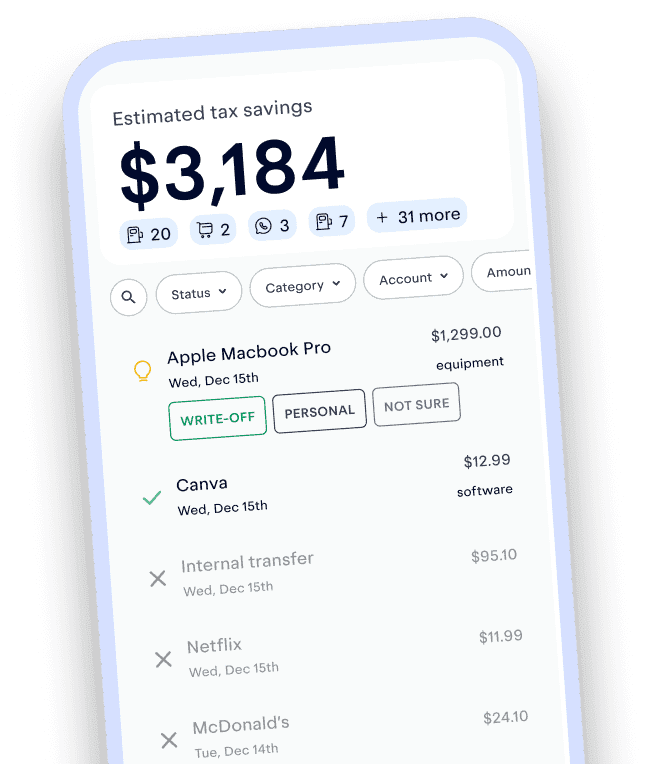
Track and claim every eligible deduction with Keeper
Keeper scans your accounts for write-offs and files your return — with tax pros reviewing every one.
Try it freeBonus deduction for seniors 65+
Taxpayers aged 65 or older may claim an extra deduction of up to $6,000 for 2025 through 2028, whether they itemize or take the standard deduction. If both spouses are 65+ and file a joint return, that goes up to $12,000! The benefit phases out for higher earners, starting at $75,000 of modified adjusted gross income ($150,000 married filing jointly).
The child tax credit increased
The child tax credit increased from $2,000 to $2,200 per child for 2025, and it stays at $2,200 for 2026. Up to $1,700 of it can be refunded to you even if you don't owe any tax. To get the credit, your child must be under 17 at the end of the year and must have lived with you for more than half the year. Your child needs a Social Security number valid for employment, and so do you (on a joint return, at least one spouse).
Get $1,000 for having a baby between 2025 and 2028
The federal government will put $1,000 into individual investment accounts for babies who are US citizens born between January 1, 2025 and December 31, 2028. These are tax-advantaged savings accounts (also known as Trump Accounts).
Family members and employers can contribute up to $5,000 per year in total, starting July 4, 2026, and the government's $1,000 doesn't count toward that limit. Parents' contributions aren't tax-deductible, but the money grows tax-deferred. You generally can't withdraw it before the year your child turns 18.
SALT deduction cap increased to $40,000
From 2018 to 2024, the SALT (state and local taxes) deduction was capped at $10,000. The cap is temporarily increased to $40,000 for 2025 and $40,400 for 2026, or half that if you're married filing separately. But it phases down by 30% of your modified adjusted gross income (MAGI) above $500,000 ($505,000 for 2026), though never below $10,000. The higher cap lasts through 2029.
This deduction generally benefits higher income homeowners in high-tax states like California, New York, New Jersey, Illinois, etc.
Note: you must itemize your deductions to claim it!
New for 2026: Deduct charity without itemizing
Starting in 2026, you can deduct up to $1,000 of cash donations to qualifying charities ($2,000 if married filing jointly), even if you take the standard deduction. Gifts to donor-advised funds don't count, and neither do donated goods.
If you itemize, there's a new catch: starting in 2026, only the part of your donations above 0.5% of your income (your adjusted gross income, in most cases) is deductible.
Bye bye clean energy tax credits
Previously, homeowners could claim a 30% federal tax credit for solar panels, battery storage, and other clean energy equipment (the residential clean energy credit), plus a separate credit for energy-efficient upgrades like heat pumps, insulation, and new windows (the energy efficient home improvement credit). Both ended after December 31, 2025. So if you installed solar panels or made those upgrades after that date, you're out of luck!
The New Clean Vehicle Credit also offered a $7,500 tax break for many electric vehicles. It ended for vehicles acquired after September 30, 2025, and so did the credits for used clean vehicles and commercial clean vehicles.
The IRS now knows about your crypto transactions
In prior years, crypto reporting was largely self-reported. Now, a new IRS tax form (Form 1099-DA) reports crypto and other digital asset sales. Starting with 2025 transactions, if you sold or traded crypto on a major exchange like Coinbase or Kraken, the exchange reports it to the IRS, and you should expect to receive a 1099-DA. This change comes from a 2021 law and IRS rules, not the OBBB. Even if you don't receive a 1099-DA, it's on you to report all taxable crypto transactions on your tax return!
Note: for 2025, exchanges report your gross proceeds but not your cost basis (what you paid). Basis reporting starts with 2026 sales of crypto bought in 2026 or later. Until then, you need your own records to figure your gains and losses.
New for 2026: Higher 1099 thresholds
Starting with payments made in 2026, clients only have to send you a Form 1099-NEC or 1099-MISC if they pay you $2,000 or more in a year, up from $600. The Form 1099-K threshold for payment apps and online marketplaces is back to more than $20,000 and more than 200 transactions.
Either way, all of your income is still taxable, even if you don't get a form. Keep your own records of what you earn.
The QBI deduction (up to 20%) is here to stay
Are you a business owner? If you have US-based qualified business income (QBI), you can deduct up to 20% of your QBI from your personal taxable income, thus reducing the amount of taxes you owe. See our QBI deduction guide for the details.
That means if you earned $100,000 net from your LLC, you may be able to deduct up to $20,000 ($100,000 × 20%), so you're taxed as if you made $80,000 instead of $100,000. Nice!
One thing to note: If your taxable income is above $197,300 ($394,600 if married filing jointly) for 2025, or $201,750 ($403,500 if married filing jointly) for 2026, the deduction is limited or phased out for Specified Service Trades or Businesses (SSTBs). An SSTB includes businesses where the principal asset is the reputation or skill of one or more employees or owners. That includes doctors, therapists, lawyers, CPAs, consultants, pro athletes, etc. You can read more here.
New for 2026: if you have at least $1,000 of QBI from a business you actively work in, your deduction will be at least $400.
100% bonus depreciation remains for qualified property
If you acquired qualified property (for business use!) after January 19, 2025, you can deduct the full cost of those assets upfront, rather than depreciating them over time.
Note: If you acquired the property BEFORE January 19, 2025, you might still be eligible for bonus depreciation. It's best to consult a Keeper tax pro.
Section 179 deduction has increased
Section 179 allows business owners to immediately deduct the full cost of qualifying business property in the year it's placed in service instead of depreciating it over time. Under the One Big Beautiful Bill, the maximum Section 179 deduction limit doubled from $1.25 million to $2.5 million for 2025, with a new phase-out threshold of $4 million (up from $2.5 million). For 2026, those limits rise with inflation to $2.56 million and $4.09 million.
That means equipment-heavy businesses can get massive upfront write-offs. Pair this with 100% bonus depreciation, and watch those tax savings skyrocket.
How will the OBBB tax law changes impact your taxes?
The One Big Beautiful Bill (OBBB) introduced sweeping tax law changes for 2025 and 2026, from new deductions and credits to expanded reporting rules. If you're feeling unsure on how these changes impact your taxes, we can help. Get instant help from our AI-powered accountant (trained on thousands of pages of tax law), or book a call with one of our tax pros for personalized guidance and peace of mind.

Over 1M Americans trust Keeper for their complex taxes
The #1 tax app for freelancers, gig workers, and self-employed filers.
Get started free


Krislyn is Chief Growth Officer at Keeper. At Keeper, she strives to make expert-level tax strategies that used to require a traditional CPA accessible to all. Prior to Keeper, she was at Curology, where she helped bring custom, prescription-grade skincare out of the dermatologist's office to millions of faces.
View full bio
a tax professional
This content has been reviewed by an Enrolled Agent (EA) with the IRS — the highest credential awarded by the agency. Enrolled Agents are empowered to represent all taxpayers before the IRS, on all types of tax-related matters. Accountants who earn this certification have passed a comprehensive three-part exam on individual and business tax returns. To maintain EA status, they must stay up to date in the field by completing 72 hours of continuing education every three years.
View full bio2 sources
Keeper’s tax guides are built on primary sources: the tax code, IRS forms, instructions and publications, and state tax agency guidance. We link to external sources where appropriate and check figures against the tax year they apply to. This article was peer reviewed by a licensed tax professional (CPA or EA).
This article is for informational purposes only and isn’t tax, legal, or financial advice. Tax rules change and depend on your situation, so talk to a tax professional about yours.