



Key takeaways
Florida lets cottage food operations sell up to $250,000 a year in homemade food, with no state permit, license, or registration (Fla. Stat. §500.80).
You can sell foods that don't need refrigeration, like breads, cookies, cakes, candy, jams, and granola. Anything with cream cheese frosting, custard, or other refrigerated fillings is out.
You can sell online and by mail, and ship by USPS or a commercial carrier. Wholesale is not allowed.
Every product needs a label with the exact statement: "Made in a cottage food operation that is not subject to Florida's food safety regulations."
Florida has no state income tax, but you still owe federal income tax and 15.3% self-employment tax on your profit.
Baked goods are exempt from Florida sales tax. Candy is taxable, even though it's an approved cottage food.
Florida's cottage food law is one of the most open in the country.
This guide covers what you can sell, how to label and ship it, and the taxes most Florida cottage food guides leave out. It's based on Florida Statutes, the Florida Department of Agriculture and Consumer Services (FDACS), and the Florida Department of Revenue as of October 14, 2026.
What is Florida's cottage food law?
Florida's cottage food law, section 500.80 of the Florida Statutes, lets you make certain foods in your home kitchen and sell them directly to customers without a food permit. You qualify as long as your yearly cottage food sales stay at or under $250,000 and you sell only foods that don't need refrigeration (FDACS).
The last big change came in 2021, when the Home Sweet Home Act raised the sales limit from $50,000 to $250,000, allowed sales and delivery by mail, and stopped cities and counties from banning cottage food operations (Florida Senate). The 2025 legislature reworded the definition of cottage food slightly, but didn't change the limit. No cottage food bill passed in 2026.
What can you sell under the Florida cottage food law?
You can sell foods that aren't "time or temperature controlled for safety," meaning they're safe at room temperature. FDACS lists these examples (FDACS):
Loaf breads, rolls, and biscuits
Cakes, pastries, and cookies
Candies and confections
Honey
Jams, jellies, and preserves
Fruit pies and dried fruits
Dry herbs, seasonings, and mixtures
Homemade pasta
Cereals, trail mixes, and granola
Coated or uncoated nuts
Vinegar and flavored vinegars
Popcorn and popcorn balls
What you can't sell. Anything that needs refrigeration is excluded. The University of Florida's extension service lists baked goods with "custard, cream cheese icing or filling," along with meat, jerky, canned vegetables, pickles, dairy products, eggs, salsa, nut butters, and CBD products (UF/IFAS). Pet treats aren't covered, because the law only applies to human food.
What about buttercream? Neither FDACS nor UF/IFAS has published a ruling on buttercream. The test is whether your frosting needs refrigeration to stay safe. If it does, like cream cheese frosting, it's not allowed.
Do you need a license or permit for a Florida cottage food business?
No. Cottage food operations are "exempt from the permitting requirements" for food businesses, and Florida doesn't require state registration (§500.80). FDACS inspects a cottage food operation only after a complaint.
Cities and counties can't ban or regulate your cottage food operation, because the law gives that power to the state. You still have to follow Florida's rules for home-based businesses, which means:
You may need a local business tax receipt. Home businesses are subject to local business taxes under Florida law (Fla. Stat. §559.955). Check with your city and county tax collector.
HOA and condo rules still apply. The home-business law doesn't override HOA, condo, or co-op restrictions.
Farmers markets and event venues may also have their own requirements.
Where and how can you sell cottage food in Florida?
You can sell directly to customers in person, online, or by mail order. Florida lets you deliver cottage food (§500.80):
In person, directly to the customer
To a specific event venue
By the US Postal Service or a commercial carrier
Wholesale isn't allowed. You can't sell to stores or restaurants to resell, and UF/IFAS says consignment isn't allowed either. You can only sell products stored at your home, and free samples have to be prepackaged.
Shipping out of state. Florida's law doesn't ban it, and UF/IFAS says products may be "shipped across state lines." The other state's food laws may also apply, so check before you ship.
Florida cottage food label requirements
Every product has to be prepackaged with a label that includes (§500.80):
The name and address of your cottage food operation
The name of the product
The ingredients, in descending order by weight
The net weight or net volume
Allergen information, as required by federal labeling rules
Nutrition information, but only if you make a nutrition claim
This statement, in at least 10-point type in a color that contrasts with the background: "Made in a cottage food operation that is not subject to Florida's food safety regulations."
Unlike Texas, Florida doesn't let you replace your home address with an ID number.
How much can you earn under the Florida cottage food law?
Your gross sales of cottage food products can't go over $250,000 a year, counting all sales at every location. FDACS can ask you for records that show your sales (§500.80).
That cap is a licensing rule, not a tax rule. Staying under $250,000 doesn't make your income tax-free, and going over it changes which food safety rules apply, not how you're taxed.
Over 1M Americans trust Keeper for their complex taxes
The #1 tax app for freelancers, gig workers, and self-employed filers.
Get started free

Do you pay taxes on cottage food sales in Florida?
Yes, but Florida has no personal income tax (Florida Department of Revenue). Your taxes come down to federal income tax, self-employment tax, and sales tax on a few taxable items.
Tax | Do Florida cottage food sellers owe it? |
|---|---|
State income tax | No. Florida doesn't have one |
Federal income tax | Yes, on your profit, along with your other income |
Self-employment tax | Yes, 15.3% on your profit if it's $400 or more (IRS) |
Sales tax | Only on taxable items, like candy |
Federal income tax and self-employment tax
You report your cottage food income on Schedule C with your federal return, and you pay tax on your profit: sales minus business expenses like ingredients, packaging, shipping, and market fees.
Every $1,000 in business expenses you claim saves you about $230 in federal tax if you're in the 12% bracket, or about $305 in the 22% bracket. That's why tracking ingredient and shipping costs matters. Our cottage food tax guide walks through a full example.
If you expect to owe $1,000 or more, you'll generally need to make quarterly estimated payments (IRS). Use Keeper's 1099 tax calculator to estimate what you'll owe.
Florida sales tax on cottage food
Florida exempts food for home consumption, and that includes baked goods (Fla. Stat. §212.08). The Department of Revenue's rule specifically lists "baked goods" and "cookies, including chocolate-coated or cream-filled" as exempt (Rule 12A-1.011).
But several cottage foods are taxable:
What you sell | Florida sales tax? |
|---|---|
Breads, cookies, cakes, pies, and pastries sold to go | Exempt |
Jams, honey, granola, and dried herbs | Exempt |
Candy, fudge, and other confections | Taxable |
Soft drinks | Taxable |
Hot food, or food sold to eat at a venue that charges admission | Taxable |
Gift baskets where taxable items are more than 25% of the cost | The whole basket is taxable |
Candy is the trap. It's an approved cottage food, but Florida taxes "candy and any similar product regarded as candy or confection." Where sales tax applies, the rate is 6% plus your county's discretionary sales surtax (Florida Department of Revenue).
Do you need to register for sales tax? If you sell anything taxable, like candy or gift baskets with taxable items, the Department of Revenue says you must register to collect sales tax. If you sell only exempt baked goods, Florida doesn't spell out whether you need to register, so check with the Department of Revenue.
What Florida cottage food sellers can write off
🧈 Ingredients and packaging (only the business share of mixed grocery runs)
📦 Shipping costs and supplies, since Florida lets you mail orders
🏷️ Labels that meet the 10-point disclaimer rule
⛺ Your local business tax receipt and market fees
🚗 Mileage for deliveries and supply runs: 72.5¢ a mile for January–June 2026 and 76¢ for July–December 2026 (IRS)
💳 Payment app fees and online store subscriptions
See can you deduct shipping costs for more on mailing orders.
Keeper scans your bank and card transactions for write-offs like ingredients, shipping, and packaging, and files your taxes with every deduction included.

Do you need an LLC for a Florida cottage food business?
No. Most cottage food sellers run as sole proprietors and report their income on Schedule C.
If you form an LLC, plan for Florida's annual report fee: $138.75, due by May 1 each year, with a $400 late fee after that (Florida Division of Corporations). A single-member LLC taxed like a sole proprietorship doesn't file a separate Florida corporate income tax return (Florida Department of Revenue).
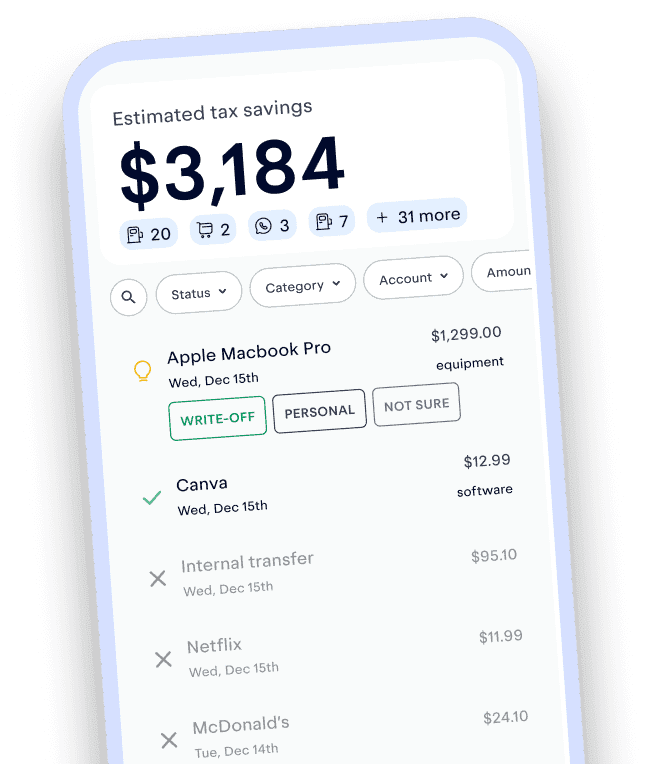
Track and claim every eligible deduction with Keeper
Keeper scans your accounts for write-offs and files your return — with tax pros reviewing every one.
Try it freeFAQ
No. Florida doesn't require a state permit, license, or registration for cottage food operations. You may need a local business tax receipt from your city or county, and HOA rules still apply.
Yes. You can sell online or by mail order and deliver in person, to an event venue, or by USPS or a commercial carrier.
Florida's law doesn't ban it, and the University of Florida's extension service says cottage food may be shipped across state lines. Check the destination state's food laws before you ship.
No. Cookies and other baked goods are exempt from Florida sales tax when sold to go. Candy, fudge, and soft drinks are taxable.
Florida hasn't issued a specific ruling on buttercream. The rule is that cottage foods can't need refrigeration. Frostings that do, like cream cheese frosting, aren't allowed.
Your name and address, the product name, ingredients by weight, net weight or volume, allergens, and this statement in at least 10-point type: "Made in a cottage food operation that is not subject to Florida's food safety regulations."
You won't pay state income tax, because Florida doesn't have one. You still owe federal income tax and self-employment tax on your profit, and sales tax on taxable items like candy.
Over 1M Americans trust Keeper for their complex taxes
The #1 tax app for freelancers, gig workers, and self-employed filers.
Get started free
Krislyn is Chief Growth Officer at Keeper. At Keeper, she strives to make expert-level tax strategies that used to require a traditional CPA accessible to all. Prior to Keeper, she was at Curology, where she helped bring custom, prescription-grade skincare out of the dermatologist's office to millions of faces.
View full bio14 sources
- Cottage Foods · fdacs.gov
- House Bill 663 (2021) · flsenate.gov
- FSHN20-55/FS425: Cottage Food in Florida · ask.ifas.ufl.edu
- Statutes & Constitution :View Statutes : Online Sunshine · leg.state.fl.us
- Statutes & Constitution :View Statutes : Online Sunshine · leg.state.fl.us
- Florida Department of Revenue · floridarevenue.com
- Self-employment tax (Social Security and Medicare taxes) · irs.gov
- Estimated taxes · irs.gov
- Statutes & Constitution :View Statutes : Online Sunshine · leg.state.fl.us
- 12A-1.011 : Sales of Food Products for Human Consumption by Grocery Stores, Convenience Stores, and Supermarkets; Sales of Bakery Products by Bakeries, Pastry Shops, or Like Establishments; Drinking Water; Ice · flrules.org
- Florida Dept. of Revenue · floridarevenue.com
- Standard mileage rates · irs.gov
- LLC Fees · dos.fl.gov
- Florida Dept. of Revenue · floridarevenue.com
This article is for informational purposes only and isn’t tax, legal, or financial advice. Tax rules change and depend on your situation, so talk to a tax professional about yours.