



Key takeaways
Money from selling baked goods, jams, candy, or other cottage foods is taxable income, even if it's cash, and even if you never get a 1099 tax form.
If your profit is $400 or more, you also owe 15.3% self-employment tax. You report sales and expenses on Schedule C.
Many states cap how much you can sell each year under cottage food rules. That cap is a licensing rule: it decides whether you can keep selling from your home kitchen, or whether you'd need a commercial kitchen and a food permit. It's not a tax rule, so staying under the cap doesn't make your income tax-free.
In most states, bread, cookies, and cakes sold to go are exempt from state sales tax. But Virginia, Georgia, Illinois, and North Carolina can still charge local tax on them, and candy is often taxable. Check the state table below.
Ingredients and packaging are often your biggest write-off. Separate business groceries from family groceries, because you can only deduct the business share.
Your kitchen usually doesn't qualify for the home office deduction, because you also cook for your family there.
Every $1,000 in expenses you forget to claim costs a home baker about $230 to $305 in federal tax. Keeper finds write-offs like ingredients, packaging, and booth fees in your bank and card statements automatically.
Home baking has grown from bake-sale fundraising into a real side business. Every state now has a cottage food law.
For most people it's a side income. Home bakers who reviewed the hustle on Keeper's Side Hustle Index report median earnings of $275 a month before expenses (the middle half earn $175 to $375) for about 8 hours a week. Two of the four reviewers said unexpected expenses surprised them most.
Do you have to pay taxes on cottage food sales?
Many home bakers assume a small, licensed home business doesn't owe any taxes. Spoiler alert: you do!
Money you make selling food you bake or make at home is taxable income. That includes cash at a farmers market, Venmo or Zelle payments for custom cakes, and online orders. The IRS says to report all income from your business, from all sources (Schedule C instructions). That's true whether or not you get a tax form for it.
Three different taxes can apply, and they work very differently:
Income tax | Self-employment tax | Sales tax | |
|---|---|---|---|
Who pays it | You, on your profit | You, on your profit | Your customer, on the sale price. You collect it and send it to the state |
When it applies | Depends on your total income from all sources | When your business profit is $400 or more | Only if your state taxes the food you sell |
Where it's reported | Your federal return (Schedule C) and your state return | Schedule SE, on your federal return | Your state sales tax return |
If you sell regularly and you're trying to make money, the IRS treats you as running a business, even if it's a side hustle. You report sales and expenses on Schedule C and pay self-employment tax if your profit is $400 or more (IRS).
Over 1M Americans trust Keeper for their complex taxes
The #1 tax app for freelancers, gig workers, and self-employed filers.
Get started free

Your cottage food license is not a tax exemption
Here's where a lot of the confusion starts. Cottage food laws are written by state health and agriculture departments. They decide what you can sell, how it must be labeled, and how much you can sell each year.
It's easy to mix these rules up with tax rules, but they're completely separate. Your cottage food license has no effect on the taxes you owe. A few things to know:
Your sales cap is a license limit. Texas, for example, caps cottage food sales at $150,000 a year. Selling $12,000 (well below the $150,000 cap) doesn't make that income tax-free.
"Exempt" in a cottage food law usually means exempt from a food permit or inspection, not exempt from taxes.
Registering with your state isn't registering with the IRS. A sole proprietor doesn't file anything with the IRS to start a business. You simply report the income on your next tax return.
How each state handles cottage food sales and sales tax
All 50 states allow cottage food sales, but the rules and sales tax treatment vary widely. This table covers 12 states: the 9 with the most US Google searches for their cottage food laws, according to Semrush (October 2026), plus North Carolina, New York, and Pennsylvania, three of the most populous states. It's based on state statutes and state agriculture, health, and revenue department pages as of October 14, 2026.
"To go" means packaged food the customer takes home, sold without plates or utensils. Hot food, food eaten on site, and candy are often taxed differently.
State | Annual sales cap (2026) | State registration | Sales tax on baked goods sold to go | Sales tax permit if everything you sell is exempt? |
|---|---|---|---|---|
$150,000 (since Sept. 1, 2025) | No. Food handler training required | Exempt. Candy and heated food are taxable | Not clearly addressed. Ask the Comptroller | |
$250,000 | No | Exempt. Candy, hot food, and food eaten on site are taxable | Generally no. Registration is tied to taxable sales | |
$88,878 (Class A) or $177,756 (Class B) | Yes. Class A registration or Class B permit from your county | Exempt as cold food to go. Hot food is taxable | Not always. CDTFA says some sellers with only nontaxable sales don't need one | |
$50,000, or $75,000 if items sell for $250+ each (since March 2026) | No. Optional registration | Exempt when sold without utensils, including candy | Not clearly addressed. Ask Treasury | |
Ohio | No cap | No | Exempt to go. Soft drinks are taxable | Generally no. A license is tied to taxable sales |
No cap. The state license ended July 1, 2025 | No | Exempt from the 4% state tax, but local sales tax applies | Likely yes, because local tax is due | |
Virginia | No cap for baked goods | No | 1% (the local tax on food) | Yes, because the 1% applies |
No cap | Yes. Local health department, up to $50 a year | 0% state since Jan. 1, 2026. 1% local grocery tax where adopted. Candy is fully taxable | Yes. Illinois requires it for retail sellers | |
Indiana | No cap for home-based vendors | No. Food handler certificate required | Exempt when sold without utensils. Candy is taxable | Unclear. Ask the Department of Revenue |
No cap | One-time home kitchen inspection | 2% local rate if you qualify as an "artisan bakery." Otherwise taxed as prepared food | Yes. NCDA&CS says you need a sales tax number | |
No cap | Yes. Home processor registration (free) | Exempt. Heated food, food eaten on site, platters, and candy are taxable | Only if you sell taxable items | |
No cap | Yes. Limited food establishment registration ($35 a year) | Only if you sell taxable items |
Cottage food laws are changing fast. Texas tripled its cap to $150,000 in September 2025, Michigan doubled its cap to $50,000 and allowed in-state online sales in March 2026, and Georgia dropped its state license in July 2025. Check with your state agriculture or health department for the latest.
Do you need a sales tax permit if your food isn't taxable?
It depends on the state. Illinois and North Carolina require one even for exempt food sellers, and Georgia and Virginia charge local tax on food, so you'd need one there too. In California, New York, and Pennsylvania, you generally need one only if you sell something taxable, like hot drinks or a gift basket with a mug or candle.
If you do collect sales tax, the IRS says to include it in your gross receipts on Schedule C line 1, then deduct the amount you paid to the state on line 23 (Schedule C instructions). The two amounts cancel out, so the sales tax you collect isn't counted as your income. That only works if you record both.
How much tax will you owe on cottage food income?
You pay tax on your profit, not your sales. Profit is what's left after you subtract business expenses like ingredients, packaging, and booth fees. That's why tracking expenses matters so much for bakers: ingredients and packaging take a real bite out of every sale.
Let's see an example
Maria sells sourdough and custom cakes at a weekend farmers market and through Instagram orders. She also has a W-2 job that puts her in the 12% federal tax bracket. In 2026, her baking business looks like this:
Amount | |
|---|---|
Sales (cash, Square, and Venmo) | $9,000 |
Ingredients and packaging | −$2,700 |
Farmers market booth fees | −$480 |
Square processing fees | −$260 |
Cottage food registration and food handler course | −$150 |
Labels and website | −$200 |
Mileage: 600 miles Jan.–June at 72.5¢, 600 miles July–Dec. at 76¢ | −$891 |
Profit | $4,319 |
Here's what she owes in federal tax on that profit:
Amount | |
|---|---|
Self-employment tax ($4,319 × 92.35% × 15.3%) | $610 |
Income tax (12% of profit, after the deduction for half of SE tax and the 20% QBI deduction) | $385 |
Total federal tax | About $996 |
That's about 23% of her profit, plus any state income tax. If Maria hadn't tracked her business expenses, she'd have reported about $4,681 more in profit and paid roughly $1,080 more in federal tax.
These numbers are rounded and simplified for illustration. Your bracket, state, and other income will change the result. Use Keeper's 1099 tax calculator to estimate yours.
Why tracking expenses reduces your taxes
Every business expense you claim lowers your profit, which lowers both income tax and self-employment tax. For each $1,000 of expenses:
In the 12% bracket, you save about $230 in federal tax.
In the 22% bracket, you save about $305.
That's why the grocery receipts matter. Bakers on Keeper's Side Hustle Index report spending $150 to $300 a month to keep their business running, against median earnings of $275 a month (4 reviews as of October 2026). At that scale, expenses can be a large share of what comes in, and claiming them can wipe out much of your taxable profit. A baker who spends $3,000 a year on ingredients and claims none of it pays roughly $700 to $900 more than they have to.
How much to set aside from each sale
A simple rule: set aside about 25% of your profit for federal taxes, and more if you're in a higher bracket or your state has an income tax. If your expenses are about a third of sales, that works out to roughly 15% to 20% of each sale.
What can home bakers and cottage food sellers write off?
You can deduct expenses that are ordinary and necessary for your food business. If something is used for both your business and your family, you can only deduct the business share.
Write-off | What counts |
|---|---|
🧈 Ingredients | Flour, butter, sugar, eggs, chocolate, fruit, and anything else that goes into what you sell. Only the business share of a mixed grocery run |
📦 Packaging and labels | Boxes, bags, cake boards, jars, stickers, and printed ingredient labels your state requires |
🧾 Licenses, permits, and training | Cottage food registration or permit fees, food handler courses, and local business license fees |
⛺ Market and event costs | Farmers market booth fees, vendor event fees, tables, tents, signs, and display stands |
💳 Payment and platform fees | Square, Stripe, PayPal, and Venmo business fees, plus online store or ordering subscriptions |
🚗 Mileage | Driving to markets, deliveries, and supply runs made for the business. 72.5¢ a mile for January–June 2026 and 76¢ for July–December 2026 (IRS). See mileage vs. actual expenses |
🥣 Equipment and tools | Mixers, pans, a second oven or fridge, cooling racks, scales, and decorating tools. Deduct the business-use share if your family uses them too |
📣 Marketing | Instagram or Facebook ads, business cards, flyers, website costs, and photos of your products |
🛡️ Insurance | Product liability or vendor insurance that markets often require |
📱 Phone and internet | The business-use share of your phone bill and internet, if you take orders and post online |
Starting out? If your business began this year, you can generally deduct up to $5,000 of start-up costs, like a food safety course, label design, and marketing before your first sale, in the first year (Schedule C instructions). Home bakers on the Side Hustle Index report startup costs of $500 to $1,000, so most will fall well under that limit. See start-up costs.
How to handle mixed grocery runs
This is where most bakers lose money. You buy flour for your orders and cereal for your kids in the same Costco trip, then the receipt gets lost, and none of it gets claimed.
A few habits fix it:
Use one card only for the business. Put every ingredient run, packaging order, and booth fee on it. Your statement becomes your expense record.
Split the cart at checkout when you can. Two transactions are easier to prove than one receipt with notes.
Keep the receipt or a photo of it when one trip mixes both. Mark which items were for the business.
The IRS doesn't require a paper receipt for every purchase, but you need records that show what you bought and why it was for the business. See receipts for taxes and whether a card statement works as a receipt.
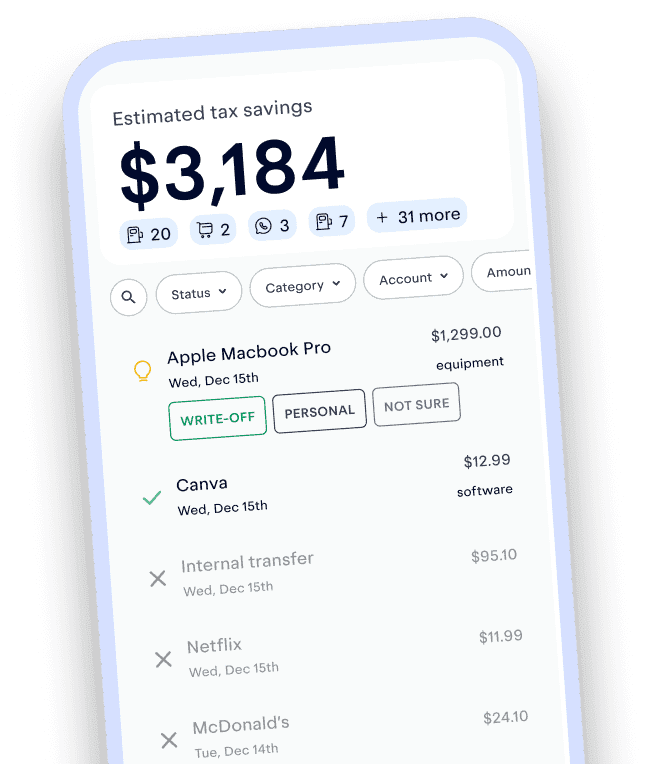
Once your business spending runs through one card, Keeper scans those transactions for write-offs automatically and files your taxes with every deduction included.
Track and claim every eligible deduction with Keeper
Keeper scans your accounts for write-offs and files your return — with tax pros reviewing every one.
Try it freeCan you deduct your kitchen?
Usually not. To claim the home office deduction, you have to use that part of your home only for business. A kitchen where you also cook dinner fails that test, even if you bake for customers there every day (IRS Publication 587).
There's one exception that can help some sellers. If your home is the only fixed location of your business and you sell products at retail, you may be able to deduct a space you regularly use to store inventory, like a shelf unit or a corner of the garage set aside for the products you sell. It doesn't have to be used only for business, but it does need to be a separate, identifiable storage space. Ask a tax pro whether your setup counts.
Will you get a 1099-K? Probably not
Payment apps and card processors like Square, PayPal, and Venmo send a Form 1099-K only if you receive more than $20,000 across more than 200 transactions in a year (IRS). Some states require the form at lower amounts.
Most home bakers will never cross that threshold. Not getting a form doesn't change anything. The income is still taxable, and the IRS expects you to report it. See how to report cash income without a 1099.
If you do get a 1099-K, it shows your gross sales before fees and refunds. Report the full amount on Schedule C, then subtract your fees and other expenses below it. See our guides to the Square 1099, Venmo 1099, and PayPal 1099.
Do you need to pay quarterly estimated taxes?
You generally need to make quarterly estimated payments if you expect to owe $1,000 or more when you file (IRS). The 2026 due dates are:
Income earned | Payment due |
|---|---|
Jan. 1 – Mar. 31, 2026 | April 15, 2026 |
Apr. 1 – May 31, 2026 | June 15, 2026 |
June 1 – Aug. 31, 2026 | Sept. 15, 2026 |
Sept. 1 – Dec. 31, 2026 | Jan. 15, 2027 |
If you also have a W-2 job, there's an easier option: raise the tax withheld from your paycheck to cover your baking income. Withholding counts as if it were paid evenly through the year. Use the quarterly tax calculator to see what you owe, and the safe harbor rule to avoid penalties.
Is home baking a business or a hobby?
If you sell regularly, take custom orders, or sell at markets, it's almost certainly a business. The IRS looks at things like whether you run it in a businesslike way, keep records, and are trying to make a profit (IRS).
Being a business is usually better for you. Hobby income is still taxable, but it goes on Schedule 1 and you can't deduct any hobby expenses (Schedule C instructions). That rule is now permanent (26 U.S.C. 67(h)). So a hobby baker who sells $3,000 of cookies pays tax on the full $3,000, even after spending $1,500 on ingredients.
A one-time bake sale for your kid's school is different. If the money goes to the school, it isn't your income. See business vs. hobby for the full list of factors.
Do you need an LLC or an EIN to sell baked goods?
You don't need an LLC. Most cottage food sellers are sole proprietors, and you can deduct business expenses and file Schedule C without one.
An LLC can help separate your personal assets from business debts, but it doesn't lower your taxes on its own. A single-member LLC files the same Schedule C. Some states charge yearly LLC fees, so check the cost before forming one. Product liability insurance is often the more practical protection for a home baker.
You don't need an EIN either, unless you hire employees or set up certain retirement plans. A sole proprietor with no employees can use their Social Security number (IRS). Some bakers get a free EIN anyway so they don't have to share their SSN with markets or wholesale buyers.
How to file taxes on cottage food income, step by step
Add up all your sales. Include cash, card, Venmo, Zelle, and online orders.
Total your business expenses. Keeper helps you keep track of your income and expenses across connected bank accounts and credit cards.
Fill out Schedule C. Enter your gross sales and expenses. Many home bakers use business code 311800 (bakeries and tortilla manufacturing). Caterers often use 722300. See business codes.
Fill out Schedule SE if your profit is $400 or more (Schedule SE instructions).
Claim the QBI deduction (Form 8995) and the deduction for half of your self-employment tax. See the QBI deduction.
File your state income tax return, and any state sales tax returns if you collect sales tax.
Subtract any estimated payments and pay the balance by April 15, 2027. A filing extension gives you more time to file, not to pay.
Our step-by-step guide to self-employment taxes covers each form in more detail.
FAQ
You won't owe self-employment tax if your profit is under $400. You still report the income on your tax return, and it may be subject to income tax depending on your other income.
Yes. Cash is taxable the same as card or app payments. Keep a simple sales log for each market day so you can total it at tax time.
In most states, packaged baked goods sold to go are exempt from state sales tax. But Virginia charges 1% local tax on food, Georgia and parts of Illinois charge local tax, and North Carolina charges 2% for qualifying bakeries. Candy and anything served hot are often taxable. Check the state table above and your state revenue department.
Yes, the ingredients you use for products you sell are deductible. Only the business share of a mixed grocery trip counts, so keep receipts or use a separate card for business shopping.
No. You can run a cottage food business as a sole proprietor and file Schedule C. An LLC is optional and doesn't lower your taxes on its own.
The cap is a licensing rule, not a tax rule. Going over it may mean you need a commercial kitchen or a different food permit, but it doesn't change how your income is taxed. Contact your state agriculture or health department.
Generally yes, if you're running it as a business. A Schedule C loss can reduce your other taxable income, such as W-2 wages. Losses year after year can make the IRS question whether it's really a hobby.
Over 1M Americans trust Keeper for their complex taxes
The #1 tax app for freelancers, gig workers, and self-employed filers.
Get started free
Krislyn is Chief Growth Officer at Keeper. At Keeper, she strives to make expert-level tax strategies that used to require a traditional CPA accessible to all. Prior to Keeper, she was at Curology, where she helped bring custom, prescription-grade skincare out of the dermatologist's office to millions of faces.
View full bio31 sources
- Instructions for Schedule C (Form 1040) (2025) · irs.gov
- Self-employment tax (Social Security and Medicare taxes) · irs.gov
- Texas Cottage Food Production · dshs.texas.gov
- Grocery and Convenience Stores · comptroller.texas.gov
- Chapter 500 Section 80 · flsenate.gov
- Chapter 212 Section 08 · flsenate.gov
- California · cdph.ca.gov
- Getting Started · cdtfa.ca.gov
- Michigan · legislature.mi.gov
- Revenue Administrative Bulletin 2026-2 · michigan.gov
- Section 5739.02 · codes.ohio.gov
- Cottage Food FAQ · agr.ga.gov
- DOWNLOAD (PDF) · dor.georgia.gov
- Grocery Tax · tax.virginia.gov
- Illinois · ftp.ilga.gov
- FY 2026-03, Illinois Grocery Tax Changes Effective January 1, 2026 · tax.illinois.gov
- SIB29 (PDF) · in.gov
- Food & Drug · ncagr.gov
- G.S. 105-164.13B · ncleg.gov
- New York · agriculture.ny.gov
- Food and Food Products Sold by Food Stores and Similar Establishments · tax.ny.gov
- Apply for or Renew a Limited Food Establishment Registration · pa.gov
- 61 Pa. Code § 60.7. Sale and preparation of food and beverages. · pacodeandbulletin.gov
- Standard mileage rates · irs.gov
- Publication 587 (2025), Business Use of Your Home · irs.gov
- Understanding your Form 1099-K · irs.gov
- Estimated taxes · irs.gov
- Hobby or business: here’s what to know about that side hustle · irs.gov
- 26 U.S. Code § 67 · law.cornell.edu
- Single member limited liability companies · irs.gov
- Instructions for Schedule SE (Form 1040) (2025) · irs.gov
This article is for informational purposes only and isn’t tax, legal, or financial advice. Tax rules change and depend on your situation, so talk to a tax professional about yours.