
Headway Taxes: A Therapist's Guide to the 1099-NEC and Write-Offs (2026)
Headway makes getting paid as a therapist easier—but taxes? That’s on you. From 1099 income and quarterly estimated taxes to tax deductions for therapists, this guide breaks down what Headway providers need to know so tax season feels a little less like its own therapy session.
 Krislyn ChanKrislyn is Chief Growth Officer at Keeper. At Keeper, she strives to make expert-level tax strategies that used to require a traditional CPA accessible to all. Prior to Keeper, she was at Curology, where she helped bring custom, prescription-grade skincare out of the dermatologist's office to millions of faces.
If you see clients through Headway, the platform handles insurance credentialing and billing, which removes a huge amount of hassle from private practice. Come tax time, though, Headway providers run into a very specific set of surprises. This guide helps you get your taxes squared away.
Do you owe taxes on Headway income?
Yes. As a Headway provider you are self-employed, so your Headway income is taxable and your taxes aren't withheld like with a traditional W-2 job.
Why your Headway 1099 says "New York Medical Behavioral Health Services, P.C."
When your 1099 arrives, the payer, the company that paid you, is usually listed as New York Medical Behavioral Health Services, P.C., not Headway. A lot of providers see that and assume the form is a mistake.
That professional corporation is the legal entity Headway uses to pay clinicians, and Headway confirms this is the correct payer name. If you also received a bonus or incentive from Headway, you might see a second name, TherapyMatch, Inc., which is Headway's corporate name. So it is normal for one provider to see paperwork with two different company names, one for session pay and one for bonuses. Your bank deposits reference the same entity, which is why the name on your statements may not say "Headway" either.
Is the 1099 before or after Headway's cut?
Headway keeps a percentage of each session's rate and pays you the balance. The amount on your 1099-NEC is the net, meaning it already reflects what you were actually paid after Headway's share.
Because the fee was already taken out before you were paid, you do not deduct a separate "Headway fee" as a business expense.
What form does Headway send, and when?
Headway issues a 1099-NEC (nonemployee compensation). It is typically emailed by January 31, so check your spam folder if you do not see it.
Historically the form is issued to providers paid $600 or more in the year. That threshold is scheduled to rise to $2,000 for the 2026 tax year, which means a provider who earned between $600 and $2,000 in 2026 might not get a form. If that is you, the income is still taxable and still needs to be reported!
Self-employment tax and quarterly tax payments
Because Headway treats you as an independent contractor, you're on the hook for 2 things.
First, you owe self-employment tax of 15.3% on your net earnings, on top of regular income tax. That covers the Social Security and Medicare that an employer would normally split with you.
Second, since nothing is withheld, the IRS expects you to pay quarterly estimated payments, due in April, June, September, and January. Skipping them can lead to an underpayment penalty on top of the tax. Our quarterly taxes guide walks through the mechanics.
Keeper pro tip: As a general rule of thumb, you should automatically set aside roughly 25% to 35% of your Headway income.
Why your 1099 might not match your deposits
Even though the 1099-NEC is net, the total may not line up exactly with what you see in your bank account.
A session late in December that Headway pays in early January lands on the next year's 1099.
Refunds, cancellations, and corrected claims shift amounts between periods.
Any private-pay clients, out-of-network work, or sliding-scale sessions you bill outside the platform are not on the Headway 1099. You have to track and report those yourself.
Keeper pro tip: Keep one bank account just for practice income and reconcile it against your Headway dashboard each month.
Headway therapist tax write-offs
Private practice comes with the ability to claim business deductions on your taxes. Common ones for therapists include:
Category | Examples |
|---|---|
Licensing and education | License and renewal fees, CEUs, certifications, trainings |
Insurance | Malpractice and professional liability coverage |
Software | EHR and practice management tools, telehealth video platforms |
Office | Rent and utilities for a dedicated office, or a home office used only for work |
Supervision | Clinical supervision and consultation fees |
Memberships | APA, NASW, ACA, and state association dues |
Health insurance | Self-employed health insurance premiums, deducted above the line |
Check out our full list of therapist tax deductions here.
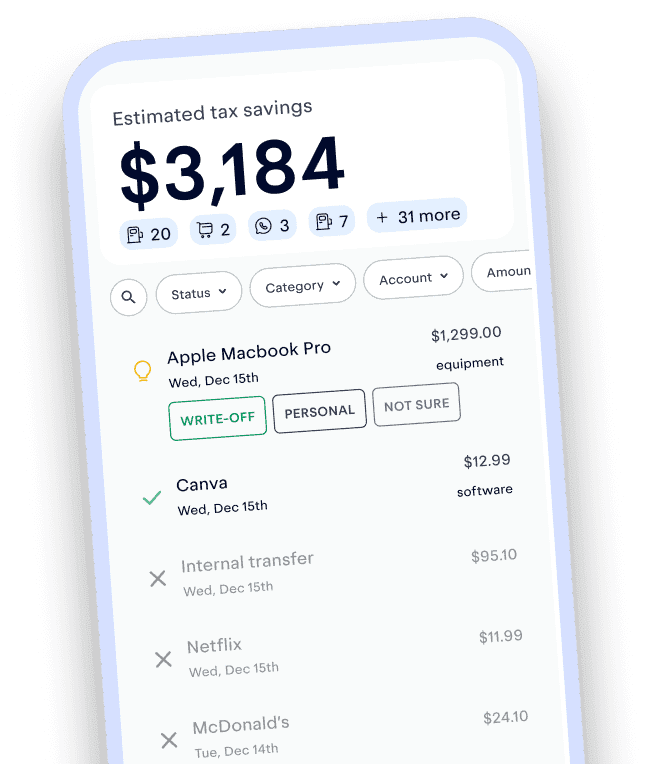
Track and claim every eligible deduction with Keeper
Keeper scans your accounts for write-offs and files your return — with tax pros reviewing every one.
Try it freeHow to file your Headway taxes
Gather your records. Your Headway 1099-NEC, your Headway dashboard reports, and records of any private-pay income.
Total your deductions, but do not deduct a Headway fee, since the 1099 is already net.
Report your net profit on Schedule C and calculate self-employment tax on Schedule SE.
Pay quarterly taxes.
Accountant tips most Headway providers miss
Look at the QBI deduction and a retirement plan. Many therapists qualify for the 20% qualified business income deduction, and a SEP-IRA or Solo 401(k) can cut your taxable income further.
Deduct your health insurance above the line if you pay your own premiums, which is separate from your business expenses.

Over 1M Americans trust Keeper for their complex taxes
The #1 tax app for freelancers, gig workers, and self-employed filers.
Get started free

Frequently asked questions
My 1099 says New York Medical Behavioral Health Services, P.C., not Headway. Is this a mistake?
No. That is the legal entity Headway uses to pay providers. Use the payer name and tax ID exactly as shown when you file.
Does Headway send a 1099-NEC or a 1099-K?
A 1099-NEC, since Headway pays you directly for services rather than processing card payments.
Why doesn't my 1099 match my deposits?
Usually timing, such as a December session paid in January, plus any refunds or corrections. Also remember that private-pay income billed outside Headway is not on the form.
Headway removes the billing headache, but it also makes you self-employed, which changes how you handle taxes. Once you know the payer name is correct, the 1099 is already net, and private-pay income is on you to track, filing is straightforward. Keeper can track your licensing, software, and home-office write-offs and handle your quarterly payments so nothing catches you off guard.
Read next

Solo 401(k) vs. SEP IRA: What's the Best Plan for Your Freelance Income?
A solo 401(k) will save most freelancers more money on their taxes, but a SEP IRA could be the better option for you. Find out which is the right choice.
 By Neeraja Viswanathan, JD
The QBI Tax Deduction: What Is It and Who Can Claim It?
Can I Take the Standard Deduction and Deduct Business Expenses?

Krislyn is Chief Growth Officer at Keeper. At Keeper, she strives to make expert-level tax strategies that used to require a traditional CPA accessible to all. Prior to Keeper, she was at Curology, where she helped bring custom, prescription-grade skincare out of the dermatologist's office to millions of faces.
View full bio