




1. Getting your cost basis right
Everything in rental property taxation starts with your cost basis: the IRS's term for what you paid for the property, adjusted over time. Get this number right at purchase, and you'll save yourself significant headaches (and taxes) when you eventually sell.
Your initial basis is typically the purchase price. But according to IRS Publication 551, you can and should add certain closing costs: title fees, legal fees, recording fees, and transfer taxes. Notably, you cannot include mortgage-related costs like loan origination fees.
Let's say you buy a duplex for $400,000. You pay $3,500 in title insurance, $1,200 in recording fees, and $800 in legal fees. Your starting cost basis is $405,500, not just the $400,000 purchase price. That extra $5,500 reduces your eventual taxable gain when you sell.
One thing to note is that land is not depreciable. You must separate your purchase price between the building (depreciable) and the land (not depreciable). A common method is using the county property tax assessment to determine the ratio. If the county values the property at 80% building / 20% land, apply that same split to your purchase price.
Keeper pro tip: Keep a record of home improvements you make. This includes things like roof replacements, HVAC systems, and kitchen remodels. Each one increases your cost basis and reduces your future taxable gain. Under IRS Publication 527, these must be capitalized (not deducted as repairs), but they work in your favor at sale time.
2. Depreciation
Depreciation is the single most powerful ongoing tax benefit available to rental property owners. According to IRS Publication 527, residential rental properties are depreciated over 27.5 years using the straight-line method. That means you deduct roughly 3.64% of your building's value every year, whether or not the property actually loses value.
Using the duplex example above: if the building portion of your $405,500 basis is $324,400 (80%), your annual depreciation deduction is approximately $11,796. If you're in the 24% federal tax bracket, that single deduction saves you around $2,831 per year in federal taxes alone.
The catch: Depreciation recapture
Here's where many investors get blindsided. When you sell the property, the IRS "recaptures" all the depreciation you've claimed (or were allowed to claim), whether you actually did or not. This is governed by Section 1250 of the Internal Revenue Code. Depreciation recapture is taxed at your ordinary income rate, up to a maximum of 25%. This applies separately from capital gains tax. In practice, you'll face two different tax calculations on the same sale:
Depreciation recapture: taxed up to 25%
Remaining capital gain (appreciation above your adjusted basis): taxed at 0%, 15%, or 20% depending on your income
Say you purchased that duplex for $405,500, claimed $70,000 in cumulative depreciation over 6 years (adjusting for the land split), and your adjusted basis is now $335,500. You sell for $550,000.
Total gain: $214,500 ($550,000 − $335,500)
Depreciation recapture portion: $70,000, taxed at up to 25% = up to $17,500
Remaining capital gain: $144,500, taxed at your long-term capital gains rate
And if your modified adjusted gross income (MAGI) exceeds $200,000 as a single filer or $250,000 married filing jointly, the IRS also adds a 3.8% Net Investment Income Tax (NIIT) on top of that.
Keeper pro tip: Even if you never claimed depreciation, the IRS calculates recapture on the amount you were allowed to deduct. If you skipped depreciation deductions, you owe recapture tax anyway, but didn't get the deduction benefit. If this applies to you, file Form 3115 to catch up on missed depreciation immediately.
Cost segregation studies
For investors looking to front-load their depreciation deductions, a cost segregation study is one of the most powerful tools in the playbook.
A cost segregation study is an IRS-approved engineering analysis that reclassifies components of your property from the standard 27.5-year residential schedule into much shorter recovery periods. Personal property assets like appliances, flooring, and cabinetry typically qualify for 5- or 7-year depreciation. Land improvements such as parking lots, fencing, and landscaping generally fall into a 15-year category. By accelerating these deductions into the early years of ownership, investors can dramatically reduce taxable income right when the property is acquired.
Cost segregation studies typically run $5,000–$15,000 depending on property size and complexity. The fee is itself deductible as a professional service expense.
3. Rental property tax deductions
Rental income is taxed as ordinary income, reported on Schedule E of your federal return. But what distinguishes smart landlords is how they reduce that taxable income through deductions.
Deductions you should never miss:
Mortgage interest (reported on Form 1098 from your lender)
Property taxes
Property management fees
Insurance premiums
Maintenance and repairs
Advertising and tenant screening costs
Travel to and from the property for legitimate management purposes
Professional fees: CPA, attorney, property management software
Track and claim every eligible deduction with Keeper
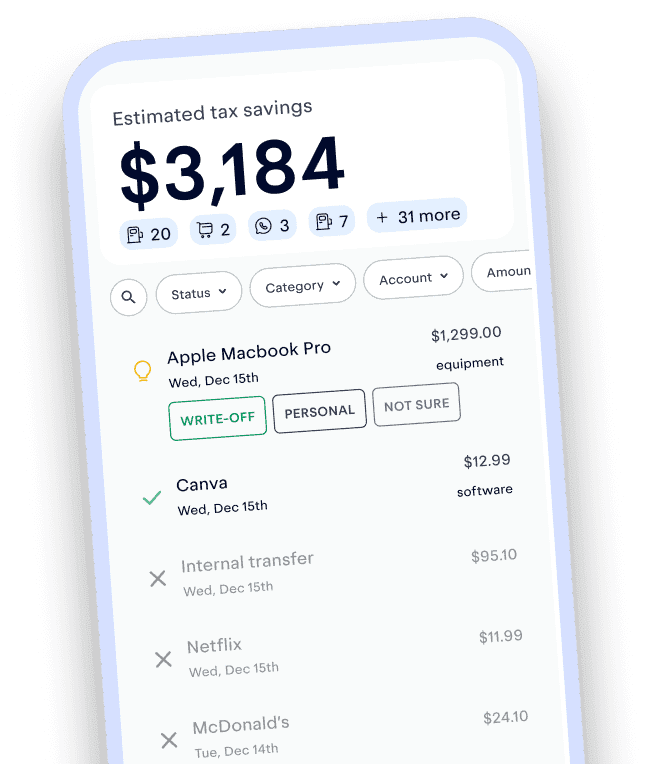
Keeper scans your accounts for write-offs and files your return — with tax pros reviewing every one.
Try it freeRepairs vs. improvements
A repair restores something to working condition, and is tax deductible in the current year. An improvement adds value, extends life, or adapts the property to a new use, and must be capitalized and depreciated. Fixing a broken window is a repair. Replacing all the windows in the building with energy-efficient ones is an improvement.
Keeper pro tip: The IRS's Tangible Property Regulations (often called the "repair regs") provide a de minimis safe harbor: for landlords without applicable financial statements, amounts up to $2,500 per item can be deducted immediately rather than capitalized. Many small landlords underutilize this.
Passive activity loss rules
The IRS classifies rental income as passive, which means rental losses generally cannot offset your W-2 wages or other active income. However, there's an important exception:
If you actively participate in managing your rental (approving tenants, authorizing repairs) and your MAGI is under $100,000, you can deduct up to $25,000 in passive rental losses against ordinary income.
This $25,000 allowance phases out at 50 cents for every dollar of MAGI between $100,000 and $150,000.
Above $150,000 MAGI, passive losses are suspended and carried forward to future years.
Suspended passive losses are not lost. They accumulate and are fully released when you sell the property. This makes timing your sale strategically important (more on this in Section 5).
4. Does your rental property qualify for the QBI deduction?
The Tax Cuts and Jobs Act established a 20% deduction on Qualified Business Income (QBI) for pass-through businesses. The TCJA was set to expire in 2025, but has now been made permanent, making this one of the most consequential long-term tax developments for real estate investors in recent years.
If your rental activity qualifies as a trade or business (not merely investment activity) you may be able to deduct 20% of your net rental income before calculating your tax. For a landlord earning $80,000 in net rental income, that's a $16,000 deduction potentially saving $3,840+ at the 24% bracket.
Keeper pro tip: Not all rentals automatically qualify for QBI. The IRS requires the activity to rise to the level of a trade or business. Factors include time spent on management, number of properties, and documentation. Work with a CPA to establish and document that your rental rises to the trade or business threshold, and consider a written rental policy, formal tenant screening, and regular property visits to support this classification.
5. Selling your rental property
The sale of a rental property is where careful planning truly pays off. Here are the five strategies a CPA would put on the table before any client signs a listing agreement.
Strategy 1: The 1031 Like-Kind Exchange
Under Section 1031 of the Internal Revenue Code, you can sell a rental property and defer 100% of your capital gains and depreciation recapture taxes by reinvesting the proceeds into another investment property. As the IRS confirms, no gain is recognized at the time of exchange if properly structured.
The rules are strict but manageable:
You must identify a replacement property within 45 days of the sale
You must close on the replacement property within 180 days
Proceeds must flow through a qualified intermediary - you can never touch the funds
You must purchase a replacement property of equal or greater value to defer all gains
The beauty of a 1031 exchange is that gains can be deferred indefinitely, or potentially eliminated entirely if the property is held until death and passes with a stepped-up basis to your heirs.
One nuance: if you have accumulated passive loss carryforwards, they do not get released by a 1031 exchange. They transfer to the replacement property and remain suspended. If you want to use those losses, consider taking some "boot" (cash proceeds) equal to the carryforward amount. The taxable boot triggers release of the losses, which can net to zero or even positive if your passive losses are large enough.
Strategy 2: Convert the rental property to your primary residence
Under Section 121, homeowners can exclude up to $250,000 in capital gains ($500,000 for married couples) from a primary residence sale, provided they've lived in the property for 2 of the last 5 years. If you own a rental property that could plausibly become your primary home, moving in for two years before selling can eliminate a substantial portion of your capital gains tax.
The IRS does impose limits here: you cannot exclude the portion of gain attributable to depreciation (recapture still applies), and the non-qualified use rules reduce your exclusion proportionally for the years the property was used as a rental after 2008. But on a highly appreciated property, even a partial exclusion can save tens of thousands.
Strategy 3: Installment sales
If you sell your rental property and carry back a seller-financed note, essentially acting as the bank, you can spread your capital gain over multiple tax years using the installment method (IRS Form 6252). This is especially powerful if doing so keeps you in a lower capital gains bracket each year. Note that depreciation recapture must be recognized in the year of sale, but appreciation gains can be spread.
Strategy 4: Harvest losses to offset gains
If you have multiple investment properties, coordinate your sale timing to offset gains in one property with losses in another. Capital losses from one property offset capital gains from another dollar for dollar. If you're planning to sell your most appreciated property, the same tax year might be the right time to exit an underperforming one.
Strategy 5: Step-up in basis at death
For investors with a long time horizon, passing rental property to heirs results in a stepped-up cost basis to the property's fair market value at the date of death. This eliminates all accumulated capital gains and depreciation recapture. This is a powerful generational wealth strategy when combined with 1031 exchanges throughout ownership.
6. Important tax forms to know
When you sell a rental property, several forms come into play:
Schedule E (Form 1040): Reports annual rental income and expenses
Form 4797: Reports gain or loss on the sale of business property, including rental real estate
Schedule D: Reports capital gains and losses
Form 8949: Itemizes each individual capital asset sale
Form 8824: Required for 1031 exchanges - filed in the year of the exchange
Form 4562: Reports depreciation deductions
Form 8582: Calculates passive activity loss limitations

Over 1M Americans trust Keeper for their complex taxes
The #1 tax app for freelancers, gig workers, and self-employed filers.
Get started free

Disclaimer: This article is for informational purposes only and does not constitute legal, financial, or tax advice. Tax laws change frequently. Always consult a qualified CPA or tax attorney before making decisions.

Krislyn is Chief Growth Officer at Keeper. At Keeper, she strives to make expert-level tax strategies that used to require a traditional CPA accessible to all. Prior to Keeper, she was at Curology, where she helped bring custom, prescription-grade skincare out of the dermatologist's office to millions of faces.
View full bio
a tax professional
This content has been reviewed by an Enrolled Agent (EA) with the IRS — the highest credential awarded by the agency. Enrolled Agents are empowered to represent all taxpayers before the IRS, on all types of tax-related matters. Accountants who earn this certification have passed a comprehensive three-part exam on individual and business tax returns. To maintain EA status, they must stay up to date in the field by completing 72 hours of continuing education every three years.
View full bio4 sources
Keeper’s tax guides are built on primary sources: the tax code, IRS forms, instructions and publications, and state tax agency guidance. We link to external sources where appropriate and check figures against the tax year they apply to. This article was peer reviewed by a licensed tax professional (CPA or EA).
This article is for informational purposes only and isn’t tax, legal, or financial advice. Tax rules change and depend on your situation, so talk to a tax professional about yours.