




What is the short-term rental property loophole?
If you earn a high W-2 salary and own a vacation rental on Airbnb or VRBO, there is a fully legal IRS-recognized strategy that could save you tens of thousands of dollars per year in federal taxes. It's called the short-term rental (STR) tax loophole, and it's one of the most powerful tax reduction tools available to high-income earners today.
Under normal tax rules, rental income is considered "passive income," which means any losses from your rental property can only offset other passive income - not your salary, bonuses, or business profits. But the STR loophole creates an exception. If your rental meets specific IRS criteria, it is reclassified as an active business activity, allowing rental losses (driven primarily by depreciation) to directly reduce your taxable income from any source.
If you have some time to kill, give the IRS Publication 925 (Passive Activity and At-Risk Rules), and Temporary Regulation §1.469-1T(e)(3)(ii) a read. But if you're like me and don't want to wade through the incredibly esoteric tax code, I'll break it down for you below.
Rental income is generally considered passive income
The IRS classifies the vast majority of rental real estate as a passive activity under Section 469 of the tax code. As a result, losses from a passive rental generally cannot reduce your W-2 income. Those losses get "suspended" and carried forward on Form 8582 until you either earn passive income to absorb them or eventually sell the property.
There is one limited exception for traditional rentals: if your modified adjusted gross income (MAGI) is under $100,000, you can deduct up to $25,000 in passive rental losses against ordinary income. But that allowance phases out completely once your MAGI hits $150,000. That leaves most professionals with suspended losses and no immediate tax relief.
Short-term rentals, however, operate under a different set of rules. According to IRS Publication 925, a rental activity is not treated as a rental activity when the average period of customer use is seven days or fewer. At that point, the activity is reclassified as a trade or business. Add in material participation (that means you are actively and regularly involved in the rental activity's operations!), and those losses become fully deductible against your ordinary income, regardless of how much you earn.
How to qualify for the short-term rental property tax loophole
In order to qualify for the short-term rental property (STR) tax loophole, you must satisfy 2 conditions:
Average guest stays must be 7 days or less.
You must be regularly and actively involved in managing your rental property (aka demonstrate material participation).
Prove material participation
This is the more challenging requirement for most people. The IRS defines material participation as being involved in the operation of the activity on a regular, continuous, and substantial basis. There are seven tests, and you only need to meet one of them. The most common paths are:
Spending more than 500 hours per year on the rental activity
Spending more than 100 hours per year and more than anyone else connected to the property (including cleaners, property managers, or contractors)
Performing substantially all the work involved in running the rental
Activities that count toward your hours include communicating with guests, coordinating cleanings, handling maintenance requests, updating your listing, managing pricing, purchasing supplies, and overseeing vendors. Activities that don't count include researching markets, arranging financing, or studying tax strategy.
How the tax savings actually work
Now let's look at an example. Imagine primary care physician, Dr. Rivera, is earning $350,000 per year in W-2 income. That's a great salary! She purchases a lakeside vacation rental in Tennessee for $500,000, listed entirely on Airbnb with an average guest stay of 4 nights.
Her CPA commissions a cost segregation study, which breaks the property into its component assets: appliances, flooring, fixtures, landscaping, and the structure itself. Components with shorter useful lives, like furniture (5 years) or land improvements (15 years), can be depreciated much faster than the building itself. Combined with bonus depreciation, a large portion of those costs can be deducted in year one rather than spread over decades.
The result: Dr. Rivera's cost segregation study identifies $190,000 in first-year accelerated depreciation. She materially participates by managing guest communications, coordinating her cleaning crew, and handling bookings herself, easily surpassing the 100-hour threshold. Because her STR qualifies as non-passive, that $190,000 in paper losses flows directly against her $350,000 salary, potentially saving her over $60,000 in federal income taxes in year one alone. The property may even be cash-flow positive at the same time.
Keeper pro tip: Under the One Big Beautiful Bill (OBBB) signed in 2025, bonus depreciation has been restored to 100% for qualified property acquired and placed in service after January 19, 2025. This is a significant change from the prior phaseout schedule (which was sitting at 40% for most of 2025 under the old law) and makes the STR loophole substantially more powerful for newly acquired properties.
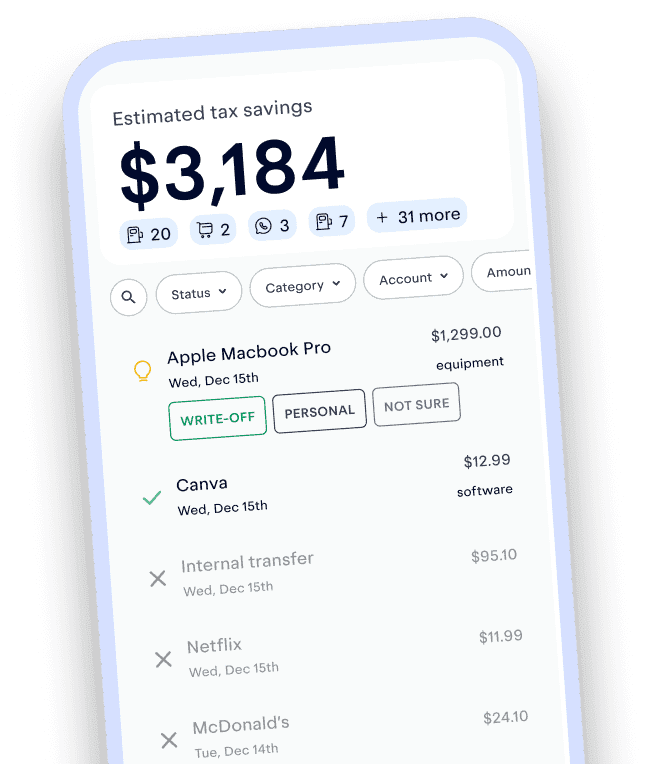
Track and claim every eligible deduction with Keeper
Keeper scans your accounts for write-offs and files your return — with tax pros reviewing every one.
Try it freeA word of caution: avoid these STR loophole mistakes
A seasoned CPA, like one of our tax experts at Keeper, will consider the following, which can land you in hot water if you're not careful!
Watch the personal use rule.
If you use your STR property for personal purposes for more than 14 days per year or more than 10% of total rental days (whichever is greater), the IRS may reclassify it as a personal residence. This limits your deductions significantly. If you want to maximize the tax benefits, keep personal use to a minimum and document every night carefully.
Don't let property managers kill your qualification.
A common mistake is entering into a "master lease" arrangement with a management company, where you effectively lease your property to the manager, who then sublets it to guests. In this structure, your customer is the management company, not the nightly guest, which breaks the short-term rental classification at the property owner level. If you use a property manager, make sure they are acting as your agent, not as a tenant.
Make sure to track your hours.
The IRS has made it clear that reconstructing time logs from memory during an audit is a red flag. Keep a contemporaneous log using a calendar, property management software, or even a simple spreadsheet. Note the date, task, and time spent. Track contractor and cleaner hours separately, because if a cleaning crew logs 300 hours and you only log 120, you may fail the "more than anyone else" test.
Consider an LLC, but understand the limits.
Holding your STR in a single-member LLC can add liability protection and simplify bookkeeping. However, entity structure alone doesn't change your tax classification. Whether you own the property personally or through an LLC, you still need to meet the same IRS tests for material participation and average rental period.
Recapture is real.
When you eventually sell the property, the IRS will recapture depreciation at a rate of up to 25% under Section 1250 rules. A 1031 exchange can defer recapture if you reinvest into another qualifying property.
Each property is evaluated separately.
Unlike real estate professional status, where you can elect to group all properties, the STR loophole is generally applied property by property. If you own three vacation rentals, you'll need to demonstrate material participation for each one individually.
Know local and state regulations.
It's worth noting that some local and state governments have moved aggressively to regulate or restrict short-term rentals. Cities like New York, San Francisco, and Denver have implemented licensing requirements, caps on rental nights, or outright bans in certain zones. Before purchasing a property for the STR loophole, due diligence on local regulations is just as important as understanding the federal tax rules.

Over 1M Americans trust Keeper for their complex taxes
The #1 tax app for freelancers, gig workers, and self-employed filers.
Get started free

FAQ
No. Unlike the $25,000 passive loss allowance for traditional rentals, which phases out above $100,000 in MAGI, the STR loophole has no income cap. High earners can use it without restriction as long as they meet the IRS requirements.
Technically no, but practically yes. The combination of cost segregation studies, bonus depreciation, material participation documentation, and entity structuring makes this one of the more complex strategies in the tax code. Mistakes can trigger audits or disqualify your deductions entirely. Book a call with a Keeper CPA, who has specific experience with real estate investors and STR tax strategy.
STR income and losses are typically reported on Schedule E (Form 1040). If passive activity limitations apply, you'll use Form 8582 to calculate allowable losses. A cost segregation study will affect your depreciation schedule and may involve Form 4562.
Yes, with additional complexity. You must report all foreign rental income on your U.S. return, meet the same material participation tests, and navigate foreign tax credits appropriately. The structural rules are the same, but the compliance burden is meaningfully higher.

Krislyn is Chief Growth Officer at Keeper. At Keeper, she strives to make expert-level tax strategies that used to require a traditional CPA accessible to all. Prior to Keeper, she was at Curology, where she helped bring custom, prescription-grade skincare out of the dermatologist's office to millions of faces.
View full bio
a tax professional
This content has been reviewed by an Enrolled Agent (EA) with the IRS — the highest credential awarded by the agency. Enrolled Agents are empowered to represent all taxpayers before the IRS, on all types of tax-related matters. Accountants who earn this certification have passed a comprehensive three-part exam on individual and business tax returns. To maintain EA status, they must stay up to date in the field by completing 72 hours of continuing education every three years.
View full bio3 sources
Keeper’s tax guides are built on primary sources: the tax code, IRS forms, instructions and publications, and state tax agency guidance. We link to external sources where appropriate and check figures against the tax year they apply to. This article was peer reviewed by a licensed tax professional (CPA or EA).
This article is for informational purposes only and isn’t tax, legal, or financial advice. Tax rules change and depend on your situation, so talk to a tax professional about yours.