
23 Tax Write-Offs for Professional Painters
NAICS business codeYour NAICS business code is a six-digit string of numbers that shows the type of work your business does. NAICS stands for North American Industry Classification System. When you do your taxes, you'll enter it in Box B of your Schedule C.238320
 Reviewed bySabrina Wiechart, CPASabrina is a Certified Public Accountant (CPA) with over 15 years of experience in tax preparation, planning, and S-Corp compliance. She holds a Master’s in Accounting and specializes in helping self-employed individuals make smart tax decisions. Sabrina is passionate about simplifying the S-Corp process and making sure every client keeps more of what they earn.
As a commercial painter, the quality of your work speaks for itself. But do you pay the same attention to detail when filing your taxes? Too often, painters neglect to take all the write-offs that their business is entitled to, gumming up their savings and drying out future opportunities.
That’s why Keeper has compiled a list of the best write-offs for commercial painters, so that your return can gleam as vibrant as the houses you spruce up. Simply mix up the right write-offs for your business, and you’re good to go!
Squarespace, Wix, GoDaddy, and other website service fees are fully tax-deductible.
Print and online advertising costs for your business are considered write-offs.
Business cards, brochures, service menus, and flyers promoting your business are deductible.
Any uniforms you're required to wear on the job are considered tax-deductible.
This applies to clothing you can't reasonably wear outside of work. Everyday clothes don't qualify, even if you only wear them on the job.
If you need to get your uniform professionally dry cleaned , you can write it off.
This applies to clothing you can't reasonably wear outside of work. Everyday clothes don't qualify, even if you only wear them on the job.
Paint, brushes, tarps, cloths, and any other supplies you need to paint are all write-offs.
Larger equipment — commercial sprayers, scaffolding, lifts — is depreciated on Box 13 rather than expensed as a supply.
Write off the fees you pay to contract labor to help you complete projects.
Pay any one contractor $600 or more in a year and you'll need to file a Form 1099-NEC for them.
Protecting yourself and your business with liability insurance? It's a write-off.
Fees to renew your license to perform your work are fully deductible.
If your state requires you to carry a bond to hold your license, the premium is deductible.
Write off the protective gear, like goggles and gloves, you wear on the job.
Disposing of solvents, biohazard or medical waste the way your work requires is a write-off.
If you drive for work ...
Driving around the city, whether to a job location, to pick up paint supplies, or to meet with a client, might not exactly qualify as painting the town red. But the good news is that you can write off a portion of your car expenses, relevant to the amount you use it for work.
Parking for a meeting downtown, or any other work trip, is tax-deductible!
A toll while driving to or from a work destination is tax-deductible!
If you buy a new car, you can write off part of the cost every year for five years.
Flashlights, tire iron, duct tape, and other tools you may need in your vehicle are deductible.
Car insurance monthly fees, registration, even roadside assistance are partially deductible — if you use the actual expense method. The standard mileage rate already covers them.
Oil changes, repairs, and regular checkups are deductible if you use the actual expense method. Take the standard mileage rate instead and they're already baked into your per-mile deduction.
If you discuss work at a restaurant ...
Grabbing dinner with a friend to decompress after a shift doesn't count as a business meal.
However, meeting a contractor, accountant, vendor, client, or fellow painter to talk about work does count — and the cost is considered a write-off.
If you discuss work with a coworker, mentor, client, or prospective client, it's a write-off — 50% of the tab.
If you leave town for work ...
Networking is a big part of how freelancers line up their work.
So if you head out of town to attend an industry conference or meet with an out-of-town client, keep in mind that you can deduct your travel expenses from your taxes.
Planes, trains, and car rentals are all work-related travel costs that can be written off.
When you travel for work, lodging expenses such as hotel rooms or Airbnb are write-offs.
When you're traveling for work, your meals are 50% deductible — takeout included. (Long-haul truck drivers subject to DOT hours-of-service rules can deduct 80%.)
If you work from home ...
If you manage finances and paperwork, client development, or industry research from home, go ahead and write off a portion of your home office expenses.
A desk, chairs, lamps, and other home office necessities are all tax write-offs. Anything over about $2,500 gets depreciated on Form 4562 instead of written off all at once.
Repairs just for your home office are 100% deductible. Repairs to the rest of your home count too, prorated by your business-use percentage on Form 8829.
Gotta keep the lights on in your home office! A portion of your electricity bill counts.
Whether it's rental or homeowners insurance, you can write off a portion through your home office deduction.
It'd be hard to work in an office without running water, huh? Your water bill counts.
You need internet to do your job! If you claim a home office, deduct it prorated on Form 8829 along with your other utilities. Internet you pay for on the road, purely for work, is 100% deductible.
You may also enjoy learning about ...

Ultimate Guide to Car Tax Deductions and Mileage
If your freelancing, 1099 contracting, or small business involves driving, then you can claim car-related tax write-offs. Here's how to save on your car expenses at tax time — and everything you can deduct.
 By Krislyn Chan
Everything You Need to Know About the Business Travel Tax Deduction

The Business Meal Deduction: A Freelancer's Guide

Receipts for Taxes: What Do You Need to Keep?
The Last Schedule C Guide You'll Ever Need

How To File Your Self-Employment Taxes in 7 Easy Steps
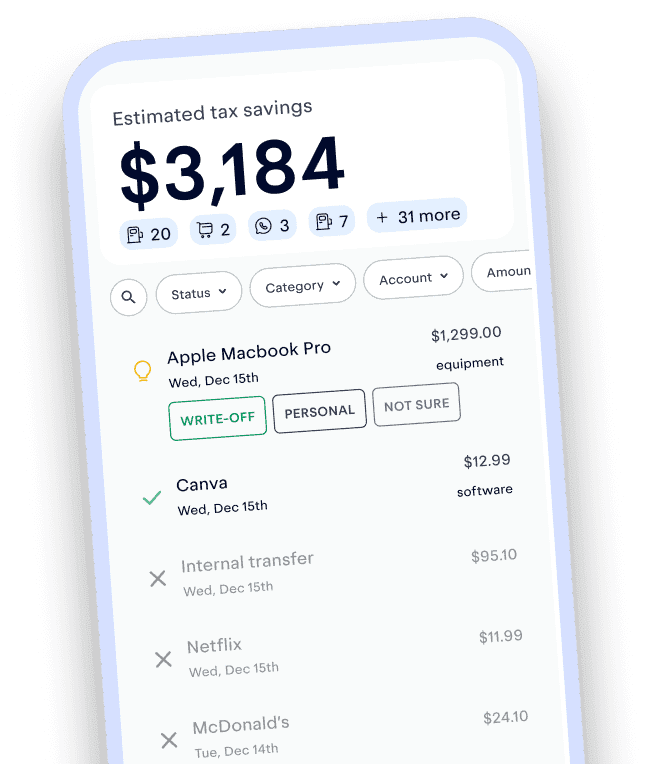
Track and claim every eligible deduction with Keeper
Keeper scans your accounts for write-offs and files your return — with tax pros reviewing every one.
Try it free