
30 Tax Write-Offs for Independent Musicians
NAICS business codeYour NAICS business code is a six-digit string of numbers that shows the type of work your business does. NAICS stands for North American Industry Classification System. When you do your taxes, you'll enter it in Box B of your Schedule C.711510
 Reviewed bySabrina Wiechart, CPASabrina is a Certified Public Accountant (CPA) with over 15 years of experience in tax preparation, planning, and S-Corp compliance. She holds a Master’s in Accounting and specializes in helping self-employed individuals make smart tax decisions. Sabrina is passionate about simplifying the S-Corp process and making sure every client keeps more of what they earn.
Listen, we get it — just because you’re used to counting time, that doesn’t mean you’re a math whiz. Taxes in particular can easily trip people up, with their complex rules and rapidly changing tempo.
Luckily, there’s an easy trick all independent musicians can use to save money on their taxes. By writing off all the ordinary business expenses you run up every day, you can easily lower your tax bill several octaves. Talk about music to your ears!
Adobe, Audacity, GarageBand are necessary for the job and therefore tax-deductible.
Write off AI tools you use to edit videos, music, transcripts, or podcasts.
Cables, mics, stands and other lower-cost hardware you use to record or perform are deductible as supplies. Higher-cost gear — PA systems, mixers, audio interfaces — is depreciated on Box 13 instead of written off all at once.
Squarespace, Wix, GoDaddy, and other website service fees are fully tax-deductible.
Coaching, seminars, or workshops used to maintain your work-related skills can be written off.
This covers training that maintains or improves skills for the work you already do. Courses that qualify you for a new trade or profession are not deductible.
Instruments are capital assets: you depreciate them over time, or expense them up front under Section 179 or the de minimis safe harbor.
Spotify, Pandora, and other services help you keep up with industry trends and do research for your own work.
Only the portion you use for business research or performance is deductible — if it doubles as personal listening, that share doesn't count.
Print and online advertising costs for your business are considered write-offs.
If you need to hire an editor, designer, photographer, or other creative pro, write off what you pay them.
Pay any one contractor $600 or more in a year and you'll need to file a Form 1099-NEC for them.
If you buy a phone or laptop and use it for work, it's partially deductible — in proportion to how much you use it for business. The device itself is depreciated on Box 13 (or expensed under Section 179); your monthly service plan belongs on Box 27b, and accessories on Box 22.
Purchasing records, CDs, and tapes for research is tax-deductible for you.
Only the portion you use for business research or performance is deductible — if it doubles as personal listening, that share doesn't count.
If you rent a recording studio, you can write off the expense.
You can write off the depreciation on your recording equipment over the years.
Cases, bows, music stands and similar lower-cost accessories are deductible as supplies in the year you buy them.
Registration and membership fees for a performing rights organization — ASCAP, BMI, SESAC — are deductible.
CDs, vinyl, shirts and other merch you buy to sell at shows are counted as cost of goods sold rather than a plain expense.
If you belong to a union, go ahead and write off your dues . The share of your dues that goes toward lobbying isn't deductible — your organization can tell you what percentage that is.
Where a union spends part of your dues on lobbying, that portion is not deductible.
Protecting yourself and your business with liability insurance? It's a write-off.
If you drive for work ...
It might be music to your ears to find out that you can deduct car expenses if you drive for work, like to get to a gig or band practice.
Parking for a meeting downtown, or any other work trip, is tax-deductible!
A toll while driving to or from a work destination is tax-deductible!
If you buy a new car, you can write off part of the cost every year for five years.
Flashlights, tire iron, duct tape, and other tools you may need in your vehicle are deductible.
Car insurance monthly fees, registration, even roadside assistance are partially deductible — if you use the actual expense method. The standard mileage rate already covers them.
Oil changes, repairs, and regular checkups are deductible if you use the actual expense method. Take the standard mileage rate instead and they're already baked into your per-mile deduction.
If you discuss work at a restaurant ...
If you go out to eat or grab a drink with a venue owner, promoter, producer, or agent to promote your music, it counts as a business expense and can be written off your taxes. Similarly, getting food or drinks with fellow musicians to talk about trends in the music industry also counts!
If you discuss work with a coworker, mentor, client, or prospective client, it's a write-off — 50% of the tab.
If you leave town for work ...
If you're playing at an out-of-town gig, you can write off the associated travel expenses, like renting a van or booking accommodations.
Planes, trains, and car rentals are all work-related travel costs that can be written off.
When you travel for work, lodging expenses such as hotel rooms or Airbnb are write-offs.
When you're traveling for work, your meals are 50% deductible — takeout included. (Long-haul truck drivers subject to DOT hours-of-service rules can deduct 80%.)
If you work from home ...
If you have a home studio or just a dedicated workspace to research and compose music, you can write off some of your home office expenses.
A desk, chairs, lamps, and other home office necessities are all tax write-offs. Anything over about $2,500 gets depreciated on Form 4562 instead of written off all at once.
Repairs just for your home office are 100% deductible. Repairs to the rest of your home count too, prorated by your business-use percentage on Form 8829.
Gotta keep the lights on in your home office! A portion of your electricity bill counts.
Whether it's rental or homeowners insurance, you can write off a portion through your home office deduction.
It'd be hard to work in an office without running water, huh? Your water bill counts.
You need internet to do your job! If you claim a home office, deduct it prorated on Form 8829 along with your other utilities. Internet you pay for on the road, purely for work, is 100% deductible.
You may also enjoy learning about ...

Advertising Expenses and How To Claim Them
Advertising is a great way to attract new customers and keep old ones, and it’s also 100% tax deductible. Find out creative ways to increase your advertising write-off.
 By Sarah York, EA
Is My Subscription A Tax Deduction?
What Education Expenses Are Tax-Deductible in 2026?

Use This Free Spreadsheet for Your Independent Contractor Expenses
The Last Schedule C Guide You'll Ever Need

How To File Your Self-Employment Taxes in 7 Easy Steps
Track and claim every eligible deduction with Keeper
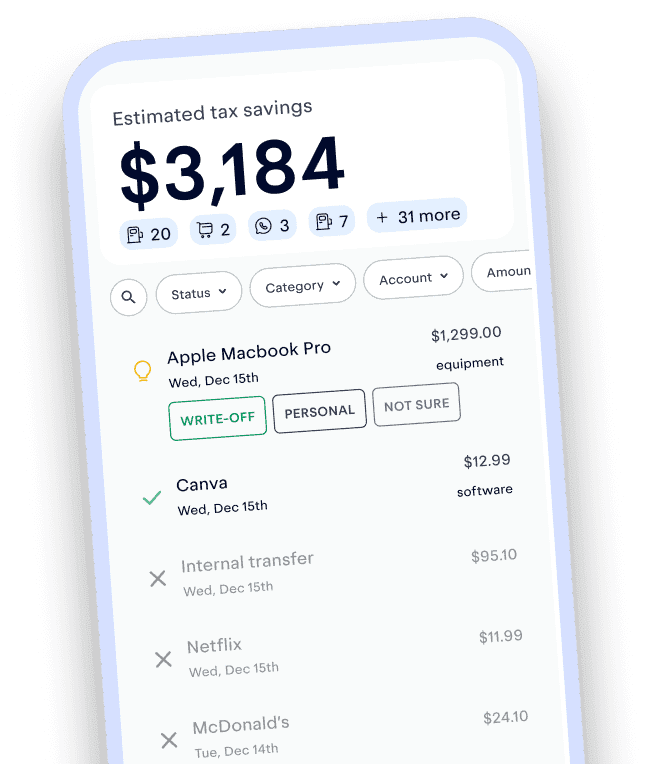
Keeper scans your accounts for write-offs and files your return — with tax pros reviewing every one.
Try it free