
31 Tax Write-Offs for Online Sellers
NAICS business codeYour NAICS business code is a six-digit string of numbers that shows the type of work your business does. NAICS stands for North American Industry Classification System. When you do your taxes, you'll enter it in Box B of your Schedule C.455000
 Reviewed bySabrina Wiechart, CPASabrina is a Certified Public Accountant (CPA) with over 15 years of experience in tax preparation, planning, and S-Corp compliance. She holds a Master’s in Accounting and specializes in helping self-employed individuals make smart tax decisions. Sabrina is passionate about simplifying the S-Corp process and making sure every client keeps more of what they earn.
Whoever would have imagined just a few decades ago that people could run their own store from the comfort of home? Yup, it sure is a wonderful world of e-commerce out there. So why are so many online sellers overpaying on their taxes? Luckily, you can avoid this trap, simply by claiming the everyday business purchases you make all the time.
It doesn't matter if you're selling on eBay, TikTok shop, Etsy, Depop, or your own Shopify setup; these tax write-offs apply to you whether you're selling your own handmade goods or sourcing the best items from your local thrift stores. We’ve made it even easier, by compiling a list of the best write-offs for online sellers in one place. It’s like applying an automatic coupon at checkout!
Deduct what you pay for ecommerce programs like Shopify and WooCommerce.
Bubble mailers, boxes, tissue paper and more: anything you buy to ship customer orders is a write-off.
Fees you pay your vendor or supplier can be written off.
Ad campaigns on Google, Meta, TikTok, and more are all deductible on your taxes.
If you keep your inventory in a warehouse, you can write off your rent on it.
Write off any email marketing software like Mailchimp or ActiveCampaign.
Write off AI tools you use to manage listings, edit product photos, or market your store.
Any equipment you use to shoot promotional tapes, portraits, and more can be written off.
Individual items under roughly $2,500 can be expensed up front under the de minimis safe harbor instead.
The 2.75% fee (give or take) that you pay your payment processors adds up. It's deductible!
Online seller platforms take some of your money on every sale. You can deduct those costs!
Sponsored search placements on Amazon, Etsy, and more are deductible advertising expenses.
Make your own products? If you sell, say, hand-embroidered clothes, write off the fabric, floss, and your Singer.
Materials consumed making the product are cost of goods sold. Reusable equipment like a sewing machine is depreciated on Box 13 instead.
Deduct anything you order to show off your personal brand: T-shirts, stickers, mugs, and more.
If you need to hire an editor, designer, photographer, or other creative pro, write off what you pay them.
Pay any one contractor $600 or more in a year and you'll need to file a Form 1099-NEC for them.
Write off the tools you use to create assets, schedule posts, or pull analytics.
Protecting yourself and your business with liability insurance? It's a write-off.
Fees to renew your license to perform your work are fully deductible.
Return and chargeback fees billed separately from ordinary card processing are deductible.
If you drive for work ...
While commuting expenses aren't deductible, errands like picking up inventory, dropping off a package, or meeting with a vendor or supplier are considered work-related. So if you're an online seller who does any of the above, you can write off car expenses!
Parking for a meeting downtown, or any other work trip, is tax-deductible!
A toll while driving to or from a work destination is tax-deductible!
If you buy a new car, you can write off part of the cost every year for five years.
Flashlights, tire iron, duct tape, and other tools you may need in your vehicle are deductible.
Car insurance monthly fees, registration, even roadside assistance are partially deductible — if you use the actual expense method. The standard mileage rate already covers them.
Oil changes, repairs, and regular checkups are deductible if you use the actual expense method. Take the standard mileage rate instead and they're already baked into your per-mile deduction.
If you discuss work at a restaurant ...
Stocking your fridge with healthy snacks to keep you going through the workday might not count as a business meal. But going for dinner or coffee to talk about your work with fellow online sellers, vendors, accountants, or lawyers does count. So go ahead and write off the cost!
If you discuss work with a coworker, mentor, client, or prospective client, it's a write-off — 50% of the tab.
If you leave town for work ...
There are lots of annual ecommerce seminars, workshops, and conferences around the country each year. If you end up going to any of them to learn and network, you can write the travel costs off as business expenses. This also counts for other work-related trips, like visiting an out-of-town supplier!
Planes, trains, and car rentals are all work-related travel costs that can be written off.
When you travel for work, lodging expenses such as hotel rooms or Airbnb are write-offs.
When you're traveling for work, your meals are 50% deductible — takeout included. (Long-haul truck drivers subject to DOT hours-of-service rules can deduct 80%.)
If you work from home ...
Online sellers often have areas of their homes dedicated to photographing products or packaging orders. You might also have a desk where you work on marketing and industry research. Both of these scenarios make you eligible to claim home office deductions!
A desk, chairs, lamps, and other home office necessities are all tax write-offs. Anything over about $2,500 gets depreciated on Form 4562 instead of written off all at once.
Repairs just for your home office are 100% deductible. Repairs to the rest of your home count too, prorated by your business-use percentage on Form 8829.
Gotta keep the lights on in your home office! A portion of your electricity bill counts.
Whether it's rental or homeowners insurance, you can write off a portion through your home office deduction.
It'd be hard to work in an office without running water, huh? Your water bill counts.
You need internet to do your job! If you claim a home office, deduct it prorated on Form 8829 along with your other utilities. Internet you pay for on the road, purely for work, is 100% deductible.
You may also enjoy learning about ...

TikTok Shop Taxes: The Complete 2026 Guide for Sellers
How TikTok Shop sellers handle taxes in 2026: 1099-K rules, sales tax, write-offs, quarterly payments, and a step-by-step filing guide.
 By Krislyn Chan
How To Handle eBay 1099 Taxes the Right Way in 2026
Shopify Tax Documents: Everything You Need to File Your 1099 Taxes in 2026

How To File (and Save Money on) Your Etsy 1099 Taxes

How To Pay Taxes on Poshmark Sales in 2026

Depop Taxes: Filing Taxes for Depop Earnings in 2026

Facebook Marketplace Taxes: What Online Sellers Need to Know in 2025
Mercari Taxes: What Sellers Owe and How To File in 2026
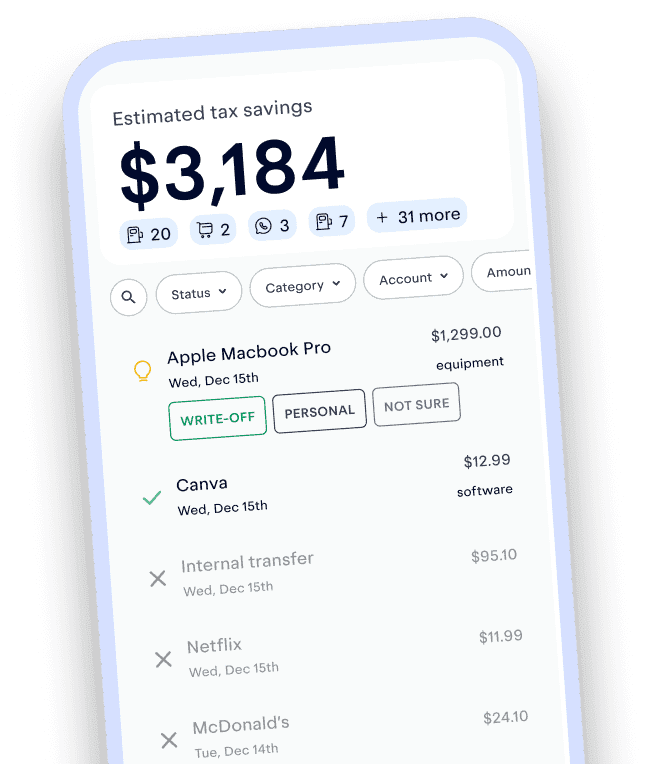
Track and claim every eligible deduction with Keeper
Keeper scans your accounts for write-offs and files your return — with tax pros reviewing every one.
Try it free