






Key takeaways
Any profit you make on Depop is taxable, whether or not Depop sends you a tax form.
Depop sends a 1099-K once you pass $20,000 in sales and 200 transactions, but a few states have a $600 threshold.
Selling your own used clothes for less than you paid is not taxable, but it can still show up on a 1099-K, so you may need to report it and cancel it out.
If reselling is a real business, you file a Schedule C and pay 15.3% self-employment tax on your profit.
Your 1099-K reports gross sales before Depop's fees, so it may end up looking higher than what actually hits your bank account. Don't fret - you get to deduct fees, refunds, and expenses to get to your true net profit.
Depop isn’t just a resale app where you can find Y2K graphic tees at low-to-moderate prices. It’s also a solid place to grow a side hustle - as long as you have the time and the inventory.
If you’re new to the online marketplace grind, you might be wondering whether you have to pay taxes on what you earn there. The answer is: It depends on whether you sell regularly, or just offload the occasional item you’re no longer feeling.
This 2026 guide breaks down who owes tax, what the 1099-K means, how to maximize your tax write-offs, and file.
Do you have to pay taxes on Depop sales?
Probably. As a rule of thumb, online sellers who make $400 or more in a year in profit should assume they owe taxes. (More on the profit part later.)
There are two special circumstances you should know about: “virtual garage sales” and hobby selling.
Virtual garage sales aren't taxed
Let’s say you finally take Marie Kondo’s advice and KonMari your closet, then log on to Depop to list the clothes and accessories that don’t spark joy. This is basically a Depop garage sale - you’re hosting a one-off event to get rid of your old stuff. (Plus, it's likely that you didn't make a profit on those items. When you consider how much you paid for them, you probably incurred a loss.)
In this case, you’re not on the hook for taxes, according to the IRS. But if you find yourself holding virtual garage sales on a regular basis, you probably have a small business on your hands. And that means taxes.
Hobby income is taxed — and deductions are limited
You might be thinking, “Selling thrifted Mudd jeans on the internet doesn’t really feel like a business. It feels like more of a hobby.”
That’s a fair point if you’re not actually in it for the money. And the IRS does have rules for determining if a money-making activity counts as a business or a hobby. But you’re still required to report and pay income taxes on your hobby earnings.
In addition, hobby sellers aren’t able to claim write-offs. So you’re getting a pretty raw deal here: kind of like a dry-clean-only skirt that you discover is also from Shein.
How Depop taxes work for minors
90% of Depop’s 26 million users are under 26, according to company information, and a sizable portion of those are teenagers. This means sellers under 18 — and their parents — might find themselves in a confusing situation.
No matter their age or dependent status, Depop sellers should plan to file their own tax returns for the year if they make $400 or more.
“They are considered self-employed,” says Bill Hampton, a Georgia-based tax consultant. “They’re considered contractors.”
With Keeper, you can track business expenses and file your taxes right from your phone. If you run into problems or have questions, Keeper’s team of tax experts is ready to help.
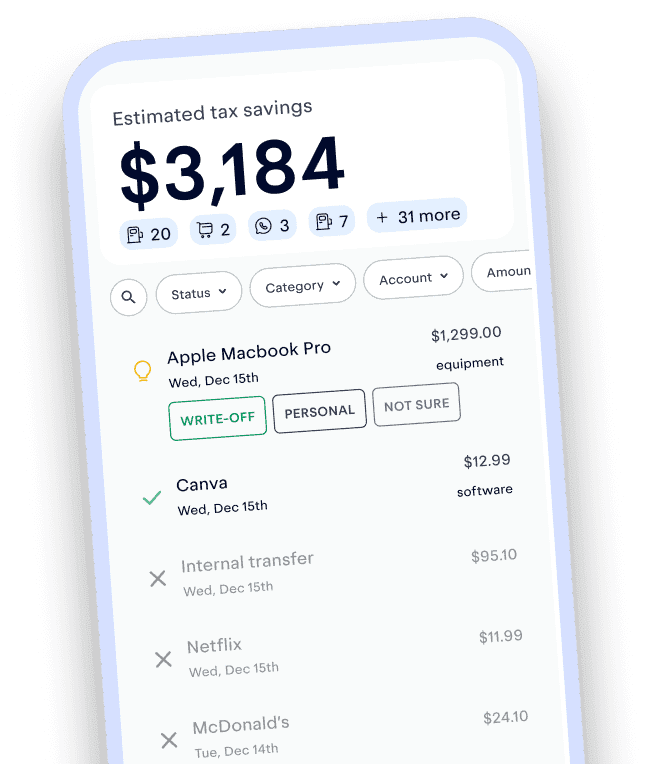
Track and claim every eligible deduction with Keeper
Keeper scans your accounts for write-offs and files your return — with tax pros reviewing every one.
Try it freeWhat tax form does Depop send?
If you made over $20,000 on Depop and logged at least 200 sales in a year, you’ll automatically get a 1099-K form from the company.
The 1099-K is a version of the 1099 form for independent contractors who are paid via debit card, credit card, or third-party platforms (like PayPal or Venmo).
It’ll detail the gross income you earned from your shop. That’s helpful for figuring out what you’re working with when you subtract your write-offs.
What | What to know |
|---|---|
Tax form | 1099-K |
When you'll get it | Sent by January 31 |
Who gets it | If you surpassed $20,000 in sales AND more than 200 transactions For Maryland, Massachusetts, Vermont, Virginia, and D.C., the threshold is $600. For Illinois, the threshold is $1,000 and 4 sales. |
Where to find it | Your Depop account, under your tax or payment settings |
Didn't get a 1099-K from Depop?
If, for whatever reason, you don’t receive it, don’t panic - you don’t absolutely need it to file. (You can also see your sales history, including gross totals, when you access Depop’s Selling Hub.)
Unfortunately, not receiving a 1099-K doesn’t mean you don’t have to pay taxes. Remember: If you make over $400 in self-employment income, you should plan to file.
You sold your own clothes at a loss. Do you owe tax?
Good news. Selling a personal item for less than you paid doesn't constitute taxable income, because you didn't make anything off the sale. However, that sale can still show up on your 1099-K, so to cancel it out on your taxes you have to report the following:
On Schedule 1, Line 8z, enter the amount from the 1099-K and label it "Form 1099-K Personal Item Sold at a Loss."
On Schedule 1, Line 24z, enter the same amount as an offsetting adjustment with the same label.
Do you have to pay taxes if it's a hobby?
Let’s say you regularly sell on Depop and your earnings are high enough that you do owe taxes. But what if it’s just something you enjoy doing on the side of your full-time job? Does that really count as a business?
According to the IRS’s hobby vs. business rules, it might! Your Depop activity likely counts as a business if:
You devote a significant amount of time to selling items (even if it’s your side hustle)
You develop methods to increase your profitability
You depend on Depop income for your livelihood
The IRS asks taxpayers to consider nine factors total when making this determination. (A few of them are subjective - like having a path to profitability and having the knowledge needed to run a successful business.)
Once you’ve figured that out, here’s how your taxes will differ based on which category your Depop sales fall into.
Business | Hobby |
|---|---|
✅ Pays income taxes | ✅ Pays income taxes |
✅ Pays self-employment taxes | ❌ Doesn't pay self-employment taxes |
✅ Claims tax write-offs | ❌ Doesn't claim tax writre-offs |
Do Depop sellers have to pay sales tax?
The good news: You don’t have to deal with sales tax on what you sell. Depending on where you live, though, your buyers might have to foot the bill.
There are five states that don’t have sales tax:
Alaska
Delaware
Montana
New Hampshire
Oregon
Everywhere else, your buyer will pay the appropriate sales tax for the state they live in.
Depop handles sales tax for you.
You, the seller, won’t have to do anything. Congrats!
According to Depop’s blog, the platform “will calculate and collect this tax according to the rules in your buyer’s state. The state sales tax will be automatically charged to the buyer and included in your buyer’s purchase breakdown.”
The TL;DR: Depop will handle sales tax from buyers on the government’s behalf. You don’t need to calculate the tax or account for it when posting your items. Concentrate on arranging the perfect backdrop for those vintage clogs instead.
How much tax will you owe?
The taxes you’re on the hook for as a Depop seller depend on the kind of selling you’re doing. If your store is a bona fide business, you’ll have to pay income tax and self-employment tax. If you’re a hobbyist seller, you’ll just have to pay income tax.
Self-employment tax of 15.3% for Social Security and Medicare, once net profit is $400 or more.
Income tax at your regular rate.
Want to get an idea of how much you’ll owe (or - fingers crossed - how much your refund will be)? Check out Keeper’s free income tax calculator.
Nothing is withheld, so set aside 25% to 30% of your profit. If you expect to owe $1,000 or more, the IRS wants four quarterly payments.
Depop tax write-offs lower your self-employment taxes
One advantage self-employed people do have is the ability to write off business expenses — something hobby sellers don’t get to do.
Like other self-employed people, Depop sellers only get taxed on profit: the amount of money you earn on the app, minus what it cost you to earn that money.
If your buyers paid you a total of $5,000 for the year, you shouldn’t pay taxes on the whole $5,000 — you didn’t get to pocket all of it. Instead, you should subtract what you spent to run your shop. (That process, of subtracting business expenses from income, is what people mean when they talk about “writing something off.”)
Say your write-offs come out to $2,200, for your packaging materials, the thrifted clothes you sold, and more. That makes your actual taxable income $2,800.
These write-offs can save you a lot on taxes, but you have to tell the IRS about them - and find them. How do you find write-offs? We’re so glad you asked.

Your write-offs as an online seller will vary, depending on how big and involved your Depop operation is. But here are a few suggestions. (We combed through r/Depop for inspiration, then had our accountant fact-checker take a look.)
📦 Shipping materials: Do you buy padded envelopes, boxes, packing tape, tissue paper, Sharpies, or bubble wrap to package your products for shipment? Those are write-offs. (Plenty of buyers prefer sellers to reuse packaging they already have, though — no shame in the sustainability game.)
👚 Inventory expenses: Speaking of inventory, that’s deductible, too. Think: The cost of items you’ll resell, the cost of repairing items, or the cost of getting clothing laundered before selling
📱Phone bill: Depop sellers will naturally conduct most of their business from their phones. Generating shipping labels, posting new items, editing photos, dealing with the never-ending stream of lowball offers — these are all tasks that you’ll likely need your phone for. If you (or your child) is on a family plan, you can still deduct the portion used for work. Learn more about that in Keeper’s guide to deducting your cell phone bill
📸 Photography expenses: Do you spend money on backdrops, props, ring lights, or fancy photo editing apps? Congrats, you are truly committed to your shop’s aesthetic — and those supplies are write-offs
🚗 Transportation: If you drive to the post office to drop off parcels, or to the Goodwill bins to source inventory, those expenses can be written off. Calculating the business-use percentage of your car can be a little tricky, so check out Keeper’s guide to writing off car expenses to get started
🧺 Home office and storage: Your dedicated workspace, whether that’s where you stage photos or where you store inventory, can be written off, too
💰Depop and PayPal fees: They can add up. Luckily, they’re also deductible!
How to file your Depop taxes
If you owe taxes on your Depop income, you’ll need to know about a few forms. They are:
Here’s how to handle each of them, step by step.
Get your 1099-K form. If you made over $20,000 on Depop and logged at least 200 sales in a year, you’ll automatically get a 1099-K form from the company.
Fill out your Schedule C.
Part I of the form is for reporting your “gross receipts or sales,” which is basically your income before you claim any deductions. If you used any other sales platforms, like Vinted or Poshmark, you'll report what you earned from those sources here too.
Part II of the form is for recording your deductions. These are the business expenses that will lower your taxable income — and lower the amount you owe. Not sure where to start? Keeper has a comprehensive guide to Schedule C, so you can maximize your savings at tax time. You can also use the Keeper app to track and record your business expenses. It’ll even fill out Schedule C for you!
Make quarterly estimated tax payments on January 15, April 15, June 15, September 15 if you expect to owe >$1,000.
A note of caution: If you used both Depop Payments and PayPal to collect payment from your buyers, you’ll likely get two 1099 forms: one from Depop and one from PayPal. Keep in mind that the 1099 from PayPal will include all the income you’ve received on the platform. So if you also sell on Poshmark or eBay using PayPal those transactions will be there, too.
Over 1M Americans trust Keeper for their complex taxes
The #1 tax app for freelancers, gig workers, and self-employed filers.
Get started free

FAQs
Do I owe taxes on Depop if I sold my clothes for less than I paid?
Generally no, because a loss on personal items is not taxable. If you get a 1099-K, report it on Schedule 1 Line 8z and cancel it out on Line 24z.
I did not get a 1099-K. Do I still report Depop income?
Yes. Any profit is taxable whether or not a form was issued. If, for whatever reason, you don’t receive it, don’t panic — you don’t absolutely need it to file. (You can also see your sales history, including gross totals, when you access Depop’s Selling Hub.)
Why is my Depop 1099-K higher than my payouts?
It reports gross sales before Depop's fees and includes sales tax. Deduct the fees to reach real profit.
Is my Depop selling a hobby or a business?
If you buy to resell regularly for profit, it is a business, which means Schedule C and self-employment tax.
Do I owe self-employment tax on Depop income?
Yes, if reselling is a business and your net profit is $400 or more.

Keeper Office Hours
Got a tax question, a confusing expense, or something you're stuck on in Keeper? Join a live, open Q&A with a Keeper expert. Submit your question ahead of time or ask it during the session. No presentation. No lecture. Just answers.

Chloe is a former staff writer at Keeper and a writer, editor, and journalist. She previously reported on internet culture and lifestyle trends for Mashable, where she also led the shopping section. In her free time, she enjoys reading and writing poetry, traveling, watching the Mets, and hanging out with her dog Pete.
View full bio
a tax professional
This content has been reviewed by an Enrolled Agent (EA) with the IRS — the highest credential awarded by the agency. Enrolled Agents are empowered to represent all taxpayers before the IRS, on all types of tax-related matters. Accountants who earn this certification have passed a comprehensive three-part exam on individual and business tax returns. To maintain EA status, they must stay up to date in the field by completing 72 hours of continuing education every three years.
View full bio7 sources
- FS-07-23 (PDF) · irs.gov
- Facts and figures · news.depop.com
- Bill Hampton · hamptonfinancialllc.com
- Selling Hub · depop.com
- Earning side income: Is it a hobby or a business? · irs.gov
- According to Depop’s blog · depophelp.zendesk.com
- R/Depop · reddit.com
Keeper’s tax guides are built on primary sources: the tax code, IRS forms, instructions and publications, and state tax agency guidance. We link to external sources where appropriate and check figures against the tax year they apply to. This article was peer reviewed by a licensed tax professional (CPA or EA).
This article is for informational purposes only and isn’t tax, legal, or financial advice. Tax rules change and depend on your situation, so talk to a tax professional about yours.