




You can rent your home to your business (and reap the tax benefits), only if your business is structured as a separate taxpayer (an S-Corp, C-Corp, partnership, or multi-member LLC). If you're a sole proprietor or single-member LLC filing a Schedule C, the IRS treats you and your business as the same taxpayer, so the strategy doesn't quite work the way the LinkedIn finfluencers make it sound. We'll get into it later.
This strategy is called the Augusta Rule (or Internal Revenue Code Section 280A(g)). It lets you rent your home up to 14 days per year without paying taxes on that income, and if you're renting your home to your business, you get to deduct it as an ordinary expense while excluding that income earned from your personal tax return. Win win!
What is the Augusta rule?
The Augusta Rule got its nickname from Augusta, Georgia. Homeowners near the Masters golf tournament started renting their homes to attendees for a week or two each spring and lobbied Congress to let them keep that income tax-free.
If you rent out a personal residence for fewer than 15 days during the tax year, you don't have to report the rental income, and you can't deduct rental expenses tied to those days either - unless you rent your personal residence to your business (such as an S-Corp or C-Corp). In that case, the business can write off the rental expense, and you pocket the cash tax-free.
Remember the 14-day limit
Hey, the IRS isn't kidding about this. If you rent your home for even 1 day beyond the 14 day limit, the entire rental income becomes taxable, and has to be reported on Schedule E.
You have to live there
To qualify, the home must be a "dwelling unit used as a residence" under IRS Publication 527. That means your personal use of the home during the year must exceed the greater of (a) 14 days or (b) 10% of the days it was rented at fair price. For your primary home, this is automatically met. For vacation homes, watch out!
You have to own the property
Do you rent your home? Well, if you rent it out, you don't qualify for this benefit! Homeowners only allowed, or so the IRS says.
Can I deduct rental expenses?
In this scenario, you rent out your personal home to your own business. The business deducts the rent as an ordinary expense, and the owner excludes the income on their personal return.
Watch out! This strategy only works if your business is one of these:
S-Corporation (Form 1120-S)
C-Corporation (Form 1120)
Partnership or multi-member LLC (Form 1065)
Why sole proprietors and single-member LLCs can't use the Augusta Rule to "rent to themselves"
If you file your business income on a Schedule C, which describes the vast majority of freelancers, gig workers, and 1099 contractors, you and your business are the same legal taxpayer. There's no separate entity to pay you rent. You'd be writing a check to yourself, deducting it on Schedule C, and excluding it on your personal return. Admit it: renting to yourself already sounds sus when you say it out loud. Well, the IRS thinks so too.
Single-member LLCs that haven't elected S-Corp status hit the same wall, because they're "disregarded entities"; that means for tax purposes, the LLC doesn't exist, and the owner is treated as a sole proprietor.
Keeper pro tip: If you're a sole prop with strong, consistent profit (think $60K+ in net self-employment income), it may be worth talking to a CPA about electing S-Corp status. That election creates the separate taxpayer the Augusta Rule needs, and it saves you 15.3% in self-employment tax on a portion of your income!

Over 1M Americans trust Keeper for their complex taxes
The #1 tax app for freelancers, gig workers, and self-employed filers.
Get started free

The 5-step Augusta Rule playbook
The strategy isn't complicated, but the documentation has to be airtight. The IRS knows this is a related-party transaction and scrutinizes it accordingly.
1. Establish fair market value
Your rental rate has to mirror what a third party would charge for a comparable space (hotel meeting rooms, coworking venues, event halls, or short-term rental sites). Pull screenshots from at least three local comparables (think Peerspace, Hilton, Marriott, Airbnb listings, local conference venues) and save them with the date pulled.
2. Identify legitimate business purposes
The rental needs a real business reason for requiring the space:
Quarterly board or strategy meetings
Annual shareholder or partner meetings (required by state law for corporations)
Team offsites and retreats
Client appreciation events
Photo or video shoots for marketing
Workshops or training sessions you host
3. Sign a written rental agreement
The agreement should name the parties (you as landlord, your business as tenant), specify the rental dates, list the daily rate and total, describe the space being rented, and reference the business purpose.
4. Document each rental day
For every rental day, keep an agenda, an attendee list, meeting minutes or notes, and photos if relevant (especially for offsites or shoots).
5. Cut a real check
The business writes a check or sends an ACH from its business account to your personal account on or near the rental date. Avoid cash. Make sure the payment trail matches the rental dates on your agreement.
A concrete example
You run a marketing consultancy you've elected to be taxed as an S-Corp. You host one full-day strategy session and one client appreciation event at your home each quarter:8 days total for the year. Comparable event spaces in your city rent for $1,500 a day. Your business pays you $1,500 × 8 = $12,000 over the year.
Your S-Corp deducts $12,000 as a rent expense on Form 1120-S. At a combined 35% federal + state rate, that's roughly $4,200 in tax savings flowing to you via the K-1.
You exclude the entire $12,000 from your personal 1040.
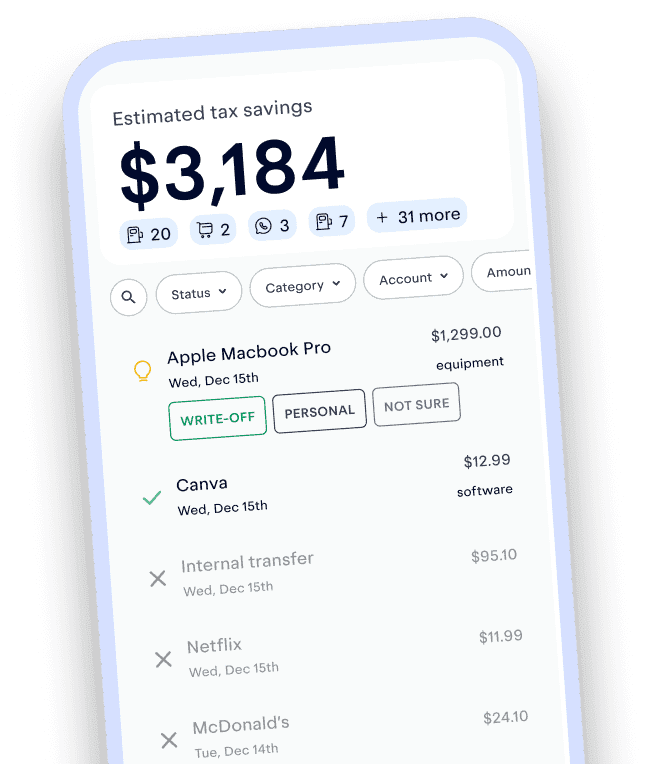
Track and claim every eligible deduction with Keeper
Keeper scans your accounts for write-offs and files your return — with tax pros reviewing every one.
Try it freeWhat's the tax move for sole proprietors?
For everyone filing a Schedule C, renting to your business doesn't work, but the home office deduction does, and most freelancers underclaim it or skip it entirely out of audit fear that's mostly outdated.
To qualify, a portion of your home must be used regularly and exclusively for your business and be your principal place of business. That means either you actually work there or you handle administrative work there and have no other fixed office. Check out our home office deduction quiz to see whether you can claim the deduction.
FAQs
Can a sole proprietor use the Augusta Rule?
Not to rent to themselves. Because a sole proprietor (or single-member LLC taxed as a sole prop) is the same taxpayer as their business, there's no separate party to pay rent. The "rent your home to your business" version of the Augusta Rule requires your business to be an S-Corp, C-Corp, or partnership. Sole props can still rent their home to a real outside party for up to 14 days tax-free, though!
Do I need to issue a 1099-NEC or 1099-MISC to myself?
No. The Augusta Rule exclusion means you don't report the income on your personal return at all. Your business deducts the rent on its return and keeps a copy of the rental agreement, invoices, and proof of payment. There's no self-issued 1099 in this strategy.
How do I prove fair market value?
Pull three to five comparable local rentals (hotel meeting rooms, coworking event spaces, Airbnb listings priced for events, Peerspace listings), and screenshot them with the date. Save those screenshots in your Augusta Rule file.
Can I rent for 15 days?
Technically yes, but then every dollar of rent becomes taxable rental income on Schedule E. You can deduct related expenses, but you lose the tax-free benefit. So, keep track!
What if I also claim a home office deduction. Can I do both?
Generally yes, but with care. The home office deduction covers space used regularly and exclusively for business throughout the year. The Augusta Rule covers up to 14 days of rental for specific business events. They cover different uses of the home, so most CPAs are comfortable claiming both. You can chat with a Keeper CPA to confirm your specific setup.
Do I need to report Augusta Rule rent anywhere on my personal return?
No. If you stay within the 14-day rule, you don't report the rent on Schedule E or anywhere else on Form 1040. If you receive a Form 1099-K from a platform (Airbnb, VRBO) for those days, report the amount on Schedule 1 and back it out with an offsetting "Section 280A(g) exclusion" adjustment, with a note. TurboTax's guide on short-term rentals walks through the 1099-K mechanics.
Does the Augusta Rule apply to vacation homes?
Yes, as long as the property qualifies as a "residence" under IRS Publication 527, meaning your personal use exceeds the greater of 14 days or 10% of the days it's rented at fair price.
Disclaimer: This article is for informational purposes only and does not constitute tax or legal advice. Tax laws change, and individual situations vary. Consult a qualified CPA or tax advisor for guidance specific to your situation.

Keeper Office Hours
Got a tax question, a confusing expense, or something you're stuck on in Keeper? Join a live, open Q&A with a Keeper expert. Submit your question ahead of time or ask it during the session. No presentation. No lecture. Just answers.

Krislyn is Chief Growth Officer at Keeper. At Keeper, she strives to make expert-level tax strategies that used to require a traditional CPA accessible to all. Prior to Keeper, she was at Curology, where she helped bring custom, prescription-grade skincare out of the dermatologist's office to millions of faces.
View full bio
a tax professional
This content has been reviewed by an Enrolled Agent (EA) with the IRS — the highest credential awarded by the agency. Enrolled Agents are empowered to represent all taxpayers before the IRS, on all types of tax-related matters. Accountants who earn this certification have passed a comprehensive three-part exam on individual and business tax returns. To maintain EA status, they must stay up to date in the field by completing 72 hours of continuing education every three years.
View full bio4 sources
- 26 U.S. Code § 280A · law.cornell.edu
- About Schedule E (Form 1040), Supplemental Income and Loss · irs.gov
- Publication 527 (2025), Residential Rental Property · irs.gov
- 10 Tax Tips for Airbnb, HomeAway & VRBO Vacation Rentals · turbotax.intuit.com
Keeper’s tax guides are built on primary sources: the tax code, IRS forms, instructions and publications, and state tax agency guidance. We link to external sources where appropriate and check figures against the tax year they apply to. This article was peer reviewed by a licensed tax professional (CPA or EA).
This article is for informational purposes only and isn’t tax, legal, or financial advice. Tax rules change and depend on your situation, so talk to a tax professional about yours.