





First things first: what makes S-Corp tax deductions different?
Before we dive into specific deductions, let's clear up a common point of confusion. As an S-Corp owner, you wear two hats: you're both an employee and a shareholder. This dual status creates unique tax advantages (and a few rules you need to follow).
S-Corps are pass-through entities, meaning the business itself doesn't pay federal income tax. Instead, profits and losses pass through to your personal tax return. But unlike sole proprietors or partnerships, S-Corp owners can take distributions that aren't subject to self-employment tax (as long as you're paying yourself a reasonable salary first).
This structure opens up strategic deduction opportunities that other business types can't access the same way.
16 S-Corp tax deductions every S-Corp owner should know about
1. Owner's salary and payroll taxes
Let's start with the most important "deduction" that's actually a requirement: your salary. If you actively work in your S-Corp, the IRS requires you to pay yourself a reasonable salary through payroll. This isn't optional, and "reasonable" means what someone else would earn doing the same job in your industry and location.
Your salary is a deductible business expense. Plus, while you'll pay payroll taxes on your salary, the remaining profits you take as distributions avoid the 15.3% self-employment tax.
Here's an example:
Sarah runs a marketing consultancy that nets $100,000 annually.
She pays herself a $60,000 salary (reasonable for her experience and market location) and takes $40,000 as distributions.
She pays payroll taxes only on the $60,000, potentially saving over $6,000 compared to being a sole proprietor.
Want to see this for yourself? Check out our S-Corp tax savings calculator to see how much you could end up saving in taxes.
Keeper pro tip: DON'T try to lowball your salary to save on taxes. The IRS actively audits S-Corps that try to minimize salaries unreasonably. Use (and document!) salary data from the Bureau of Labor Statistics or industry reports to justify your compensation. Make sure to check out our guide to establishing a reasonable salary to make sure you're IRS compliant.
2. Health insurance premiums
S-Corp owners get special treatment when it comes to health insurance, but you have to set it up correctly.
Your S-Corp can deduct 100% of health insurance premiums paid for you, your spouse, and your dependents. However, the premiums must be reported as wages on your W-2 (even though they're not subject to payroll taxes), and then you claim the self-employed health insurance deduction on your personal return.
Here's our step-by-step guide on how to handle your health insurance deduction on your taxes. Spoiler alert: it's pretty straightforward - as long as you know what you're doing!
Here's a real-world example:
Mike pays $1,500 monthly for family health insurance.
His S-Corp includes this $18,000 on his W-2, deducts it as a business expense, and Mike deducts it again on his personal tax return.
This creates a double benefit that saves him roughly $6,000 in taxes.
Keeper pro tip: If you're eligible for health insurance through your spouse's employer, you may not be able to take this deduction. The rules get technical here, so make sure to consult with a Keeper tax advisor. If you're on the premium free trial, your first consultation is free!
3. Home office deduction
If you run your S-Corp from home, this deduction can be substantial. But you need to meet specific requirements:
The space must be used regularly and exclusively for business
It must be your principal place of business, or where you meet clients/customers
Not sure if you can take the home office deduction? Take our home office deduction quiz!
Keeper pro tip: Clients who live in a studio (and thus don't really have a totally separate space just for business) are in a grey area. In a 2014 tax court case (Miller, TC Summ. Op. 2014-74), a taxpayer had a small studio in New York City where she regularly used her space for business. She successfully claimed the deduction by dividing her apartment into 3 sections (entryway/bathroom/kitchen, office space, bedroom). What does this mean for you? Arrange your space so your business area is clearly defined and separate. Keep only business items in that zone - no TV watching from your desk, no using it for personal activities.
4. Business vehicle expenses
Whether you drive to client meetings, job sites, or make deliveries, your vehicle costs can generate significant deductions. There are 2 methods you can use to claim vehicle deductions:
Standard mileage rate: 72.5 cents per mile for the first half of 2026, rising to 76 cents for the second half of 2026.
Actual expense method: deduct actual costs like your gas, maintenance, insurance, etc.
To figure out which method is best for you, read our mileage vs expense method guide.
Here's an example: Carlos drives 15,000 business miles annually. Using the standard mileage rate at the 2025 rate of $0.70, he deducts $10,500. His actual vehicle expenses total $8,000, so the mileage rate saves him more. He uses a mileage tracking app to automatically log every business trip.
5. Retirement plan contributions
S-Corp owners have several retirement plan options that offer both current tax deductions and long-term wealth building:
Solo 401(k): Contribute up to $23,500 as an employee (2025), plus up to 25% of your W-2 compensation as employer contributions. Total limit is $70,000.
SEP IRA: Contribute up to 25% of your W-2 compensation, maximum $70,000 for 2025. Easier to set up than a 401(k) but no catch-up contributions.
SIMPLE IRA: Good for S-Corps with employees. Contribute up to $16,500 ($20,000 if 50+), plus required employer contributions.
Keeper pro tip: The employer portion of your retirement contribution is a deductible business expense on your S-Corp return, while the employee portion reduces your personal taxable income.
6. Office supplies and equipment
Everything you need to run your business day-to-day is deductible. That includes things like:
Computers and laptops
Your phone bill
Software subscriptions (Adobe, Slack, Canva, etc.)
Office furniture
Keeper has a free tool to help you figure out what types of expenses are tax deductions based on your profession!
Keeper pro tip: The Section 179 deduction allows you to deduct up to $2,500,000 instead of depreciating the asset over time. So if you needed to make significant upfront equipment investments, this helps you claim the tax savings upfront!
Here's an example: Tom's S-Corp buys a $5,000 computer setup, $3,000 in office furniture, and $2,000 in software. Instead of depreciating the computer and furniture over 5-7 years, he uses Section 179 to deduct the full $10,000 in the purchase year, immediately reducing his tax bill.
7. Professional services and subscriptions
The cost of running a professional business includes various services and memberships. That includes thing like:
Accounting and bookkeeping fees
Attorney fees for business matters
Business coaching and consulting
Professional licensing fees
Industry association memberships
Trade magazine subscriptions
Business research tools and databases
Let's see an example: Emma's graphic design S-Corp pays $3,600 annually for her accountant, $500 for professional design associations, $600 for Adobe Creative Cloud, and $1,200 for project management software. All $5,900 is deductible, reducing her tax burden by roughly $1,800.
Keeper pro tip: Whether you use a traditional accountant like Emma or a tax platform like Keeper, those fees are tax deductible!
8. Marketing and advertising costs
Every dollar you spend attracting customers is deductible. Common deductions include:
Website hosting and domain registration
Social media advertising (Facebook, Instagram, LinkedIn ads)
Email marketing platforms (Mailchimp, ConvertKit)
Graphic design for marketing materials
Business cards and promotional materials
9. Travel
Business travel offers substantial deduction opportunities when you follow the rules:
The trip must be primarily for business
You must travel away from your tax home
The expenses must be ordinary and necessary
Check out our guide for a full breakdown of business travel deductions!
Keeper pro tip: If your business trip doesn't require overnight stay, you can still deduct transportation, but not meals. For overnight trips, meals during travel days are 50% deductible.
Let's see an example: Diana attends a three-day industry conference in another state. Her $600 flight, $900 hotel (3 nights), $200 in meals, and $150 in ground transportation are deductible. Total deduction: $1,750 (with meals at 50%) for a trip that also grows her network and skills.
10. Business meals and entertainment
When you're grabbing coffee or eating out with a client, that's a business meeting, which means it's tax deductible. Here's what you need to know about claiming the deduction - you can claim:
50% of meals during business travel
50% of meals with clients, prospects, or business partners
100% of meals provided to employees (like catered lunch meetings)
100% of office snacks and beverages for employees
What's NOT deductible? Concerts, sporting events, club memberships, etc. And to avoid an audit, make sure you document, document, document! Keep a record of the 5 P's:
Period: date the transaction occurred
Purpose: why the expense was incurred
Place: where the expense was incurred
Person(s): who was involved
Proof of purchase: receipt, bank statement, or digital log (like in the Keeper app!)
Keeper pro tip: Keeper tracks your expenses within the app or web dashboard by scanning your connected financial accounts for eligible tax deductible expenses! Never miss a legal tax deduction again.
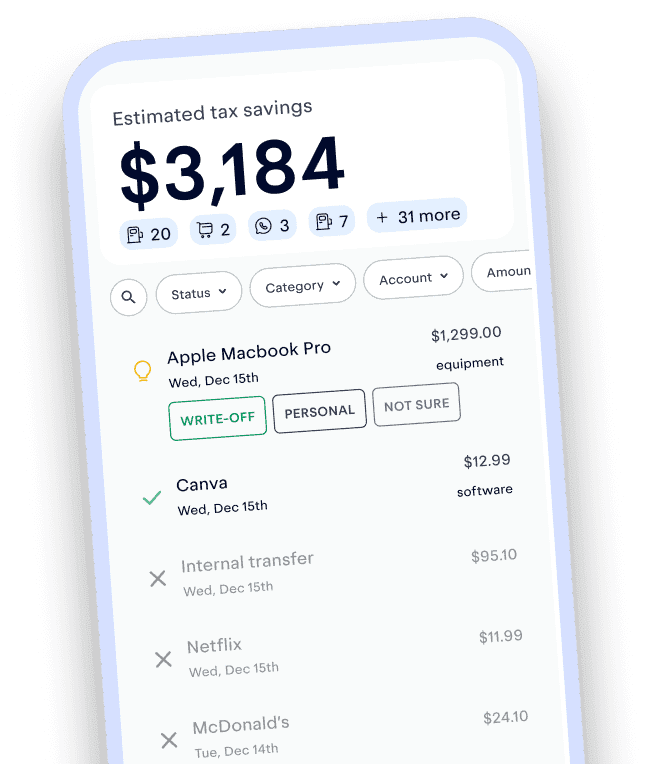
Track and claim every eligible deduction with Keeper
Keeper scans your accounts for write-offs and files your return — with tax pros reviewing every one.
Try it free11. Education and training
Investing in your skills and knowledge is deductible when it relates to your current business. That includes expenses like:
Online courses and certifications
Industry conferences and seminars
Professional development workshops
Books and educational materials
12. Insurance premiums
Beyond health insurance, S-Corps can also deduct various business insurance costs like:
General liability insurance
Commercial property insurance
Business interruption insurance
Commercial auto insurance
Keeper pro tip: If you have a home office, you may need separate business property insurance since homeowner's policies typically don't cover business equipment!
13. Contract labor and employee costs
When you hire help, those costs are deductible, but you need to classify workers correctly. When done right, you can deduct:
Employee wages and salaries
Payroll taxes (employer portion)
Employee benefits (retirement, health insurance)
Independent contractor payments
Keeper pro tip: Misclassifying employees as contractors is a common mistake that triggers IRS audits. Generally, if you control how, when, and where someone works, they're likely an employee. Make sure to send 1099-NEC forms by January 31st for any contractor paid $600 or more during the year. Missing this can result in penalties.
14. Bank fees and interest
The costs of business banking and financing are deductible, including:
Monthly business checking/savings fees
Credit card processing fees (huge for e-commerce)
Merchant account fees
Wire transfer fees
Loan interest on business debt
Business credit card interest
Keeper pro tip: Don't get carried away! Only the interest portion of loan payments is deductible, not the principal repayment.
15. Utilities
If you're paying for services used in your business, they're deductible. Common deductions include:
Cell phone bill (business use percentage)
WiFi service (business use percentage)
Electricity
What is the business-use percentage rule? For expenses used both personally and for business (like your cell phone), you can only deduct the business-use percentage! Be prepared to justify your calculation.
For example: Alex uses his cell phone 70% for business. His monthly bill is $100, so he deducts $70 monthly ($840 annually). He maintains call logs showing business vs. personal use to support this percentage.
16. Legal and regulatory fees
The costs of staying compliant and protecting your business are deductible:
Business license fees
Permit applications
Annual state filing fees
Registered agent fees
Trademark and patent applications
Legal fees for contracts and business matters
Regulatory compliance costs
What you should do next to maximize your S-Corp tax deductions
Understanding what deductions you can claim is just the first step. To see the net impact on your tax bill, you have to track and claim them on your taxes. Keeper can help.
Securely link up to 10 credit cards and bank accounts to Keeper to scan your past 18 months of expenses for qualifying tax deductions.
Take a snapshot of receipts for any cash-based purchases and add them to Keeper.
Review categorized expenses monthly to make sure they were for business.
Book a call with a Keeper tax pro for year-round tax planning support.
File your taxes with Keeper to add all your tax deductible expenses automatically to your return.
Over 1M Americans trust Keeper for their complex taxes
The #1 tax app for freelancers, gig workers, and self-employed filers.
Get started free


Keeper Office Hours
Got a tax question, a confusing expense, or something you're stuck on in Keeper? Join a live, open Q&A with a Keeper expert. Submit your question ahead of time or ask it during the session. No presentation. No lecture. Just answers.

Krislyn is Chief Growth Officer at Keeper. At Keeper, she strives to make expert-level tax strategies that used to require a traditional CPA accessible to all. Prior to Keeper, she was at Curology, where she helped bring custom, prescription-grade skincare out of the dermatologist's office to millions of faces.
View full bio
a tax professional
This content has been reviewed by an Enrolled Agent (EA) with the IRS — the highest credential awarded by the agency. Enrolled Agents are empowered to represent all taxpayers before the IRS, on all types of tax-related matters. Accountants who earn this certification have passed a comprehensive three-part exam on individual and business tax returns. To maintain EA status, they must stay up to date in the field by completing 72 hours of continuing education every three years.
View full bio1 source
- Miller, TC Summ. Op. 2014-74 · taxnotes.com
Keeper’s tax guides are built on primary sources: the tax code, IRS forms, instructions and publications, and state tax agency guidance. We link to external sources where appropriate and check figures against the tax year they apply to. This article was peer reviewed by a licensed tax professional (CPA or EA).
This article is for informational purposes only and isn’t tax, legal, or financial advice. Tax rules change and depend on your situation, so talk to a tax professional about yours.