




What is depreciation and why does it matter?
Depreciation is a tax deduction that lets you recover the cost of a rental property gradually over its "useful life," as defined by the IRS. The idea is actually really simple: buildings wear out over time, so the tax code allows you to account for that wear and tear as a business expense. This ultimately reduces your taxable income year after year.
What's wild is that depreciation is quite literally a paper loss. That means your property may actually be generating positive cash flow and appreciating in marketing value, but depreciation can show a "loss" on paper that ultimately offsets your rental income (and sometimes other income), which then legally reduces how much you owe in taxes.
Keeper pro tip: The IRS requires you to depreciate qualifying rental property. Even if you choose not to claim it, the IRS treats depreciation as "allowed or allowable" when you eventually sell. That means you could owe taxes on depreciation that you never actually deducted. Don't be a dummy. Always take the deduction!
What qualifies for depreciation?
To depreciate a rental property, 4 conditions must be met (look up IRS Publication 527 for more info):
You own the property.
You use it in a business or income-producing activity (i.e., it's rented out).
The property has a determinable useful life (it wears out, decays, or becomes obsolete).
It's expected to last more than one year.
Note that LAND IS NOT DEPRECIABLE! The IRS views land as having an indefinite useful life. Only the building (and certain improvements) can be depreciated. When you buy a rental property, you must allocate the purchase price between the land and the structure. A common method is to use the proportional values from your local property tax assessment.
Here's a simple example: You purchase a rental property for $350,000. The county property tax assessment shows the land at 20% of total value and the building at 80%. That means you can depreciate $280,000 (the building's cost basis), not the full purchase price.
How is residential rental depreciation calculated?
Ever heard of the 27.5 year rule? For residential rental property, the IRS assigns a recovery period of 27.5 years under the Modified Accelerated Cost Recovery System (MACRS). The calculation uses straight-line depreciation, meaning the deduction is spread evenly across the recovery period. The formula is straightforward:
Annual Depreciation = Depreciable Basis ÷ 27.5
Using our earlier example, let's say: $280,000 depreciable basis ÷ 27.5 years = approximately $10,182 per year in depreciation deductions. Over 10 years, that's $101,820 in total deductions. At a 22% federal tax rate, this translates to roughly $22,400 in tax savings just from depreciation.
Depreciation begins when your property is ready and available for rent (not necessarily when a tenant first moves in). That means if you purchase a property in July, make repairs, and have it ready to rent by September, depreciation begins in September, even if you don't find a tenant until November.
Keeper pro tip: As with any tax strategy... there's nuance. The IRS uses a mid-month convention for residential rental property. This means that no matter what day of the month you placed the property in service, you're treated as having placed it in service at the midpoint of that month. If you bought your rental in October, you'd get 2.5 months of depreciation in year one (October 15 through December 31).
Not everything depreciates over 27.5 years
Realistically, not everything in your rental property depreciates over 27.5 years. The IRS requires certain components to be depreciated over shorter periods:
5-year property: Appliances (refrigerators, stoves, dishwashers), carpeting, furniture used in the rental.
7-year property: Office furniture and equipment you use to manage the rental.
15-year property: Land improvements such as sidewalks, parking lots, and landscaping.
This is the foundation of a tax strategy called cost segregation, which is an engineering analysis that reclassifies components of your rental property from 27.5 year assets to 5-, 7- or 15-year assets. The shorter the depreciation period, the larger your early-year deductions.
For example, instead of depreciating your entire $280,000 building over 27.5 years, a cost segregation study might identify $60,000 of components (specialty wiring, land improvements, appliances, cabinetry) that qualify for 5- or 15-year depreciation. Combined with bonus depreciation, this can generate a very large first-year deduction.
Keeper pro tip: A word of caution. Cost segregation studies are expensive, and can cost anywhere from $5-15K. Cost segregation is most valuable when you can actually use the accelerated losses, either because your income is under $100,000, you qualify for REPS or the STR exception, or you have other passive income to absorb them. If your losses are passive and you earn over $150,000, these deductions will be suspended until you have passive income or sell the property. The strategy still has value as a tax deferral, but the timing of benefit is very different. Always model this with your CPA before commissioning a study. Need help? Book a call with a Keeper CPA.
Improvements vs repairs
One thing that often trips up people? The IRS treats repairs and improvements very differently:
Repairs (like fixing a leaky faucet, patching drywall, or painting a room) are generally deducted in the year they're incurred. That means no depreciation schedule required.
Improvements (like replacing the entire roof, installing new windows, adding a room, or replacing the HVAC system) must be capitalized and depreciated as a separate asset, typically over 27.5 years starting from the date of completion.
Keeper pro tip: The IRS uses a three-part test to determine if a rental property expenditure must be capitalized (depreciated over time). Ask yourself: does it better the property, restore it, or adapt it to a new use? If yes to any of these, it must be capitalized. When you replace an entire roof or all the windows and doors, these are restorations. They must be capitalized and depreciated, not expensed. Painting alone is typically deductible as a repair, unless it's done as part of a larger capital project, in which case the painting costs get swept into the overall improvement costs.
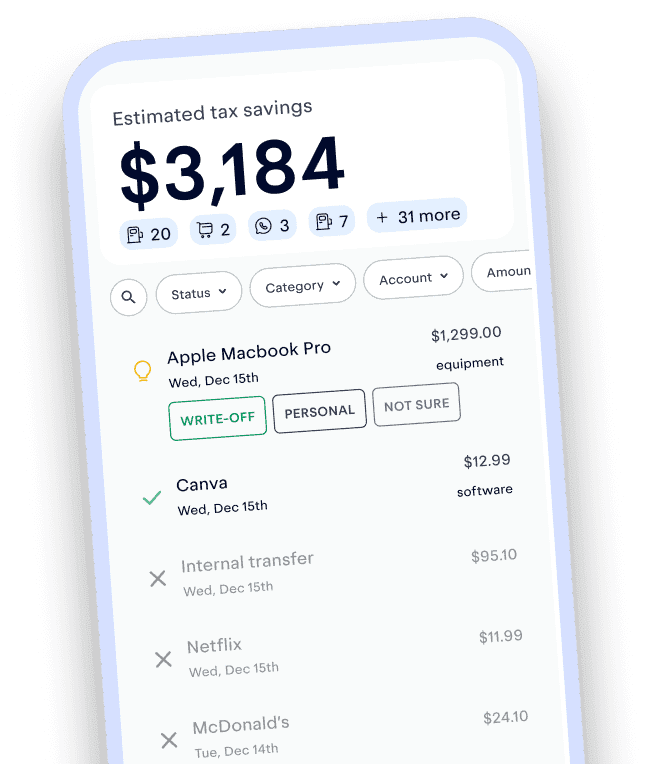
Track and claim every eligible deduction with Keeper
Keeper scans your accounts for write-offs and files your return — with tax pros reviewing every one.
Try it freeWhat happens when you sell the property?
This is the part that can lead to surprise tax bills.
When you sell a rental property, the IRS "recaptures" the depreciation you've taken over the years. For residential rental property, this is called unrecaptured Section 1250 gain, and it is taxed at a maximum federal rate of 25%, which is higher than the standard long-term capital gains rate of 0%, 15%, or 20%, but lower than ordinary income rates.
Let's see an example of this:
You purchase a rental property for $350,000 (building basis: $280,000) and hold it for 10 years.
You claim approximately $101,818 in total depreciation deductions.
Your adjusted basis is now $178,182.
You sell for $500,000, realizing a total gain of $321,818.
$101,818 of that gain is classified as unrecaptured Section 1250 gain, taxed at up to 25% ($25,454 federal tax).
The remaining $219,999 is a long-term capital gain, taxed at 0%, 15%, or 20% depending on your income. Additionally, if your income exceeds certain thresholds, a 3.8% Net Investment Income Tax (NIIT) may apply on top of these rates.
How do you defer or minimize recapture?
Method #1: Defer it with a 1031 like-kind exchange
A 1031 exchange lets you sell your rental property and roll the proceeds into a "like-kind" replacement property. This defers all depreciation recapture and capital gains taxes. To qualify, the replacement property must be of equal or greater value, and you must identify it within 45 days and close within 180 days of your sale. Done right, you can keep exchanging properties for decades and potentially eliminate the recapture liability entirely at death through a step-up in basis.
Method #2: Spread the sale proceeds over multiple years
This is what's known as an "installment sale". Instead of receiving the full sale price at closing, an installment sale lets you collect payments over several years, thus spreading your taxable gain (including recaptured depreciation) across multiple tax years. This can prevent a single large payout from pushing you into a higher bracket or triggering the 3.8% Net Investment Income Tax. Keep in mind that depreciation recapture is generally recognized in the year of sale first, before any remaining capital gain is spread out.
Method #3: Sell in a year where your income is lower
Since recaptured depreciation is taxed at a maximum federal rate of 25%, the overall tax hit is smaller when the rest of your income is low. If you plan to retire, take a sabbatical, or have a year where you can claim lots of deductions, you can strategically plan a sale during those years where your income is lower.
Method #4: Invest the gains in a Qualified Opportunity Fund
A Qualified Opportunity Zone Fund lets you defer capital gains taxes by reinvesting your gains (not the full sale proceeds) into a federally designated low-income community development fund within 180 days of the sale. If you hold the investment for at least 10 years, any appreciation on the QOZ investment itself becomes completely tax-free. Note that depreciation recapture is not eligible for QOZ deferral, so this strategy works best in combination with others to address the recapture portion separately.
At the end of the day, owning a rental property (or several!) is not for the faint of heart. It's often best to work with a tax professional to help you strategically unpack and apply the full tax benefits. The best advice we can offer is to consult a Keeper tax professional and file your taxes with Keeper to maximize your tax savings!

Over 1M Americans trust Keeper for their complex taxes
The #1 tax app for freelancers, gig workers, and self-employed filers.
Get started free


Krislyn is Chief Growth Officer at Keeper. At Keeper, she strives to make expert-level tax strategies that used to require a traditional CPA accessible to all. Prior to Keeper, she was at Curology, where she helped bring custom, prescription-grade skincare out of the dermatologist's office to millions of faces.
View full bio
a tax professional
This content has been reviewed by an Enrolled Agent (EA) with the IRS — the highest credential awarded by the agency. Enrolled Agents are empowered to represent all taxpayers before the IRS, on all types of tax-related matters. Accountants who earn this certification have passed a comprehensive three-part exam on individual and business tax returns. To maintain EA status, they must stay up to date in the field by completing 72 hours of continuing education every three years.
View full bio1 source
Keeper’s tax guides are built on primary sources: the tax code, IRS forms, instructions and publications, and state tax agency guidance. We link to external sources where appropriate and check figures against the tax year they apply to. This article was peer reviewed by a licensed tax professional (CPA or EA).
This article is for informational purposes only and isn’t tax, legal, or financial advice. Tax rules change and depend on your situation, so talk to a tax professional about yours.