
30 Tax Write-Offs for Landlords & Real Estate Investors
NAICS business codeYour NAICS business code is a six-digit string of numbers that shows the type of work your business does. NAICS stands for North American Industry Classification System. When you do your taxes, you'll enter it in Box B of your Schedule C.531100
 Reviewed bya tax professionalThis content has been reviewed by an Enrolled Agent (EA) with the IRS — the highest credential awarded by the agency. Enrolled Agents are empowered to represent all taxpayers before the IRS, on all types of tax-related matters. Accountants who earn this certification have passed a comprehensive three-part exam on individual and business tax returns. To maintain EA status, they must stay up to date in the field by completing 72 hours of continuing education every three years.
As a landlord, you understand the value of passive income and low-effort earnings. So you’ll love when we tell you that there’s a simple way to turn your business expenses into savings, without any extra effort on your part! Ready?
Simply write off the expenses your business runs into every day. By claiming the following write-offs for landlords, you’ll put those bills to work for you, making them earn their keep by lowering your overall tax bill. It’s the closest you can get to charging your expenses rent!
Fees you pay to get new tenants, like advertising or realtor commissions, can be deducted.
You can write off up to $2,500 for individual repairs to your property.
You can write off the property tax you pay on your investment properties.
The mortgage interest you pay each month for an investment property is considered a write-off.
Every year, you can write off the depreciation of your properties on your taxes.
Utility bills, like electricity, gas, and water for the property, can be written off.
Freelancers, contractors, or other services that help you run your business are tax-deductible.
If you pay a management company to take care of your property, you can write off their fees.
Do you pay a professional to audit your financial records and take care of your tax planning? Their fees are a write-off.
If you pay extra for a business bank account or business credit card, any interest or fees you incur can be written off.
Write off anything related to keeping your rental space safe and cozy!
You can write off lockboxes and spare keys you keep outside the property so people can check in without you there.
Insurance premiums for the property — including liability insurance — can be written off.
Loan-related fees, like credit checks and appraisals, can be tax write-offs.
If you drive for work ...
Landlords who use their car for work, like to show or visit a property, or to meet with a tenant, real estate agent, or property management company, can write off car expenses from their taxable income.
Parking for a meeting downtown, or any other work trip, is tax-deductible!
A toll while driving to or from a work destination is tax-deductible!
If you buy a new car, you can write off part of the cost every year for five years.
Flashlights, tire iron, duct tape, and other tools you may need in your vehicle are deductible.
Car insurance monthly fees, registration, even roadside assistance are partially deductible.
Oil changes, repairs, and regular checkups are all tax-deductible if you drive for work.
If you discuss work at a restaurant ...
The business meal deduction allows landlords to write off the cost of food or drink as long as they're bought for work purposes. So if you grab a coffee and muffin while chatting about potential partnerships with fellow landlords, mortgage brokers, real estate investors, or tenants, you can write it off.
If you discuss work with a coworker, mentor, client, or prospective client, it's a write-off!
If you leave town for work ...
Many costs associated with business trips are tax-deductible.
For instance, if you rent a car to visit an out-of-town property that needs repairs and need to spend a night in a hotel, you can write off the costs of both your transportation and lodging.
Planes, trains, and car rentals are all work-related travel costs that can be written off.
When you travel for work, lodging expenses such as hotel rooms or Airbnb are write-offs.
When you're traveling for work, all meals are tax-deductible. Even takeout!
If you work from home ...
If you regularly use a portion of your home for business, like to schedule property maintenance and repairs or to advertise vacant properties, you can write off home office expenses.
A desk, chairs, lamps, and other home office necessities are all tax write-offs.
You can write off up to $2,500 for individual repairs to your property.
Gotta keep the lights on in your home office! A portion of your electricity bill counts.
Whether it's rental or homeowners insurance, you can write off a portion through your home office deduction.
It'd be hard to work in an office without running water, huh? Your water bill counts.
Your Comcast bill is a tax write-off. You need internet to do your job!
You may also enjoy learning about ...

Do You Need To File a 1099 for Your Rental Property?
Rental properties come with lots of worries. Your 1099s shouldn’t be one of them. Our guide will tell you if you need to file them and who gets them.
 By Soo Lee, CPA
Will I Receive a 1099 for Rent? A Guide for Property Owners

Are Bank Fees Tax-Deductible? How To Save on Overdraft Fees and More

When Is Credit Card Interest Tax-Deductible? Quick and Easy Guide for Freelancers
The Last Schedule C Guide You'll Ever Need

How To File Your Self-Employment Taxes in 7 Easy Steps
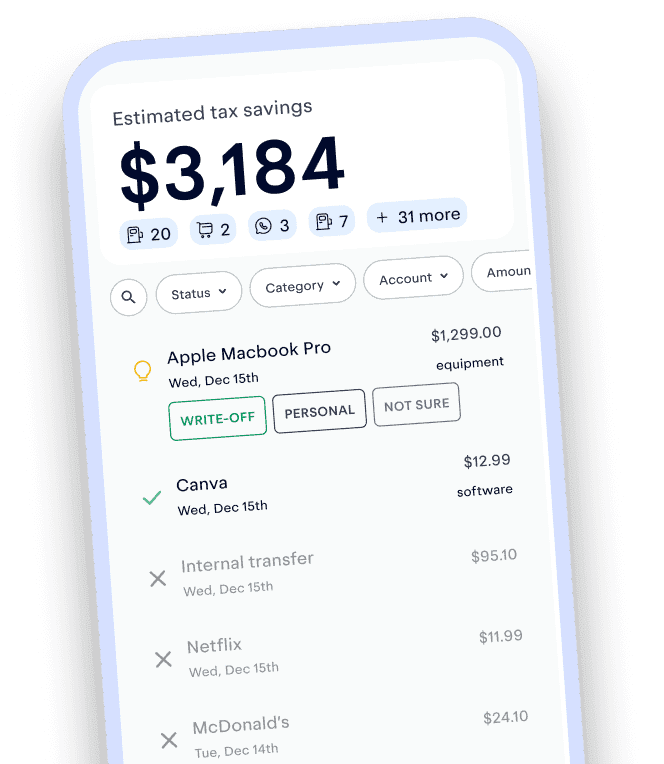
Track and claim every eligible deduction with Keeper
Keeper scans your accounts for write-offs and files your return — with tax pros reviewing every one.
Try it free