





Key takeaways
Schedule E is for passive rental income (most long-term landlords), and is not subject to self-employment tax.
Schedule C is for active business income (hotel-like rentals), and is subject to 15.3% self-employment tax. Losses can offset other income.
The IRS test: if your average rental period is 7 days or less AND you provide substantial services, you're Schedule C. Otherwise, stick with Schedule E.
The "short-term rental loophole" (using STR losses to offset W-2 income) requires Schedule C status + material participation.
If you own a rental property, chances are you'll have a host of tax questions running through your mind. Do you report income and expenses on Schedule C or E? If Schedule E, can you claim material participation without being a real estate professional? Do you depreciate your property over 39 years or should you do a cost segregation analysis to accelerate depreciation?
The list goes on and on. If you want a quick guide on tax strategies for buying and selling your rental property, check out our rental property tax guide here.
For the purposes of this quick read, let's focus on filing a Schedule C or Schedule E.
Most hosts default to Schedule E. But Airbnb-style short-term rentals can be a borderline case. Whether you belong on Schedule C or Schedule E comes down to two questions:
What's the average rental period?
Do you provide substantial services beyond what a landlord would do (for example: daily cleaning, concierge-level service)?
Schedule C or Schedule E... that is the question
Schedule E is for passive rental income. You own a property, someone rents it, you collect the checks. This describes long-term landlords and traditional residential rentals, and isn't subject to self-employment taxes.
Schedule C is for active business income. That means you're treating the rental property like an active business in which you are spending consistent time and providing services. In this case, the rental income is subject to self-employment taxes of 15.3%, and your business expenses are tax deductible.
Airbnb hosts can fall on either side of the coin. The IRS uses two tests to decide:
Test 1: Average rental period
If your average rental period is 7 days or less, the business activity could be presumed to be active, in which you're providing substantial services. This means filing a Schedule C.
Test 2: Substantial services
Even if your average rental is longer than 7 days, if you provide "substantial services" beyond what a landlord would (daily cleaning, meals, transportation, concierge service), you're Schedule C.
If neither test applies, you're Schedule E.
Schedule C or Schedule E quiz
Step 1: What's your average rental period in 2026?
Add up the total nights rented and divide by the number of distinct rentals.
If 7 days or less on average: Go to Step 2.
If between 8 and 30 days on average: Go to Step 3.
If 31+ days on average: Almost always Schedule E. Stop here.
Step 2 (average 7 days or less): Are you providing substantial services?
Examples of substantial services: daily cleaning during stay, meals, on-site concierge, transportation, organized activities or tours.
Examples of NOT substantial services: providing wifi and basic amenities, restocking toiletries between guests, leaving a coffee maker.
If yes (substantial services): Schedule C. Subject to SE tax. The IRS will treat this as a hotel-like business.
If no (no substantial services): Schedule E. Not subject to SE tax. Treated as a rental investment, even though stays are short.
Step 3 (average 8-30 days): Schedule E unless you provide substantial services.
If services are minimal, this is investment property income. If you're running cleaning between every short stay, providing on-property staff, or otherwise behaving like a hotel, Schedule C.
How Schedule C or Schedule E impacts taxes
Let's say Aidan owns one beach property he Airbnbs out, and the average stay is 4 nights. He does cleaning between guests (not during) and provides basic amenities, and earned $42,000 net profit.
If he files Schedule E, he pays federal income tax on $42,000 of rental income - no self-employment taxes.
If he files Schedule C, that $42,000 is considered business income, plus 15.3% self-employment tax. His SE tax bill = ~$5,940.
The Schedule E choice saves Maya about $5,940 in self-employment tax.
Conversely, if Maya wants to use the loss deduction strategy known as the "short-term rental loophole" (treating rental losses as active losses to offset other W-2 income), she needs Schedule C status, and that rental income would have to be considered active income.
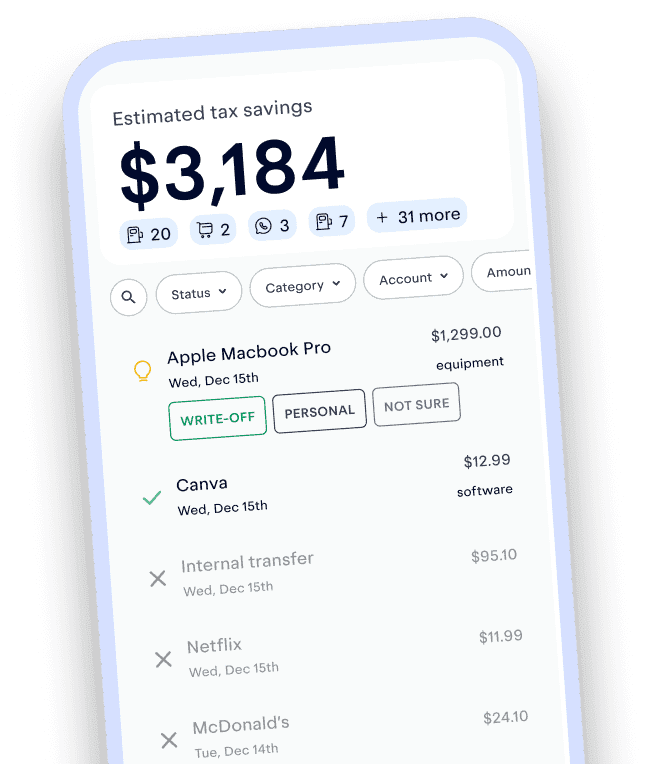
Track and claim every eligible deduction with Keeper
Keeper scans your accounts for write-offs and files your return — with tax pros reviewing every one.
Try it freeThe short-term rental loophole
The short-term rental (STR) loophole is a tax strategy that's been gaining some steam on social media for high W-2 income earners to offset their taxes.
It requires you to have a short-term rental (avg 7 days or less) where you "materially participate" (typically 100+ hours per year, and more than anyone else managing it). It's treated as a non-passive trade or business, meaning losses, including the substantial losses generated by cost segregation studies and bonus depreciation, can offset W-2 or active business income.
A long-term rental, by contrast, is considered passive income, and losses can only offset other passive income (this is rarely useful).
In 2026, with 100% bonus depreciation restored permanently by the OBBB, this strategy is even more powerful. A $400,000 property with 25% of value depreciable in year one (after a cost seg study) generates a $100,000 paper loss. Under the STR loophole, that $100,000 can offset W-2 income from a high-earning spouse, potentially saving $30,000+ in federal tax.
What counts as substantial services?
What counts as substantial:
Daily housekeeping during stays. (Not turnover cleaning between guests, but cleaning while the same guest is there.)
Meals served to guests. Even continental breakfast.
Concierge services. Booking activities, arranging restaurant reservations, providing transportation.
On-property staff during stays.
What does NOT count:
Wifi, cable, streaming subscriptions.
Cleaning between guests (turnover cleaning).
Stocking the kitchen with welcome snacks before arrival.
Providing welcome guides or local recommendations in writing.
A coffee maker, basic toiletries, and welcome amenities.
The IRS Notice 88-94 and various Tax Court cases have drawn this line pretty clearly. If you're doing what a typical Airbnb host does (turnover cleaning, sending a welcome guide, leaving a coffee maker), you're providing standard amenities, not substantial services. Don't lie about it, or you risk an audit!
Over 1M Americans trust Keeper for their complex taxes
The #1 tax app for freelancers, gig workers, and self-employed filers.
Get started free

FAQs
Probably Schedule E unless you're providing substantial services. Renting out a spare bedroom is generally treated as residential rental income.
That's Schedule C! You're providing a service (property management) for compensation, so that's considered self-employment income, and is subject to self-employment tax.
For high-income hosts using the STR loophole, be careful. The classification is a common audit topic, especially when paired with cost segregation. Keep records of average rental periods, materials and services provided, and time logs to prove material participation.
If your rental is on Schedule E, no. If it's on Schedule C with material participation, you might be able to claim a portion of the office space used to manage the rental.
Airbnb tax classification is one of those areas where the right answer can save you tens of thousands a year and the wrong answer can cost you about the same. Most casual hosts belong on Schedule E. Most active hosts who provide hotel-like services belong on Schedule C.

Krislyn is Chief Growth Officer at Keeper. At Keeper, she strives to make expert-level tax strategies that used to require a traditional CPA accessible to all. Prior to Keeper, she was at Curology, where she helped bring custom, prescription-grade skincare out of the dermatologist's office to millions of faces.
View full bio
a tax professional
This content has been reviewed by an Enrolled Agent (EA) with the IRS — the highest credential awarded by the agency. Enrolled Agents are empowered to represent all taxpayers before the IRS, on all types of tax-related matters. Accountants who earn this certification have passed a comprehensive three-part exam on individual and business tax returns. To maintain EA status, they must stay up to date in the field by completing 72 hours of continuing education every three years.
View full bioKeeper’s tax guides are built on primary sources: the tax code, IRS forms, instructions and publications, and state tax agency guidance. We link to external sources where appropriate and check figures against the tax year they apply to. This article was peer reviewed by a licensed tax professional (CPA or EA).
This article is for informational purposes only and isn’t tax, legal, or financial advice. Tax rules change and depend on your situation, so talk to a tax professional about yours.