
Tax Strategies for HENRYs and the Middle Class (2026 Guide)
It's no secret that when it comes to taxes, the middle class feels squeezed. That's because HENRYs (High Earners Not Rich Yet) and middle-class families pay the steepest effective tax rates in America. This guide covers 12 legal tax strategies, from Mega Backdoor Roths to the triple tax advantaged HSA, to help you save thousands on your taxes year after year.
 Krislyn ChanKrislyn is Chief Growth Officer at Keeper. At Keeper, she strives to make expert-level tax strategies that used to require a traditional CPA accessible to all. Prior to Keeper, she was at Curology, where she helped bring custom, prescription-grade skincare out of the dermatologist's office to millions of faces.
 Reviewed bya tax professionalThis content has been reviewed by an Enrolled Agent (EA) with the IRS — the highest credential awarded by the agency. Enrolled Agents are empowered to represent all taxpayers before the IRS, on all types of tax-related matters. Accountants who earn this certification have passed a comprehensive three-part exam on individual and business tax returns. To maintain EA status, they must stay up to date in the field by completing 72 hours of continuing education every three years.
If you earn between $100,000 and $500,000, you're in the highest-effective-tax-rate cohort in America. That means you're too rich for most credits, not rich enough for the loopholes wealthy families use. Yep, you're almost like that neglected middle child. Trust me, as a middle child, I know that feeling all too well.
However, all is not lost. That's what we at Keeper are here for: to help break down a set of strategies to save you thousands in taxes. From maxing tax-advantaged accounts, Mega Backdoor Roths, tax-loss harvesting, charitable bunching, and SALT-cap planning under the 2025 One Big Beautiful Bill Act (OBBBA), you'll be all the more equipped to lower your federal tax bill.
What is a HENRY and who counts as middle class?
"HENRY" stands for High Earner, Not Rich Yet. It's a term coined by Shawn Tully, of Fortune magazine in 2003 to describe professionals earning roughly $250,000–$500,000 per year who don't feel wealthy because student loans, high-cost-of-living cities, childcare, and lifestyle inflation eat most of their income. Sound familiar? Just scroll through TikTok and you're bound to see people talking about how they feel like they're living paycheck to paycheck.
The middle class is harder to pin down. Pew Research defines it as households earning roughly two-thirds to double the U.S. median income. If you're curious, try out their income calculator to see where you stand.
Why HENRYs and the middle class pay the highest effective tax rates
Three reasons:
W-2 income is taxed the hardest. Wages face ordinary income tax (10–37%) plus FICA (7.65%), whereas capital gains, dividends, and pass-through business income are taxed far more favorably.
Most tax credits phase out at HENRY income levels. Child Tax Credit, education credits, the Saver's Credit, and direct Roth IRA contributions all phase out somewhere between $100K and $250K. Tough luck.
You're too rich for "free money," too poor for sophisticated planning. Wealthy families pay tax pros six figures a year to optimize. Most middle-class and HENRY households DIY their taxes and miss the moves below.
12 tax strategies for HENRYs and middle-class earners in 2026
1. Max out your 401(k) and check if your plan allows a Mega Backdoor Roth
For 2026, the 401(k) employee contribution limit is $24,500 (under 50) or $32,500 with the standard catch-up if you're 50+. OBBBA added an enhanced super catch-up of $11,250 for ages 60–63 in employer-sponsored plans.
If your employer plan allows after-tax contributions and either in-plan Roth conversions or in-service distributions, you can stuff up to $70,000 total into the account in 2026. Cue the so-called Mega Backdoor Roth.
Keeper pro tip: Email your benefits team: "Does our 401(k) allow after-tax contributions beyond the employee deferral, and does it support in-plan Roth conversions or in-service distributions to a Roth IRA?" If both answers are yes, you can convert up to $35,000–$40,000 per year into a Roth bucket with no income limit.

Over 1M Americans trust Keeper for their complex taxes
The #1 tax app for freelancers, gig workers, and self-employed filers.
Get started free

2. Backdoor Roth IRA
Direct Roth IRA contributions phase out at $165,000–$175,000 (single) and $246,000–$256,000 (MFJ) for 2026. Above those limits, the Backdoor Roth is the workaround:
Contribute $7,500 ($8,500 if 50+) to a traditional IRA with after-tax dollars (no deduction).
Convert that contribution to a Roth IRA shortly after.
File Form 8606 to track basis.
Watch out for the pro-rata rule: if you have any pre-tax money in traditional, SEP, or SIMPLE IRAs, the conversion is partially taxable. Make sure to roll those balances into your current 401(k) first if your plan accepts incoming rollovers.
3. Contribute to an HSA (it's triple tax advantaged!)
A Health Savings Account beats every other account on paper: contributions are pre-tax, growth is tax-free, and withdrawals for qualified medical expenses are tax-free. And there are no income limits!
2026 limits: $4,400 (self-only), $8,750 (family), plus a $1,000 catch-up at 55+. There's a catch: you need a high-deductible health plan (HDHP) to be eligible.
Keeper pro tip: Pay current medical bills out of pocket, save the receipts, and let the HSA grow invested for decades. After 65, you can withdraw for any reason at ordinary income rates (like a traditional IRA), but you keep the option to reimburse old medical receipts tax-free anytime.
4. The new $40,000 SALT cap (and how to actually use it)
OBBBA temporarily raised the State and Local Tax (SALT) deduction cap from $10,000 to $40,000 for tax years 2025–2029. The cap applies to all filing statuses (MFS at $20,000) and phases down to $10,000 as your MAGI exceeds $500,000 (the cap is reduced by 30% of every dollar over $500K, with a floor of $10K).
If you live in a high-tax state (CA, NY, NJ, IL, MA, CT, OR, MD) and you itemize, this is a major win. Stack it with mortgage interest, charitable giving, and medical expenses to clear the standard deduction ($16,100 single / $32,200 MFJ for 2026) and capture deductions you couldn't before.
5. Tax-loss harvesting
If you have taxable brokerage accounts, you can sell positions at a loss to offset capital gains plus up to $3,000 of ordinary income per year. Unused losses carry forward indefinitely.
HENRYs with $250K+ in taxable accounts should look at direct indexing (Frec, Wealthfront, Fidelity, Schwab Personalized Indexing). Instead of owning an S&P 500 ETF, you own the underlying 500 stocks individually, which gives you 500 opportunities a year to harvest losses.
6. Charitable bunching with a Donor-Advised Fund
If your annual charitable giving is, say, $10,000, you're probably not exceeding the standard deduction, so those gifts give you zero federal tax benefit.
But here's what you can do instead. Bunch 3–5 years of giving into one tax year via a Donor-Advised Fund (Fidelity Charitable, Schwab Charitable, Vanguard Charitable). You deduct the lump sum the year you fund the DAF, then grant it out to charities on your own timeline. Donating appreciated stock instead of cash is even better, as you avoid the capital gains tax and deduct the full fair-market value.
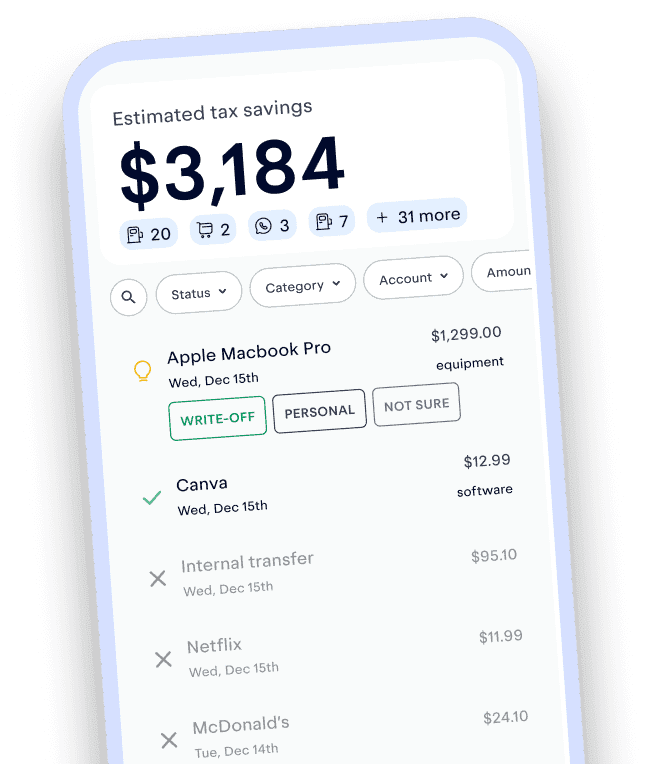
Track and claim every eligible deduction with Keeper
Keeper scans your accounts for write-offs and files your return — with tax pros reviewing every one.
Try it free7. Qualified Charitable Distribution (QCD) if you're 70½+
If you're at least 70½, you can donate up to $108,000 per year (2025 limit, indexed) directly from your IRA to charity via a Qualified Charitable Distribution. The distribution doesn't count as taxable income, which is more valuable than an itemized deduction for most people, because it lowers your AGI and helps with Medicare IRMAA brackets, Social Security taxability, and net investment income tax.
8. QBI deduction (if you have any 1099 income)
If you have side income from consulting, freelancing, an LLC, or a rental treated as a trade or business, you may qualify for the Section 199A Qualified Business Income (QBI) deduction, which is a 20% deduction on net business income. OBBBA made the QBI deduction permanent.
For 2025, the deduction starts phasing out at $241,950 (single) / $483,900 (MFJ) for Specified Service Trade or Business (SSTB) income, such as lawyers, doctors, accountants, consultants, financial advisors. For non-SSTB businesses, wage/property limits kick in at the same thresholds, but you can still capture the deduction.
For HENRYs with a W-2 plus a side hustle, route legitimate business expenses (home office, equipment, professional development) through the side business to lower QBI-eligible income strategically. See our Schedule C guide for what counts.
9. 529 plans and Trump Accounts for kids
Two stacks of tax-advantaged savings for parents:
529 plans: You don't get a federal deduction, but many states offer one (NY $10K, IL $10K, MD $2,500). Growth is tax-free for qualified education expenses. As of 2024, unused 529 funds can roll into the beneficiary's Roth IRA up to $35,000 lifetime, subject to annual Roth limits.
Trump Accounts: Created by OBBBA, kids born 2025–2028 get a $1,000 federal seed deposit, and parents can contribute up to $5,000/year that grows tax-deferred. See our full Trump Account guide to learn more.
10. Real estate: depreciation, 1031 exchanges, and the short-term rental loophole
If you own a rental property, depreciation can shelter rental income from tax. For HENRYs with a short-term rental where the average stay is under 7 days and you materially participate, depreciation losses can offset W-2 income. That's what the so-called "STR loophole" is. It's a hack used heavily by HENRYs running Airbnbs.
Cost segregation studies accelerate depreciation, which is especially valuable now that 100% bonus depreciation is back permanently under OBBBA for property acquired and placed in service after January 19, 2025.
A 1031 exchange lets you defer capital gains when you sell investment real estate by rolling the proceeds into another like-kind property within 180 days.
11. Open a Solo 401(k) or SEP IRA if you have self-employment income
If you have any self-employment or 1099 income, you can open a Solo 401(k) and contribute up to $70,000 in 2026 (or $77,500 if 50+) as both employee and employer. This stacks on top of your day-job 401(k) employee deferral limit.
A SEP IRA is simpler (no plan document, no compliance testing) but caps lower and offers no Roth option in most cases. For most freelancers with consistent income, the Solo 401(k) wins.
12. Roth conversions in a low-income year
If you have a sabbatical, a layoff, a startup year before equity vests, or you retire early, your effective tax rate may dip below your future expected rate. That's the time to convert traditional IRA / 401(k) balances to Roth. Pay tax on the conversion now at the lower rate, then never pay tax on growth or withdrawals again.
Quick reference: which strategies fit your income band
Strategy | Middle Class ($80K–$200K) | HENRY ($200K–$500K) |
|---|---|---|
Max 401(k) + employer match | Yes — top priority | Yes — table stakes |
HSA (with HDHP) | Yes | Yes |
Direct Roth IRA | Yes, under phase-out | No — use Backdoor |
Backdoor Roth | Only if above phase-out | Yes |
Mega Backdoor Roth | If plan allows | Yes — highest priority |
$40K SALT cap | If itemizing | Yes, if MAGI < $500K |
Tax-loss harvesting | If taxable brokerage | Yes |
Direct indexing | Account minimums often too high | Yes, $250K+ accounts |
DAF charitable bunching | If giving $10K+/yr | Yes |
QBI deduction | If side hustle | If non-SSTB / phase-out math works |
Solo 401(k) / SEP IRA | If any 1099 income | If any 1099 income |
529 + Trump Account | If a parent | If a parent |
STR / cost seg | If rental property | If rental property |
Roth conversions | In low-income years | In low-income years |
FAQs
What is a HENRY?
A HENRY ("High Earner, Not Rich Yet") is a household earning roughly $250,000–$500,000 per year that doesn't feel wealthy due to student loans, high cost of living, childcare costs, and a limited net worth. The term was coined by Fortune magazine in 2003 and refers to a growing demographic of professionals (doctors, lawyers, tech workers, finance employees) whose income looks high on paper but whose savings rate often lags.
What's the best tax strategy for someone making $200,000?
At $200K, the highest-impact moves are (1) maxing your 401(k) to $24,500, (2) funding an HSA to $4,400 or $8,750 if you have an HDHP, (3) using the new $40K SALT cap if you live in a high-tax state and itemize, and (4) checking whether your 401(k) allows a Mega Backdoor Roth. Together, these can lower your taxable income by $40,000–$80,000.
Can HENRYs use traditional IRAs?
You can contribute to a traditional IRA, but if you're covered by a workplace retirement plan and earn above $96,000 single / $151,000 MFJ in 2026, your contribution isn't deductible. Most HENRYs use the Backdoor Roth instead.
What's the difference between a Backdoor Roth and Mega Backdoor Roth?
A Backdoor Roth moves $7,500/year through a traditional IRA into a Roth IRA. A Mega Backdoor Roth moves up to $35,000+/year through after-tax 401(k) contributions into a Roth, but only if your employer's 401(k) plan supports after-tax contributions and in-plan Roth conversions (or in-service distributions).
Do I need an accountant if I'm a HENRY?
For income above $250K with multiple income streams (W-2 + 1099 + RSUs + rental, etc.), the answer is usually yes. The cost ($1,500–$5,000/year for a competent CPA) is typically a fraction of the savings from a good strategy. Alternatively, Keeper combines AI tax planning with on-demand CPA access at a much lower price point.
Are there income limits for an HSA?
No. Unlike Roth IRAs and many credits, HSAs have no income phase-out. The only requirement is that you're covered by a qualifying high-deductible health plan (HDHP) and not enrolled in Medicare.
How can a middle-class family lower their tax bill?
Focus on the basics first: max your 401(k) match, contribute to an HSA if eligible, claim the Child Tax Credit ($2,200/child for 2025), use the Saver's Credit if your AGI is under $77,500 MFJ, and check your state for property tax and mortgage interest deductions. If you have any 1099 income, the QBI deduction adds up fast. Stacking 3–4 of these is often the difference between owing the IRS in April and getting a refund.
Is itemizing worth it for HENRYs in 2026?
More often, yes. Thanks to the new $40,000 SALT cap. If you live in a high-tax state and pay a mortgage, your combined SALT + mortgage interest alone often exceeds the 2026 standard deduction ($32,200 MFJ). Add charitable giving and unreimbursed medical expenses above the 7.5% AGI floor, and itemizing usually wins.
What is the 2026 tax bracket for HENRYs?
Most HENRYs fall in the 24%, 32%, or 35% federal marginal bracket. For a single filer in 2026, the 32% bracket runs roughly $202,000–$257,000 and the 35% bracket runs $257,000–$642,000. Add state tax and 7.65% FICA (plus 0.9% additional Medicare tax above $200K single / $250K MFJ) for your full marginal cost.
Disclaimer: This article is for informational purposes only and does not constitute tax, legal, or investment advice. Tax laws are subject to change and individual situations vary. Consult a qualified CPA or tax advisor for guidance specific to your situation.
Read next

 By Krislyn Chan
Krislyn is Chief Growth Officer at Keeper. At Keeper, she strives to make expert-level tax strategies that used to require a traditional CPA accessible to all. Prior to Keeper, she was at Curology, where she helped bring custom, prescription-grade skincare out of the dermatologist's office to millions of faces.
View full bio