






Key takeaways
Freelancers, independent contractors, and small businesses can deduct car expenses, either using the standard mileage rate or actual expenses method.
The standard mileage rate is the simplest approach: just multiply business miles driven by the IRS mileage rate for the tax year. For 2026, it's 72.5 cents per mile for miles driven January 1 through June 30 and 76 cents per mile for miles driven July 1 through December 31.
The actual expenses method requires tracking your costs (gas, repairs, car washes, insurance, etc.), then applying the business-use percentage (business miles divided by total miles).
Keeper's free mileage vs actual expenses calculator can help you compare which method could net you a bigger deduction.
You must keep an accurate record of mileage, receipts, and business purpose to substantiate deductions.
If your freelancing, 1099 contracting, or small business involves driving, then you can claim car-related tax write-offs. Owning a car isn’t cheap, so this move can provide a significant source of tax deductions.
Who can deduct car expenses?
You don’t have to be a rideshare driver or a self-employed traveling salesperson to claim car-related tax deductions. Even if you work primarily from a home office, the occasional supply run or client meeting downtown counts.
You also don’t need to drive year-round. If you only drive for work during the summer, you can still write off car expenses during those months. One important catch: these write-offs are for self-employed people. If you're a W-2 employee, you generally can't deduct car expenses your employer doesn't reimburse, even if the job requires you to drive.
"Commuting" doesn't count
According to the IRS, "commuting" doesn't count as driving for work.
What does that mean? For the IRS, "commuting" is any driving you do between your home and your regular place of work, like an office or a coworking space.
If you have a home office that is your principal place of business, however, any driving to and from work-related meetings and errands counts! That means you use the space regularly and only for work, and it's where you run your business. If you don't have a home office that qualifies, your first drive of the day and your last drive home are usually commuting, but the drives between work stops in the middle still count.
How to write off car expenses
There are two ways to claim car-related write-offs: the standard mileage method, where you multiply your work miles by an IRS rate, or the actual expenses method, where you write off a percentage of all your car expenses (gas, maintenance, insurance, depreciation, etc.). Both methods require a mileage log.
Standard mileage method
With this method, you keep track of how many miles you actually drive for work. Then, you multiply each mile by a standard amount set by the IRS.
The rate usually changes every year. For 2026, it's 72.5 cents per mile for miles driven January 1 through June 30 and 76 cents for miles driven July 1 through December 31 (that's up from 70 cents in 2025).
The IRS has offered this option for decades. It was intended to simplify the recordkeeping process of tracking car expenses. In the old days, after all, you'd have to go through the hassle of saving and adding up paper receipts (🤮) for everything you spent on your car.
These days, though, modern tools (like Keeper!) allow you to scan and categorize your credit card transactions automatically. That makes the actual expenses method a lot more convenient, and it can add up to more tax savings, especially if your car is expensive to own and you don't drive it much. You'll still need a mileage log either way.
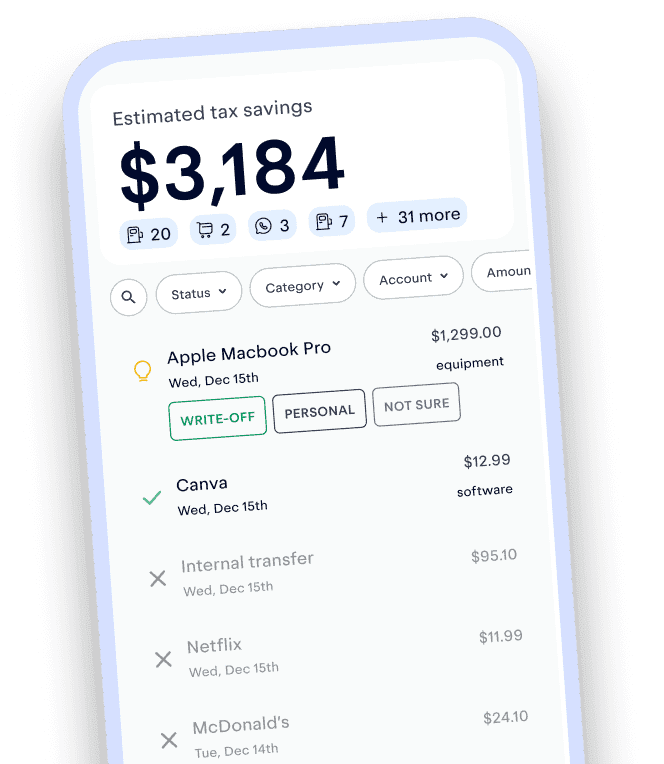
Track and claim every eligible deduction with Keeper
Keeper scans your accounts for write-offs and files your return — with tax pros reviewing every one.
Try it freeActual expenses method
Instead of claiming a set amount for each mile you drive, you deduct a percentage of all your car-related expenses. This is called your “business-use percentage”: the miles you drove for work divided by all the miles you drove that year. You'll need a mileage record supporting the percentage, so you'll still be tracking miles when using the actual expenses method.
What's better: Standard mileage or actual expenses?
Honestly, it depends on your particular situation.
One important thing to know before you pick: your first-year choice matters. If you own the car and want the option of using the standard mileage rate, you have to use it in the first year you use the car for work. After that, you can switch between methods from year to year. But if you start with actual expenses, you can't switch that car to the standard mileage rate later. And if you lease, choosing the standard mileage rate means sticking with it for the entire lease, including renewals.
Generally speaking, claiming actual expenses tends to result in a bigger tax break when your car is newer or expensive to own and you don't put many miles on it. The standard mileage rate tends to win when you drive a lot in an older or fuel-efficient car.
Here are some situations where the standard mileage method might be better for you:
You drive a lot for work (something like over 30,000 miles per year). If your work is something that requires you to be constantly on the road, like rideshare or truck driving, then the standard mileage rate might get you a bigger tax deduction. (Uber and Lyft track some miles for you, but generally not all of them.) You might also drive a lot if you live and work in a rural area, and your worksites are further apart than people typically see in the city.
You drive an electric vehicle. Since you don’t spend money on gas with an electric car, it’s likely that the standard mileage deduction will get you a bigger tax break. That said, many electric cars are expensive to buy, insure, and maintain. So actual expenses might still win.
The actual math is complicated, and it depends on lots of different factors. Check out our detailed breakdown for more examples. To compare both methods with your own numbers, try our mileage vs. actual expenses calculator.
Which car-related expenses can I write off?
There are two types of car expense write-offs: expenses you can only deduct with the actual expense method, and expenses you can deduct with both methods.

What you can write off with the actual expenses method
These expenses replace the mileage-based deduction you take with the standard mileage method.
⛽ Gas
☂️ Insurance
🔧 Maintenance
🏷️ Cost of the car (via depreciation)
If you own your car, you can't write off the car payments themselves. Instead, you write off the business share of the car's cost over several years (this is called “depreciation”), whether you paid cash or took out a loan. If you took out a loan, the business share of the interest is deductible, too. Even if you bought it a few years ago, you can still write off a portion of the car's cost. The IRS caps how much car depreciation you can take each year, and the faster write-offs (Section 179 and bonus depreciation) only work if you use the car more than 50% for work.
What you can write off with both methods
Even if you go with the standard mileage method, you can claim these deductions on top.
🅿️ Parking
🛂 Tolls
💳 Car loan interest (the business share, if you're self-employed)
Calculating your business-use percentage
If you go for the actual expenses method, you’ll have to determine your business-use percentage. To figure this out, you divide the miles you drove for work by all the miles you drove during the year, including personal errands and commuting. The IRS doesn't accept estimates here, so you'll need a mileage record to back it up.
For example, say you typically drop off your kids at school in the morning and then use the car for work errands and meetings throughout the day. If your mileage log shows 9,000 work miles and 3,000 personal miles for the year, your business-use percentage is 75%.
Just like the mileage deduction, you need records supporting your claim. Keep a mileage log regardless of which method you choose. For each work trip, write down the date, the miles, and the business reason (where you went and why), and note your odometer reading at the start and end of the year.
At tax time, car expenses go on Schedule C, line 9. If you use the actual expenses method, depreciation goes on line 13 and lease payments go on line 20a. You'll also report how many business, commuting, and personal miles you drove that year, and whether you have written evidence to back them up (on Schedule C, or on Form 4562 if you're claiming depreciation).

Krislyn Chan is a consumer subscription growth leader who has spent her career making premium services affordable and accessible. As Chief Growth Officer at Keeper, she drives growth for a platform that pairs AI with licensed tax professionals to help self-employed people keep more of what they earn. She has written more than 50 Keeper guides on tax strategy for freelancers, independent contractors, and small business owners. Previously, Krislyn was at Curology, where she helped turn dermatologist-grade custom skincare into a direct-to-consumer subscription used by millions.
View full bio
Scott Levy grew up in Miami, Florida, the son of a CPA and Tax Attorney. You could say taxes were in his blood. He's been a licensed CPA since 2011 with a Bachelors in Accounting, and a Master's in Applied Economics and Data Intelligence. Over the years, Scott has worked with a large variety of clients from different walks of life. From bartenders to CEOs, Scott has helped them all maximize their tax savings and plan for their futures.
View full bio4 sources
Keeper’s tax guides are built on primary sources: the tax code, IRS forms, instructions and publications, and state tax agency guidance. We link to external sources where appropriate and check figures against the tax year they apply to. This article was peer reviewed by a licensed tax professional (CPA or EA).
This article is for informational purposes only and isn’t tax, legal, or financial advice. Tax rules change and depend on your situation, so talk to a tax professional about yours.