






Key takeaways
Buying a car for business use lets you deduct certain costs, but you generally can’t write off the entire purchase price in one year. If the vehicle is used more than 50% for business, you may be able to deduct part of its cost through depreciation, including Section 179, subject to IRS limits. You can also deduct the business portion of loan interest and ongoing vehicle expenses. When claiming car deductions, you must choose either actual expenses or the standard mileage rate — you can’t use both for the same vehicle.
Buying a new car is a giant expenditure. More likely than not, you’ll be planning to use your new vehicle for personal and business purposes. The IRS took that into consideration when they made the rules for deductions on cars you purchase for work.
If you're an independent contractor or small business owner looking to buy a new or preowned car to use for work, pay close attention. In this article, we'll go over how to save money on your tax bill when you purchase a new car.
Can you write off a car as a business expense?
You technically can't write off the entire purchase of a new vehicle. However, you can deduct some of the cost from your gross income.
The amount you can deduct depends on:
How much you use your car for business
The vehicle's weight
Whether you deduct actual expenses or use the standard mileage rate
Pro tip: There are also plenty of other expenses you can deduct to lower your tax bill, like vehicle sales tax and other car expenses.
Deducting vehicle costs with Section 179
Section 179 of the IRS tax code allows business owners and self-employed individuals to write off certain assets faster than normal depreciation rules. It was designed to be an incentive for business owners to buy equipment and invest in themselves. To use it, the IRS usually requires the cost of the property to be capitalized and depreciated — more on that below.
To qualify for Section 179, your vehicle has to meet the following requirements:
Be new or pre-owned
Be financed and used for business before December 31
Be used for business at least 50% of the time
The deduction limit is determined by the gross vehicle weight rating (GVWR).
For lighter vehicles (<6,000 GVWR), the maximum first-year deduction is $20,400 (including bonus depreciation, aka the special depreciation allowance).
For heavy SUVs and trucks (6,000-14,000 GVWR), the Section 179 deduction is capped at $31,300 in 2025. Plus, you can deduct up to 40% of the vehicle's purchase price in 2025 with bonus depreciation.
Note: You can only deduct the business-use percentage of the car's cost. So if you use your car for work 70% of the time, you can deduct 70% of the cost.
What's the difference between Section 179 deduction and bonus depreciation?
While section 179 allows you to deduct a set dollar amount, bonus depreciation lets you deduct a fixed percentage of the vehicle's cost.
The OBBB has set bonus depreciation at 100% for qualifying property placed in served on or after Jan 20, 2025. That means you can deduct the full cost of a qualifying vehicle!
Pro tip: You can take the section 179 and bonus depreciation in the same year!
As a business owner, gig worker, or self-employed person, you'd use Form 4562 to report your Section 179 deductions.
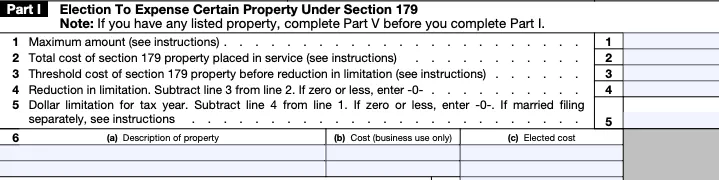
There's one important thing to keep in mind: to deduct vehicle depreciation, you'll have to forgo the standard mileage deduction. More on that later!
How depreciation works under Section 179
Before, when you purchased an item that qualified as a write-off, you'd only be able to write off a portion of the cost every year.
Section 179, however, lets business owners and self-employed people write off the entire purchase price of qualifying equipment in the one tax year. (This goes for business assets like company machinery, furniture, and even computers as well as cars.)
Naturally, business owners would much rather deduct the cost of the expense in the year they buy.

Sign up for Tax University
Get the tax info they should have taught us in school.
Deducting car sales tax
You can only take this depreciation deduction if you use your car for business. But whether or not you bought it for work, there are certain other costs you can deduct, like the sales tax you paid on it.
Writing off vehicle sales tax as a business expense
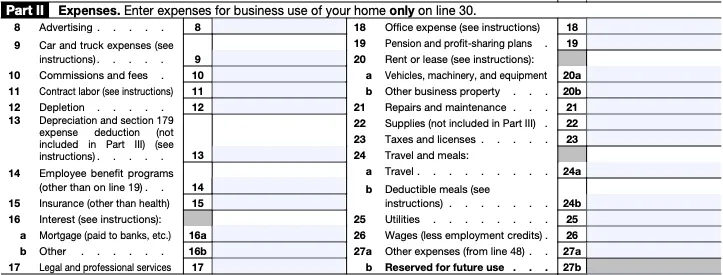
If you drive your new car for work, you can deduct the sales tax you pay on it using Schedule C. Just put down the amount you paid on line 23.
Writing off vehicle sales tax as an itemized personal deduction
There's an alternative way to write off your vehicle sales tax. You can't use this method if you deduct it on Schedule C — you'll have to pick one or the other.
If you itemize your personal deductions, you can write off the state and local sales taxes paid on the new car. (Note that, in some states, your vehicle purchase won't come with a sales tax. These are Alaska, Delaware, Montana, New Hampshire, and Oregon.)
Alternatively, you can deduct the income taxes you paid for the year. You'll have to select one option, because you can’t take both.
You report these deductions on Schedule A, an income tax form that you use to report your tax-deductible personal expenses.
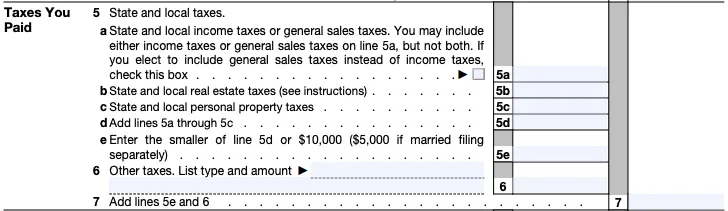
Schedule A also lets you write off your tag registration, or vehicle property tax. What you're deducting is the ad valorem tax, which takes the place of sales tax when it comes to vehicle registration. The amount of your ad valorem tax is based on the value of a transaction or of property,
In total, your deduction of state and local income, sales, and property taxes is limited to $10,000.
Deducting interest for financed vehicles
When you finance a new vehicle that you intend to use for work, you can't deduct the entire monthly bill from your taxes. However, you can write off part of your car loan interest.
Remember, you can only deduct the business-use percentage of your car. So if you use your car for work 70% of the time, you can write off 70% of your vehicle interest.
To write off your car loan interest, you'll have to deduct actual car expenses instead of the standard mileage rate.

Other vehicle tax deductions
If you drive for work, you'll be spending money on your car long after you've finished paying it off. Gas, insurance, and repairs — all of that adds up.
Luckily, there are two IRS-approved methods for deducting car expenses: actual car operating expenses and the standard mileage rate. You can find both deductions on your Schedule C, used for reporting business expenses.
You'll have to choose between the two methods, since you can't use both at once.
Deducting actual car expenses
The actual expenses for using your vehicle include costs like gas, miles, insurance, repairs, and maintenance, like oil changes and tire rotations.
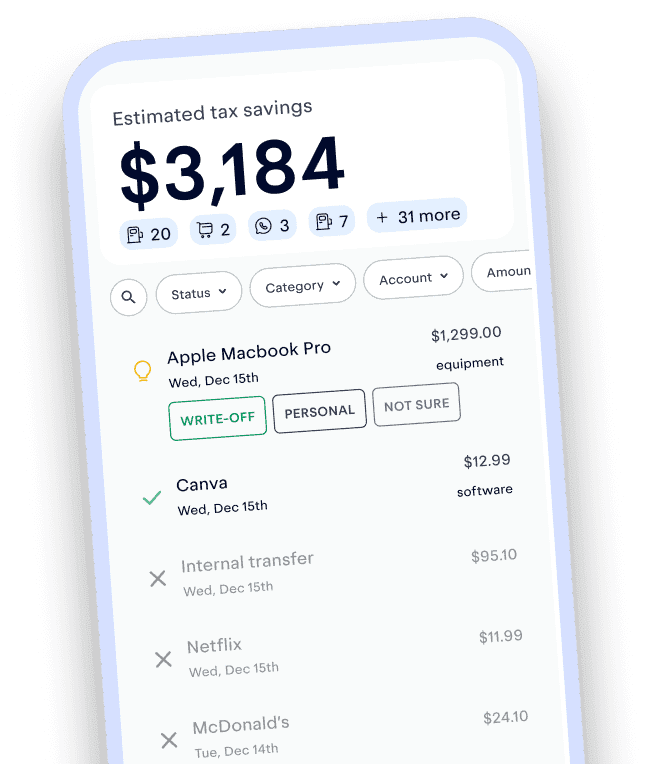
Although those expenses may not seem like a lot, the total costs can add up quickly. We recommend using Keeper, our expense tracker app, to keep track of what you spend on your car.
Track and claim every eligible deduction with Keeper
Keeper scans your accounts for write-offs and files your return — with tax pros reviewing every one.
Try it freeDeducting car expenses based on mileage
The standard mileage rate is an IRS-determined rate that a taxpayer can use to write off all the miles they drive for business purposes. Tracking your miles for taxes will work in your favor if you drive a lot over the course of your work.
Here is an example of how the flat rate works. The standard mileage rate for 2026 is $0.725 per mile for the first half of the year and $0.76 for the second half. To find your deduction, you'll simply multiply the standard mileage rate by the number of business miles you drove during the year. If you drove 5,000 business miles in the first half of 2026, for instance, multiply 5,000 x 0.725 = $3,625.
Remember: If you take the standard mileage deduction, you won't be able to write off either vehicle depreciation or the interest payments on your auto loan.

Keeper Office Hours
Got a tax question, a confusing expense, or something you're stuck on in Keeper? Join a live, open Q&A with a Keeper expert. Submit your question ahead of time or ask it during the session. No presentation. No lecture. Just answers.

As an Accountant/Tax Professional Tanaka Martin knew her place was helping small businesses. So she works as a freelancer preparing bookkeeping & taxes. Her spare time is spent teaching tax preparation and relaxing on a pier fishing.
View full bio2 sources
This article is for informational purposes only and isn’t tax, legal, or financial advice. Tax rules change and depend on your situation, so talk to a tax professional about yours.