
Is Your Car Lease Payment a Tax Write-Off?
There are many advantages to leasing your car, and your tax bill is one of them. Learn the different ways to write off your monthly lease payment at tax time.
 Keeper StaffKeeper is a delightfully smart tax filing software that's especially useful for people with 1099 contracting and freelance income. Our blog breaks down IRS guidance with real-world examples and analysis by tax professionals — empowering taxpayers to save money and take control of their finances.

Can you write off a car lease?
Yes! The IRS includes car leases on their list of eligible vehicle tax deductions. If you're a self-employed person or a business owner who drives for work (or rents out your car on a platform like Turo), your lease is fair game.
Many people incorrectly assume that car write-offs only extend to cars that you own, but a leased car fits the bill as well.
How much of a car lease can you write off?
This is where things get tricky. If you use your car 100% of the time for business purposes, you can take the whole thing. However, most of us don’t have a car that’s exclusively for work. So we have to take some extra steps.
Finding the business portion of your leased car
The portion of your lease that’s eligible to be written off is what’s called the “business portion.” To determine the business portion, you need to tally up your driving mileage and figure how much was for work and how much was for personal use, like late-night trips to Taco Bell.
Point is, figure out the split between your work and personal mileage. From there, divide your business miles by the total mileage for the year.
For example, say you drove 12,000 miles in a tax year, and 8,000 of those were for work:
Business mileage: 8,000
Personal mileage: 4,000
Total mileage: 12,000
So the business portion of your lease is 66%, because 8,000 ÷ 12,000 = 0.66.
How do I write off my car lease?
There are two basic options for writing off your lease: the actual expense method and the standard mileage rate.
Using actual expenses
This method is exactly what it sounds like: your actual auto expenses. Remember the calculation we just discussed? You’d multiply that percentage by what you actually paid on your car expenses.
Your car lease isn’t the only expense you can claim under this method. Other possible write-offs include fuel, insurance, oil changes, and repairs. If you drive for Uber or Lyft, any costs related to making your ride more “passenger-friendly” would qualify. This includes things like air fresheners, car washes, seat covers, and car organizers.
One thing to note: If you’re leasing the vehicle, you can’t claim a depreciation deduction on it. Depreciation is only allowed on vehicles you own.
Just like with mileage, you'll want to keep records of how you use your vehicle.
Using the standard mileage deduction
Every year the IRS releases a mileage “rate” that is intended to reflect the overall cost of operating a vehicle — the same costs you would claim under the “actual” method, like gas and repairs.
For 2043, the standard mileage rate is $0.67 — 67 cents — per mile.
Calculating your total mileage deduction
Let's say your total business mileage for the year is 8,000 in 2023. You'll multiply that number by the standard mileage rate: 0.67. 8000 x 0.67 = $5,360
Which method is better?
As a general rule, if you rack up a lot of miles driving for work, the mileage method will probably result in a higher write-off. If you drive a moderate amount for work, deducting actual expenses will probably save you more.
Be aware that if you use mileage one year on your leased vehicle, you can’t switch to actual costs the next year. You’re locked into whatever method you choose for the entire lease period — including any renewals.
Knowing this, carefully consider which option would be most advantageous to you before deciding.

Sign up for Tax University
Get the tax info they should have taught us in school.
Deducting sales tax on a car lease
The sales tax included in your lease payment also counts as business expense. It’s often included in the monthly cost of the lease, and it should be broken out on all your statements.
There are two ways to write off sales tax.
Writing off your sales taxes as a business expense
The business portion of your tax can be included as a write-off against your business income. You’ll include it on your Schedule C — under line 9 for “Car and Truck Expenses” — with your other auto expenses.
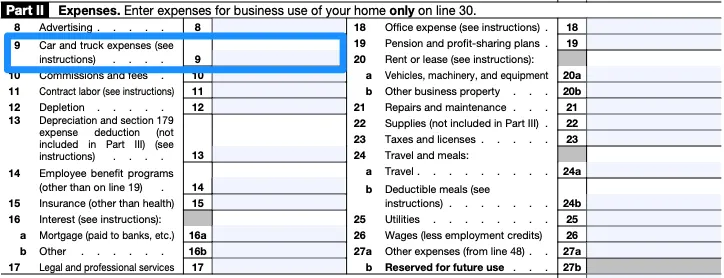
The same rules apply here as with the lease itself: only the business portion of the tax can be written off. The rest of it can be claimed in your itemized deductions.

Claiming your sales tax as an itemized personal deduction
If you itemize your personal deductions, you can include sales tax on your Schedule A. The IRS even has a nifty sales tax calculator to determine whether your actual sales taxes are higher than the approximate deduction granted automatically.
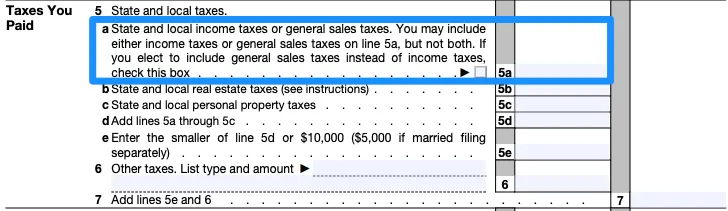
Bear in mind: If you decide to claim your sales taxes, you can’t claim state income taxes as well. It’s an either-or situation, so you’ll have to figure out which one is higher.
No matter which tax you claim, the overall deduction is limited to $10,000. What does that mean? If you have $12,000 in sales taxes, you’re only allowed to claim $10,000, and the difference can’t be carried over to future years.
So basically, my Aston Martin will have to wait.
Read next

Ultimate Guide to Car Tax Deductions and Mileage
If your freelancing, 1099 contracting, or small business involves driving, then you can claim car-related tax write-offs. Here's how to save on your car expenses at tax time — and everything you can deduct.
 By Krislyn Chan
Mileage vs. Actual Expenses: Which Method Is Best for Me?

Business Miles vs. Commuting Miles: What's the Difference?

Keeper is a delightfully smart tax filing software that's especially useful for people with 1099 contracting and freelance income. Our blog breaks down IRS guidance with real-world examples and analysis by tax professionals — empowering taxpayers to save money and take control of their finances.
View full bio