





How S-Corp losses flow to your personal return
Unlike a traditional C-Corporation that pays its own taxes, an S-Corp is a "pass-through" entity. This means all profits and losses pass directly to you, the shareholder, and appear on your personal tax return via Schedule K-1.
When your S-Corp has a loss for the year, that loss can potentially reduce your taxable income from other sources, like wages from a job, rental income, or your spouse's income if you file jointly. This is one of the major advantages of the S-Corp structure!
Here's a simple example of what that looks like: Your S-Corp has a $30,000 loss this year. You also earned $80,000 from a W-2 job. Instead of paying taxes on $80,000, you might only pay taxes on $50,000 after applying the S-Corp loss.
But before you count on using that entire loss, you need to clear three important hurdles.
3 restrictions on deducting your S-Corp losses
1. Basis limit: you can only lose what you invested
The most common restriction is basis. Think of basis as your "skin in the game". It's the amount you've personally invested in or loaned to the company. Read our stock basis guide to learn about what it is and why it matters.
Your basis includes:
Cash you initially contributed to start the business
Additional money you invested along the way
Direct loans you personally made to the S-Corp
Your share of the company's accumulated profits from previous years
Your basis does not include money the S-Corp borrowed from a bank, even if you personally guaranteed the loan.
Let's say you started your S-Corp with $10,000 and the company lost $40,000 this year. You can only deduct $10,000 of that loss on this year's taxes. The remaining $30,000 loss carries forward indefinitely until you increase your basis.
Keeper pro tip: If you're approaching year-end and see a big loss coming, you can increase your basis by making an additional capital contribution or loaning money to the company before December 31st. This must be real money transferred to the business account!
2. At-risk rules
Even if you have sufficient basis, the at-risk rules add another layer. You can only deduct losses up to the amount you could actually lose economically.
This mainly affects S-Corp owners who:
Used non-recourse loans (where you're not personally liable)
Have complex debt structures
Have protection from loss through guarantees or insurance
For most small S-Corp owners who funded their business with personal savings or personal loans, the at-risk amount equals your basis, so this doesn't create an additional limitation. But it's something you (or your tax preparer) needs to verify.
3. Passive activity loss rules
This is the big one that surprises people. The IRS classifies business activities as either "passive" or "active." Generally, losses from passive activities can only offset income from other passive activities. They can't reduce your wages, business income from active businesses, or most other income.
You're considered an active participant if you meet one of these tests:
You work more than 500 hours in the business during the year
You do substantially all the work of the business
You work more than 100 hours and no one else works more than you
Let's see a real-world example: You work full-time as an engineer and own an S-Corp rental property business where a property manager handles everything. You spend maybe 50 hours per year on it. That's passive. Your $20,000 S-corp loss likely can't offset your engineering salary. It can only offset passive income like rental profits from other properties.
Keeper pro tip: Keep a log of hours worked in your S-Corp. A spreadsheet or calendar entries created throughout the year are far more credible to the IRS than trying to reconstruct your time in April. Track significant activities: client meetings, administrative work, marketing, even business-related travel time counts.
What happens to losses you can't use
The good news: suspended losses don't disappear. They carry forward indefinitely until:
You have enough basis, at-risk amount, or passive income to absorb them
You dispose of your S-Corp stock
Let's say your S-Corp loses $50,000 but you only have $20,000 in basis. You deduct $20,000 this year. The $30,000 suspended loss carries forward. Next year, the business makes $30,000 profit. Instead of paying tax on that profit, your suspended loss wipes it out. You pay zero tax despite the profitable year! Nice!
Make these tax-smart moves to offset S-Corp losses
1. Increase your basis before year-end
If you're sitting on suspended losses and have the cash, consider making a capital contribution or loan to the company before December 31st. This increases your basis immediately and unlocks those losses for the current tax year.
2. Document your work hours
For S-Corps where your involvement might be questioned, start tracking your hours now. Don't wait until March to try to reconstruct your hours worked. Note what you did, not just hours. "Reviewed Q3 financials and approved new vendor contracts - 2.5 hrs" is more credible than "worked on business - 2.5 hrs."
3. Consider the impact of the QBI deduction
Losses from one business reduce the qualified business income (QBI) from your other businesses. If you have multiple ventures, an S-Corp loss in one might reduce the 20% QBI deduction you could claim on profits from another.
Keeper pro tip: If you have both an S-Corp and a profitable sole proprietorship or partnership, running losses through one structure versus the other can produce different tax results because of how QBI calculations work. This is worth modeling with a CPA before year-end! Need help? Consult a Keeper tax pro.
4. Don't forget your losses when you make a comeback
When your S-Corp returns to profitability after loss years, remember those suspended losses. They'll shelter the new income from taxes. Many owners forget about suspended losses and miss opportunities to use them.
5. Accelerate income if you have suspended losses
If you have suspended losses, consider triggering income to absorb them. Think of suspended losses like unused tax deductions sitting on the shelf. They're not helping you right now, but if you can create some taxable income, those losses will offset it - potentially giving you tax-free income.
Trigger income intentionally: If you were thinking about selling some stock at a gain next year, do it this year instead. The suspended losses will offset the capital gain, so you pay little or no tax on the sale.
Convert passive to non-passive income: Some income types can't be offset by your S-Corp losses due to IRS rules. If you can restructure things to make that income "non-passive," your suspended losses can now offset it.
Consider Roth conversions: Normally, converting a traditional IRA to a Roth IRA creates taxable income. But if you have suspended losses, they can offset that conversion income - meaning you get money into a Roth (where it grows tax-free forever) without paying the usual tax bill.
6. Consider the timing of equipment purchases
When you buy business equipment, you can often deduct the entire cost immediately using "bonus depreciation" - a huge tax deduction. However, if your S-Corp is already deeply negative, that big deduction doesn't help you right now. It just adds to your pile of suspended losses. As such, you might want to defer large deductions to profitable years.
Instead of buying that $50,000 piece of equipment this year (when you're already at a $30,000 loss), wait until next year when you're profitable. Then that $50,000 deduction actually saves you taxes instead of sits there unused.
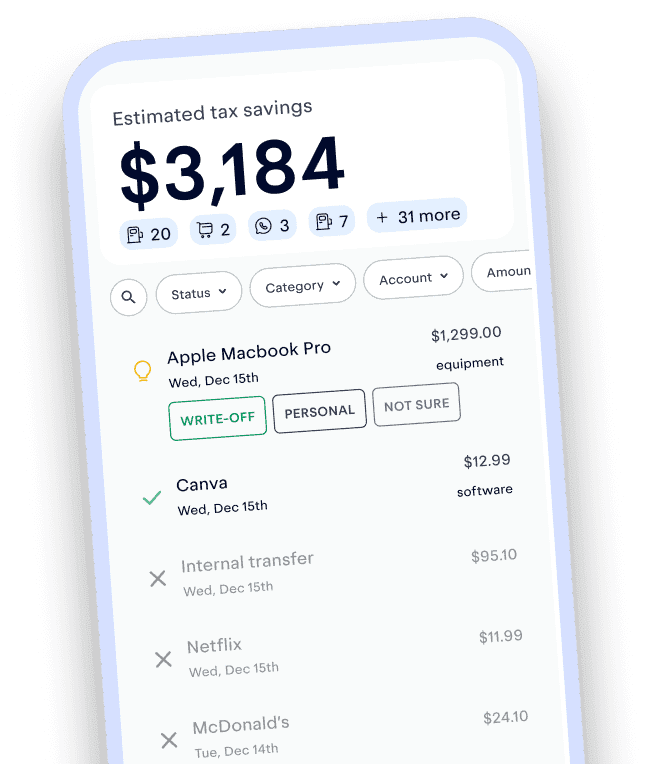
Track and claim every eligible deduction with Keeper
Keeper scans your accounts for write-offs and files your return — with tax pros reviewing every one.
Try it free7. Evaluate entity structure
If you're getting consistent losses, ask yourself: is my S-Corp still the right choice? Would partnership taxation provide better flexibility? Am I in the startup phase or is this business model failing?
The bottom line is that an S-Corp might have made sense when you thought you'd be profitable. If that's not happening, it might be time to revoke S-Corp status and restructure (i.e., convert to a partnership/LLC).
Watch out for these gotchas
Is your compensation "reasonable"?
Here's an uncomfortable truth: if your S-Corp is consistently losing money but you're still taking a salary, the IRS might question whether your compensation is truly "reasonable."
S-Corp owners must pay themselves reasonable compensation for services performed. But if the business can't afford it and is hemorrhaging money, you might need to reduce or suspend your salary.
Keeper pro tip: There’s no rule that says “You can suspend salary for X amount of years.” Instead, the question is: Are you performing services? Is there money available? Are you taking distributions? If the answer to those questions suggests economic compensation should be paid, wages are required.
Multi-year losses
Startup losses are normal. Most businesses lose money initially while establishing themselves. The IRS generally accepts this, but by year three or four, they expect to see progress toward profitability. Perpetual losses might trigger a "hobby loss" audit, where the IRS argues you're not running a legitimate business.
Distributions during loss years reduce basis
If your S-Corp loses money but you still take distributions, those distributions reduce your basis. You could end up with zero basis and suspended losses even if you originally invested significantly in the company.
Here's an example: Your S-Corp loses $20,000 but you take a $5,000 distribution. If you started with $25,000 basis, you're now at zero ($25,000 - $5,000 distribution - $20,000 losses = $0). Next year's losses won't be deductible until you rebuild basis.
State tax considerations
Don't forget state taxes. Some states don't recognize S-Corp elections or have different rules about deducting losses. California, for instance, imposes a minimum franchise tax on S-Corps even when losing money. The loss might help on your federal return but your state bill could still be substantial.
When to get professional help
You definitely need a CPA if:
Your S-Corp has multiple shareholders with different ownership percentages
You've taken loans from the business or made loans to it
You have passive losses accumulating and aren't sure why
You have multiple businesses with some profitable and others losing money
You're considering closing the S-Corp and want to maximize final loss deductions
The basis and at-risk calculations can get complex quickly, especially with loans involved. A mistake here could mean losing valuable deductions or, worse, taking deductions you're not entitled to and facing penalties later.
Want more help? Book a call with a Keeper tax pro.

Over 1M Americans trust Keeper for their complex taxes
The #1 tax app for freelancers, gig workers, and self-employed filers.
Get started free

A final word
Remember, a loss isn't necessarily bad news. That loss can reduce your tax bill on other income, putting money back in your pocket when you need it most. The key is planning: track your basis throughout the year, document your involvement in the business, and make strategic moves before December 31st when you see losses coming.
Just make sure you're playing by the rules, keeping good records, and working with a qualified tax professional who understands the nuances of S-Corporation taxation.

Krislyn is Chief Growth Officer at Keeper. At Keeper, she strives to make expert-level tax strategies that used to require a traditional CPA accessible to all. Prior to Keeper, she was at Curology, where she helped bring custom, prescription-grade skincare out of the dermatologist's office to millions of faces.
View full bio
Sabrina is a Certified Public Accountant (CPA) with over 15 years of experience in tax preparation, planning, and S-Corp compliance. She holds a Master’s in Accounting and specializes in helping self-employed individuals make smart tax decisions. Sabrina is passionate about simplifying the S-Corp process and making sure every client keeps more of what they earn.
View full bioKeeper’s tax guides are built on primary sources: the tax code, IRS forms, instructions and publications, and state tax agency guidance. We link to external sources where appropriate and check figures against the tax year they apply to. This article was peer reviewed by a licensed tax professional (CPA or EA).
This article is for informational purposes only and isn’t tax, legal, or financial advice. Tax rules change and depend on your situation, so talk to a tax professional about yours.