
Cameo Creator Taxes: 1099 Taxes, Write-offs, and More (2026 Guide)
Learn how Cameo taxes work in 2026, including how to report creator income, handle your 1099, claim tax write-offs, and pay self-employment taxes.
 Krislyn ChanKrislyn is Chief Growth Officer at Keeper. At Keeper, she strives to make expert-level tax strategies that used to require a traditional CPA accessible to all. Prior to Keeper, she was at Curology, where she helped bring custom, prescription-grade skincare out of the dermatologist's office to millions of faces.
Cameo turned "record a quick video" into real self-employment income for a lot of creators. With with more money, comes more tax problems. You may owe regular federal income tax plus self-employment tax for Social Security and Medicare.
The good news: you're generally taxed on your business profit, and qualifying business expenses can reduce the profit you're taxed on. In Keeper's Cameo tax guide, we'll walk you through it.
Do you owe taxes on Cameo income?
Yes. If you're regularly creating Cameo videos or providing other services with the goal of making money, you're generally operating a business for federal tax purposes. That means the IRS classifies it as self-employment income, and it is taxable whether or not you get a 1099 tax form.
This applies whether Cameo is:
your main source of income,
an occasional side hustle,
something you do alongside acting, sports, music, or another career,
additional income on top of a W-2 job, or
one of several creator platforms you use.
What form does Cameo send, and when?
Cameo issues a 1099, sent in January for the prior year. Because Cameo collects fan payments and pays you the balance, this is generally a 1099-K. A few creators report seeing other form types, so just be on the lookout.
The federal reporting threshold for a 1099-K in 2025 and later is more than $20,000 and more than 200 transactions. Some states use a much lower $600 threshold. And as always, if you earn under the threshold and get no form, the income is still taxable (so you'll have to report that income yourself!).
How much tax will you owe?
On your net Cameo profit you owe:
Self-employment tax of 15.3%, covering Social Security and Medicare.
Income tax at your regular rate.
Nothing is withheld from your payouts, so setting aside 25% to 30% of your net is a safe habit. If you expect to owe $1,000 or more, the IRS wants quarterly payments rather than paying one lump sum in April.
To estimate how much to pay in quarterly taxes, you can use Keeper's free quarterly tax calculator.
Keeper pro tip: We recommend setting aside 25-30% of your income for taxes in an HYSA, where it'll earn approximately 10x the interest of a traditional savings account.
Why does your Cameo 1099 look higher than what you got paid?
Your 1099 reports gross bookings, meaning the full price fans paid. But Cameo keeps a 25% cut before paying you. So if fans booked $20,000 worth of videos, Cameo keeps $5,000 and pays you about $15,000, yet your 1099 says you made $20,000. 🤔
If you book through the iOS app, Apple takes roughly 30% on those orders before Cameo and you split the rest. Note that refunds and chargebacks also aren't reflected in that gross number!
What this means practically is that the number on your 1099 form likely overstates your real earnings.
How to report Cameo earnings to avoid being overtaxed
The amount a customer pays for a Cameo can differ from what ultimately reaches your bank account because a transaction may involve:
Cameo's share of a transaction,
app-store charges,
platform or processing fees,
refunds,
chargebacks,
taxes charged to customers,
tips or other features, and
timing differences between earning and withdrawing money.
Start by comparing your 1099, Cameo earnings records, fees and adjustments, payouts, and bank deposits.
If your 1099 reports gross payments before deductible platform fees: You generally report the appropriate gross business income on Schedule C and separately deduct qualifying fees you paid or were charged. Platform commissions and fees are generally reported under Schedule C, Line 10, “Commissions and fees,” when appropriate.
For example, if your records show $20,000 of reportable gross business income and $5,000 of deductible platform commissions:
$20,000 gross business income
− $5,000 platform commissions
= $15,000 before your other business expenses
You aren't paying income tax on the $5,000 simply because it appeared in gross receipts; the qualifying deduction reduces your business profit.
Tax write-offs for Cameo creators
As self-employment income, you can deduct "ordinary and necessary" expenses related to your business. For creators, common tax write-offs include:
Category | Examples |
|---|---|
Cameo fees | The 25% platform cut, your single biggest and most-missed deduction |
Recording gear | Camera, ring light, tripod, microphone, backdrop |
Home studio | A portion of your rent and utilities for space used only for filming |
Phone and internet | The business-use share |
Props and wardrobe | Costumes, set pieces, and props bought specifically for videos |
Software | Editing apps, cloud storage, subscriptions |
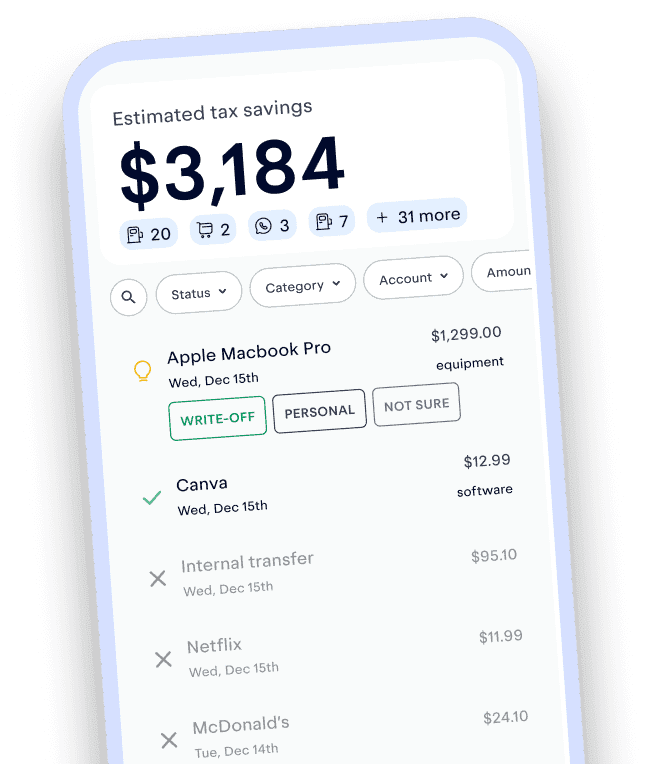
Track and claim every eligible deduction with Keeper
Keeper scans your accounts for write-offs and files your return — with tax pros reviewing every one.
Try it freeHow to file your Cameo taxes
Gather your records. Your 1099, plus your Cameo earnings statements showing gross and payout.
Report the gross on Schedule C, Line 1.
Deduct Cameo's fee on Line 10, and add your other write-offs.
Calculate self-employment tax on Schedule SE.
Make estimated quarterly tax payments if you expect to owe $1,000 or more.
Tips from a Keeper CPA
Watch for double counting. If a brand also sends you a 1099 for a promo Cameo that Cameo already reported, make sure you are not taxing the same money twice.
Back out refunds. Money you refunded to a fan is in your gross 1099 but is not income. Deduct it.
Set money aside for taxes as you go. Setting aside 25-30% for taxes after each payout helps you avoid scrambling to pay a large tax bill. Our recommendation is to put it into an HYSA, where you'll earn over interest.

Over 1M Americans trust Keeper for their complex taxes
The #1 tax app for freelancers, gig workers, and self-employed filers.
Get started free

FAQs
Why is my Cameo 1099 way higher than what hit my bank account?
Because it reports gross bookings before Cameo's 25% fee. Report the gross on Schedule C, then deduct the fee, and you are taxed on your real net.
Do I have to report Cameo income if I made less than $600 or got no form?
Yes. All of your Cameo profit is taxable regardless of whether a form was issued.
Does Cameo send a 1099-K or a 1099-NEC?
Usually a 1099-K, since Cameo processes fan payments and pays you the balance. Check the header of the form you receive to be sure.
Can I deduct Cameo's 25% fee?
Yes. Report your gross income, then deduct the fee on Schedule C, Line 10. This is the step that keeps you from overpaying.
How much should I set aside for Cameo taxes?
A reasonable starting point is 25% to 30% of your net earnings, adjusted for your total income and state.
Read next

Influencer Taxes: Do Influencers Pay Taxes on Gifts? (And Other Things Content Creators Get Wrong)
Do content creators/influencers pay taxes? Gifted PR packages, brand deals, and sponsored trips are all taxable income in the IRS's view. As a content creator, you're considered self-employed. That means navigating 1099 tax forms, tax write-offs, and
 By Krislyn Chan
TikTok Shop Taxes: The Complete 2026 Guide for Sellers

How To Get Freelancer Health Insurance (and Save Using Tax Credits)

The QBI Tax Deduction: What Is It and Who Can Claim It?

Ultimate Guide to Personal Appearance Tax Deductions

Krislyn is Chief Growth Officer at Keeper. At Keeper, she strives to make expert-level tax strategies that used to require a traditional CPA accessible to all. Prior to Keeper, she was at Curology, where she helped bring custom, prescription-grade skincare out of the dermatologist's office to millions of faces.
View full bio