






Key takeaways
Brand deals, AdSense, affiliate commissions, and subscriber revenue (Patreon, Substack, OnlyFans) are all Schedule C self-employment income.
If you got a PR package from a brand, those items are taxable income at fair market value!
The OBBB tax provision for "no taxes on tips" applies to digital content creators, podcasters, and streamers! You can claim a federal income tax deduction for up to $25,000 of qualified voluntary tips received. The tips cannot be related to fees paid for content access.
The 2026 federal 1099-K threshold is back to $20,000 + 200 transactions, meaning you may not receive a 1099-K if you fall below this threshold. However, you still owe taxes on that income!
Once you start earning money as a content creator, taxes become part of the job. Content creators generally pay self-employment tax and income tax on money they earn from brand deals, ad revenue, affiliate commissions, subscriptions, and other business activities. But one area we often see creators forget about is reporting the fair market value of free products received in exchange for content. Oops! Let's dive into the specifics.
What counts as income for a content creator
Any income you make from influencer sponsorships or content creation gigs is taxable. It's important to report your earnings truthfully, including income from brand deals, sponsorships, affiliate links, and ad revenue from YouTube or TikTok. Let's break it down:
Brand deal payments. This includes sponsored posts, paid partnerships, affiliate base fees, and is usually issued on a 1099-NEC.
AdSense and YouTube Partner Program. This income is reported on a 1099-NEC (for services) or 1099-MISC (for royalties, depending on how YouTube classifies your payout).
Affiliate commissions. Think Amazon, TikTok Shop, ShareASale, RewardStyle, Impact. You may or may not get a 1099, but that doesn't mean you're not on the hook for taxes on that income! Here's a helpful guide on what to do if you didn't get a 1099 form.
Subscriber revenue (Patreon, Substack, OnlyFans, Twitch subs). You'll be issued a 1099-NEC if direct, or 1099-K if processed through a payment platform.
Free products and PR gifts. The fair market value of items received as a result of your platform should be reported as gross receipts on Schedule C!
Tips. Creators who make less than $150,000 (or $300,000 married filing jointly) will be able to deduct up to $25,000 per year in “qualified tips” from their federal income taxes.
PR trips. Imagine a $4,500 Cabo trip paid for by a brand... that $4,500 value is taxable income even if you didn't get paid in cash. The brand should issue a 1099-NEC for the value, and the IRS still expects you to report it.
Do influencers pay taxes on gifts?
Yes! This is something most creators miss. Free products and PR gifts you get from brands is considered taxable income by the IRS if the gifts are given in exchange for promotion. These can include brand trips (hotel stays, flights, event tickets), physical products (makeup, clothes, food), and services (subscriptions, gym memberships).
Even if no cash hits your account, you'll have to pay taxes on the fair market value of the items received. This income should be reported on Schedule C.
Keeper pro tip: Make sure to log every PR item you receive and its fair market value!
What you can write off
While the above may sound daunting (oh no! I owe sooooo much in hidden taxes as a content creator!), you're considered self-employed. And that's where business deductions help lower your taxable income. The IRS considers you a business owner, and running your business costs money, so now you can write off your business expenses on your taxes to reduce your taxable income.
Ordinary and necessary business expenses that content creators can write off on their taxes include:
📸 Camera, lighting, audio equipment. Section 179 or bonus depreciation lets you write off the full cost in year one for most gear.
💻 Computer, phone, software subscriptions (Adobe Creative Cloud, editing apps, scheduling tools).
🏠 Home studio space. The home office deduction applies if you have a dedicated content creation space.
💄 Props, wardrobe, makeup specifically purchased for content. (Personal-use clothing isn't deductible.)
✈️ Travel for content creation. Hotels, flights, rideshares, meals (50%) when on a content-related trip.
📚 Education and courses. Photography courses, social media strategy, editing tutorials.
💳 Subscriptions used for content (Canva Pro, Final Cut, ChatGPT Plus, AI generation tools).
💼 Manager, agent, lawyer fees.
🌐 Hosting, domain, website costs.
📱 A portion of your phone bill (the business-use percentage).
Check out our guide to common tax write-offs for content creators.
Keeper pro tip: Travel, meals, and wardrobe carry higher audit risk. If 100% of your wardrobe purchases are deducted, that raises red flags for the IRS. Keeper thorough documentation to make sure these are defensible in an audit.
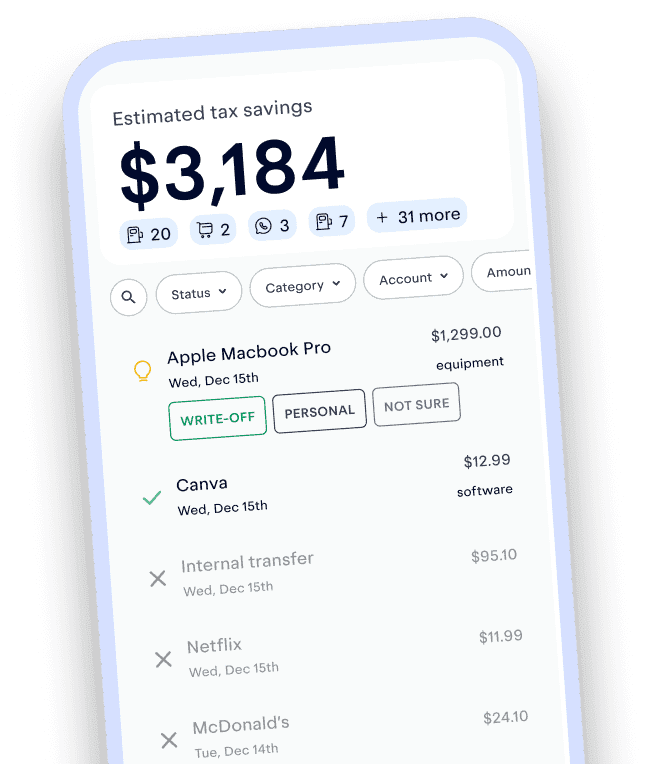
Track and claim every eligible deduction with Keeper
Keeper scans your accounts for write-offs and files your return — with tax pros reviewing every one.
Try it free1099-NEC vs 1099-K
It's not uncommon for creators to get a mix of 1099-NEC and 1099-K forms. The general rule of thumb is that a brand directly paying you for a sponsored post would issue a 1099-NEC if you made over $2,000.
A platform processing payments on your behalf (a creator-fund payout through a third-party processor) would issue you a 1099-K if the platform's thresholds are met: $20,000 and 200 transactions.
Don't double-count. If you get both a 1099-NEC from a brand and a 1099-K from the platform that processed the payment, don't count the income twice or you'll end up paying more in taxes than you should! Report your actual revenue and use the 1099s as documentation, not as separate income line items.
When should you consider an S-Corp
The S-Corp election starts paying off for content creators when your net profit hits closer to $80,000+. That's when S-Corp tax savings could be really beneficial. You can use Keeper's S-Corp tax savings calculator to estimate how much you could end up saving.
Let's see how the math works with a simple example:
Let's say you have a sole prop at $120K net profit. You pay self-employment tax (15.3%) on $120K, costing $17K in self-employment tax alone.
As an S-Corp, you'd pay yourself a "reasonable salary" (say $60K, which is W-2 income subject to FICA), then take the remaining $60K as a distribution (not subject to self-employment tax). FICA on $60K is about $9,180. So you end up saving about $7,800 in taxes.
However, setting up an S-Corp adds complexity! You have to run payroll, file form 1120-S, and handle bookkeeping. That administrative overhead might end up wiping out the tax savings, so plan carefully.
Check out our S-Corp guide to see if an S-Corp makes sense for you.
Key recent tax law provisions for content creators
The OBBB doesn't have an "influencer-specific" provision, but several changes matter:
The qualified business income (QBI) deduction is now permanent at 20%.
Most creators won't get a 1099-K unless they made $20K + had 200 transactions, but that doesn't mean you don't need to report your income on your taxes. Regardless of whether you received a 1099 form, that income is still taxable!
The no taxes on tips provision lets creators who make less than $150,000 (or $300,000 married filing jointly) are able to deduct up to $25,000 in “qualified tips” from their federal income taxes.
Over 1M Americans trust Keeper for their complex taxes
The #1 tax app for freelancers, gig workers, and self-employed filers.
Get started free

FAQs
Legally yes, if you accepted it and didn't return it. Practically, the IRS is unlikely to pursue small one-off PR boxes unless you're a high-profile creator. For trips, large items, or anything over a few hundred dollars in value, declare it.
Generally no. The IRS has been clear that cosmetic procedures (botox, fillers, surgery) are personal expenses for almost all taxpayers, including creators.
Same as domestic. All worldwide income is taxable. If the foreign brand withheld tax, you may be able to claim a foreign tax credit. Use Form 1116.
You still owe the tax. Report the income on your Schedule C. Our free guide on what to do if you didn't receive a 1099 form breaks down what you should do.

Krislyn is Chief Growth Officer at Keeper. At Keeper, she strives to make expert-level tax strategies that used to require a traditional CPA accessible to all. Prior to Keeper, she was at Curology, where she helped bring custom, prescription-grade skincare out of the dermatologist's office to millions of faces.
View full bio
a tax professional
This content has been reviewed by an Enrolled Agent (EA) with the IRS — the highest credential awarded by the agency. Enrolled Agents are empowered to represent all taxpayers before the IRS, on all types of tax-related matters. Accountants who earn this certification have passed a comprehensive three-part exam on individual and business tax returns. To maintain EA status, they must stay up to date in the field by completing 72 hours of continuing education every three years.
View full bioKeeper’s tax guides are built on primary sources: the tax code, IRS forms, instructions and publications, and state tax agency guidance. We link to external sources where appropriate and check figures against the tax year they apply to. This article was peer reviewed by a licensed tax professional (CPA or EA).
This article is for informational purposes only and isn’t tax, legal, or financial advice. Tax rules change and depend on your situation, so talk to a tax professional about yours.