




Key takeaways
57% of Gen Z workers run a side gig, the highest of any generation.
Income stacking triggers self-employment tax of 15.3% once net earnings cross $400 in a year.
If you expect to owe more than $1,000 in taxes, you'll likely need to make quarterly estimated tax payments, which are due April 15, June 15, September 15, and January 15.
Real-time expense tracking can recover thousands of dollars in deductions per year to help you save in taxes.
What is income stacking?
Income stacking is when one person earns money from multiple sources at the same time. Imagine you're a full-time receptionist who drives for Doordash on weekends, runs an Etsy shop at night, and creates UGC content on the weekend. Sounds like a lot, doesn't it? But for Gen Z, this seems to be an increasing reality.
Why is Gen Z stacking income?
According to The Harris Poll, 57% of Gen Z workers now run a side gig, compared to 21% of boomers and older Americans. The Bureau of Labor Statistics counted roughly 8.4 million U.S. adults working multiple jobs in April 2026, about 5.2% of the workforce. A 2025 Fiverr survey found that 67% of Gen Z respondents in the U.S. said having multiple ways to earn money is essential for financial security.
As a generation that's witnessed two recessions, a pandemic, a constant rotation of layoffs, and rent rising faster than wages, it's no wonder the rose colored stability of corporate life of yesteryear has cracked in favor of multiple backup income streams.
Median rent in major U.S. metros now eats roughly a third of an entry-level salary before taxes. Student loan payments are crushing salaries. Grocery prices are high. Meanwhile, the platforms that make income stacking possible, including DoorDash, Uber, Fiverr, Upwork, TaskRabbit, TikTok Shop, Substack, and dozens more, have democratized the ability to earn a second income.
These two forces now work together to allow Americans to treat income like investment strategy - build up a diverse portfolio of income streams.
There's just one problem. The U.S. tax system was built for people with traditional W-2 jobs, with most Americans expecting a refund check in April. When you stack income, you are no longer that person, and you owe the IRS more than you probably think. At Keeper, we hear it time and time again from our users. That surprise tax bill can drain bank accounts in April. That's why we built Keeper for independently employed earners to maximize their tax deductions and save on taxes.
Over 1M Americans trust Keeper for their complex taxes
The #1 tax app for freelancers, gig workers, and self-employed filers.
Get started free

The 3 most common income stacking archetypes
Almost every stacker we see at Keeper falls into one of three patterns. Each one has a different tax profile.
1. The W-2 Plus 1099 Stacker
You have a full-time W-2 job, but you also drive for a rideshare app like Uber or Lyft, freelance on the side, or sell on Etsy.
Most people don't adjust their W-2 withholding to account for their 1099 self-employment income, and so that self-employment tax creeps up as a nasty surprise on April 15.
2. The 1099 Pro Freelancer
With this archetype, you don't have a traditional W-2 job. Your 1099 income stacks up. Maybe you ghostwrite on Upwork, do graphic design through Fiverr, deliver groceries through Instacart in the gaps, and rent your spare bedroom on Airbnb.
This is the most tax-complex archetype. You have no employer covering any portion of payroll tax. You are responsible for income tax and the full 15.3% self-employment tax, and you almost certainly need to pay estimated taxes quarterly.
3. The Business-of-One
Are you running a one-person company? Maybe you're consulting, running a small Shopify or Etsy store, a niche newsletter with paid subscribers, or an indie software product. The income is steadier than a freelancer's, but you wear every hat, including marketing, fulfillment, customer support, bookkeeping, and more.
Business-of-one stackers usually carry the most legitimate deductions of any archetype, including software subscriptions, contractor payments to other freelancers, business insurance, and home office costs. They also have access to retirement vehicles a W-2 employee does not, like a SEP IRA or a Solo 401(k), which can shelter five figures of income from tax in a good year. At a certain revenue level, an S-Corp election starts to make sense.
Don't forget about the self-employment tax
The single biggest mistake stackers make is not knowing about self-employment tax.
When you work a regular job, your employer withholds 7.65% of your paycheck for Social Security and Medicare. The employer pays a matching 7.65% on top.
When you earn self-employment income, you are both the employee and the employer. You owe both halves. That is 15.3%, and it kicks in on net earnings of just $400 a year.
So if you stack a W-2 paying $55,000 with $12,000 of freelance income, you don't just owe income tax on the $12,000. You also owe roughly $1,700 in self-employment tax before income tax is even calculated.
This is also why "I didn't get a 1099" is not a defense. The 1099 is paperwork the IRS uses to cross-check what you reported. If a client paid you under the reporting threshold or just forgot to send the form, you still owe tax on the income. If you didn't get a 1099, check out our guide on what to do.
How much will you owe in taxes?
Self-employment taxes. You owe SE tax once your net self-employment earnings cross $400 in total 1099 income for the year.
1099-NEC threshold. For tax year 2025, clients must send a 1099-NEC if they paid you $600 or more. For tax year 2026 forward, the One Big Beautiful Bill Act raised that threshold to $2,000. That means many small clients will stop issuing forms, so it's your obligation to report all income earned.
1099-K threshold. Payment apps like PayPal, Venmo, Cash App, and Stripe must send you a 1099-K only if you cross both $20,000 in payments and 200 transactions in a single year.
Standard mileage rate. If you drive for work, you can deduct 72.5 cents per mile in the first half of 2026 and 76 cents in the second half. For a rideshare driver putting 15,000 work miles on a car, that is more than $10,000 in deductions that vanish if you do not track them. Check out our free mileage template if you choose to take the mileage vs actual expenses deduction.
Estimated taxes. Estimated taxes are due April 15, June 15, September 15, and January 15. If you fail to pay or underpay your taxes, you're on the hook for an underpayment penalty, which is calculated at the federal short-term rate plus 3 percent.
See how much you could end up owing in overall taxes with our tax calculator.
4 tax tips to help you with your taxes
1. Open a separate checking account.
Run every dollar of side income and every business expense through it. This is not legally required, but it makes bookkeeping easier and it makes your deductions defensible if you are ever audited.
2. Set aside 25-30 percent of your earnings for taxes.
That covers federal income tax, self-employment tax, and most state tax for the average person. This way you avoid spending income you should've set aside for taxes. We recommend setting this income aside in a high yield savings account (over a traditional savings account) so you earn interest over time.
3. Track expenses in real time.
The single most important thing you can do this year is to track every business expense as it happens. Home office, software subscriptions, phone bills, internet, supplies, and equipment are all potentially deductible. Millions of Americans earning 1099 income leave thousands of dollars in deductions on the table.
Keeper is built for exactly this. The app links to your accounts, automatically identifies the business expenses hiding in your transaction history, and tells you what you owe in real time. You could recover several thousand dollars in deductions a year. Download Keeper to try it for free.
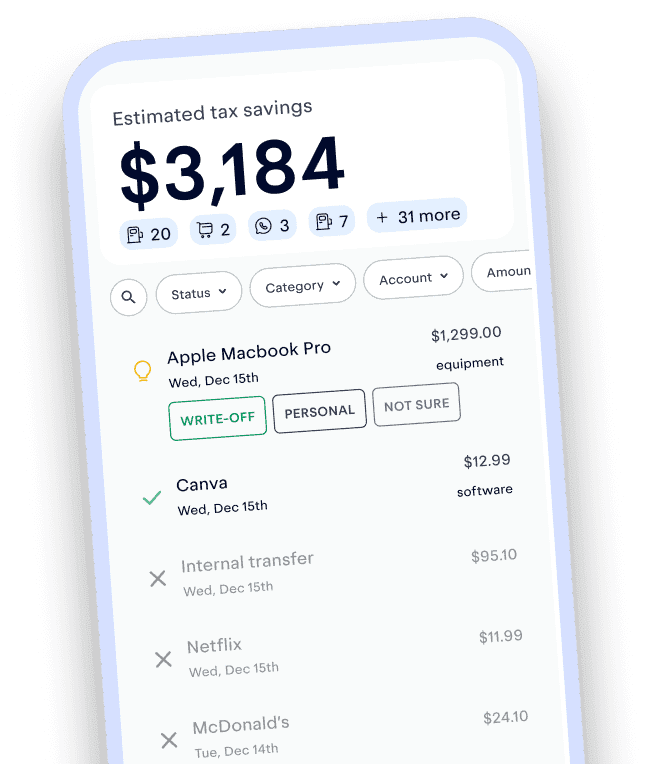
Track and claim every eligible deduction with Keeper
Keeper scans your accounts for write-offs and files your return — with tax pros reviewing every one.
Try it free4. If you also have a W-2, consider increasing your withholding.
You can adjust your W-4 to have extra federal tax withheld from your paycheck. That money covers the tax you owe on your side income and avoids the quarterly estimated tax dance.
FAQs
Do I owe taxes if I earned less than $600 from a side gig?
Yes. The $600 figure is a reporting threshold for the platform or client, not a taxability threshold. Every dollar of business income is taxable from the first dollar. If your total net self-employment earnings cross $400 for the year, you also owe self-employment tax.
Do I need an LLC for each gig?
No. An LLC offers liability protection but does not change how the income is taxed by default. Most single-member LLCs are taxed exactly the same as a sole proprietorship, which is what you are if you have not formed anything. Form an LLC if you have liability exposure or are working with clients who require it, not because you think it lowers your tax bill.
What if I have a W-2 and a 1099?
You will file one tax return that includes both. Your W-2 income, withholding, and Social Security and Medicare contributions go on the regular 1040. Your 1099 income, expenses, and self-employment tax go on Schedule C and Schedule SE attached to the same return. The IRS calculates the total bill based on the combination.
Will the IRS audit me if I have multiple income streams?
Multiple income streams alone do not raise your audit risk. What raises risk is failing to report income that was reported to the IRS on a 1099, claiming unusually large deductions relative to your income, or rounding numbers in ways that look fabricated. Stackers who report all income and document deductions are rarely audited.

Keeper Office Hours
Got a tax question, a confusing expense, or something you're stuck on in Keeper? Join a live, open Q&A with a Keeper expert. Submit your question ahead of time or ask it during the session. No presentation. No lecture. Just answers.

Krislyn is Chief Growth Officer at Keeper. At Keeper, she strives to make expert-level tax strategies that used to require a traditional CPA accessible to all. Prior to Keeper, she was at Curology, where she helped bring custom, prescription-grade skincare out of the dermatologist's office to millions of faces.
View full bio
a tax professional
This content has been reviewed by an Enrolled Agent (EA) with the IRS — the highest credential awarded by the agency. Enrolled Agents are empowered to represent all taxpayers before the IRS, on all types of tax-related matters. Accountants who earn this certification have passed a comprehensive three-part exam on individual and business tax returns. To maintain EA status, they must stay up to date in the field by completing 72 hours of continuing education every three years.
View full bio3 sources
- 57% of Gen Z · theharrispoll.com
- 5.2% of the workforce · fred.stlouisfed.org
- 67% of Gen Z · investors.fiverr.com
Keeper’s tax guides are built on primary sources: the tax code, IRS forms, instructions and publications, and state tax agency guidance. We link to external sources where appropriate and check figures against the tax year they apply to. This article was peer reviewed by a licensed tax professional (CPA or EA).
This article is for informational purposes only and isn’t tax, legal, or financial advice. Tax rules change and depend on your situation, so talk to a tax professional about yours.