





Step 1: What's my default classification?
Did you know the IRS doesn't actually tax "LLCs"?
Here's the thing most people don't know: the IRS doesn't have a separate tax category for LLCs. Instead, it treats your LLC as one of four things: a sole proprietorship, a partnership, an S corporation, or a C corporation, depending on how many members you have and whether you've made any elections.
This is called your tax classification, and it determines everything: which forms you file, how much you owe in self-employment taxes, and what deductions you can take.
Single-Member LLCs = Disregarded entity
If you own your LLC alone, the IRS automatically treats it as a disregarded entity, which is essentially a sole proprietorship for tax purposes. That means the LLC itself doesn't file a separate return. Instead, all income and expenses flow through to your personal Form 1040 via Schedule C.
Let's see an example: Sarah runs a one-person graphic design LLC. She earned $85,000 in revenue and had $15,000 in business expenses. Her net profit of $70,000 gets reported on Schedule C, and she pays income tax plus self-employment tax on that full amount.
The self-employment (SE) tax rate is 15.3% (12.4% for Social Security and 2.9% for Medicare). For a single-member LLC earning $70,000 in net profit, that's over $10,000 in SE tax alone, before any income tax. This is the number that surprises most new LLC owners. At Keeper, we term this the "freelancer tragedy" - so, so, so many hardworking self-employed individuals are overpaying their taxes, not realizing they're leaving thousands of dollars on the table at tax time by not deducting their business expenses.
Multi-Member LLCs = Partnership
If your LLC has two or more members, the IRS automatically classifies it as a partnership. You'll need to file Form 1065 (U.S. Return of Partnership Income) as an informational return, and then issue a Schedule K-1 to each member showing their share of income, losses, deductions, and credits. Each member reports their K-1 figures on their personal returns and pays SE tax on their share of active profits.
Keeper pro tip: Form 1065 is due March 17, 2025 for calendar-year partnerships (a full month before the individual filing deadline). Missing this date triggers a penalty of $245 per partner, per month!
Step 2: Which forms should you file as an LLC?
LLC Type | Default Tax Treatment | Key Form(s) |
|---|---|---|
Single-member | Disregarded entity (sole prop) | Schedule C + Form 1040 |
Multi-member | Partnership | Form 1065 + Schedule K-1s |
LLC elected as S corp | S corporation | Form 1120-S + Schedule K-1s |
LLC elected as C corp | C corporation | Form 1120 |
Other schedules you may need
Schedule SE: calculates your self-employment tax (required if net profit exceeds $400)
Form 8829: home office deduction
Schedule E: if your LLC holds rental properties
Form 1099-NEC / 1099-MISC: required if you paid any contractor $600 or more during the year (due January 31)
Step 3: Should you elect S-Corp status?
As we saw in Sarah's example earlier, by default, you pay SE tax on 100% of your LLC's net profit. With an S-Corporation election, you split your income between a W-2 salary (subject to payroll taxes) and distributions (not subject to SE tax). The distributions are where you save money.
How it works in practice:
Marcus runs a software consulting LLC netting $180,000 per year. As a default single-member LLC:
He pays 15.3% SE tax on the full $180,000 ≈ $27,540 in SE taxes
After electing S-Corp status, he pays himself a reasonable salary of $90,000:
He pays FICA taxes on $90,000 ≈ $13,770
The remaining $90,000 is taken as a distribution (no SE tax)
Annual savings: ~$13,770, minus ~$2,000–$3,000 in additional accounting/payroll costs
The S-Corp election generally makes financial sense once your net profit consistently exceeds $60,000–$100,000. Below that threshold, the payroll compliance costs can eat into your tax savings.
If you need some help deciding, you can reference our guide on whether an S-Corp makes sense for you, or use our S-Corp tax savings calculator to estimate how much you would end up saving in taxes by electing S-Corp status.
To elect S-Corp status, file Form 2553 by the 15th day of the third month of the tax year. For 2026, that deadline is March 16, 2026. Late elections may still be accepted if you can show reasonable cause. Lucky for you, we've put together a quick guide on how to backdate your S-Corp election if you miss the deadline.
Step 4: Don't forget the QBI deduction
One of the most powerful tax breaks available to LLC owners is the Qualified Business Income (QBI) deduction under Section 199A. It allows eligible business owners to deduct up to 20% of qualified business income from their taxable income. This is completely separate from any other business expense deduction you claim.
On top of that, we have some good news for 2025 and beyond. Thanks to the One Big Beautiful Bill Act (OBBBA), signed in July 2025, made the QBI deduction permanent. It was previously set to expire at the end of 2025. Starting in 2026, even if your deduction would otherwise phase out to nearly zero, a minimum deduction of $400 applies if your QBI is at least $1,000.
Who qualifies for the full 20% deduction in 2025:
Taxable income below $197,300 (single) or $394,600 (married filing jointly)
Who faces limitations:
Higher earners may face restrictions based on W-2 wages paid and property held
Owners of "specified service trade or businesses" (SSTBs) -including doctors, lawyers, accountants, consultants, and financial advisors - face a complete phase-out above $247,300 (single) / $494,600 (married)
Keeper pro tip: If you're a high-income earner without employees, your QBI deduction might be limited to zero under the default LLC structure. An S-Corp election can "unlock" the deduction by creating W-2 wages. This is one of the advanced but meaningful reasons to consider the S-Corp election beyond just SE tax savings.
Step 5: Max out your deductions
LLCs can deduct all "ordinary and necessary" business expenses, but many people forget to claim the on their taxes! Some common deductions include:
🏡 Home office: If you use a dedicated space regularly and exclusively for business, you can deduct either $5 per square foot (up to 300 sq ft) using the simplified method, or calculate actual expenses. Check out our home office deduction quiz to determine if you can claim the home office deduction.
🏥 Health insurance premiums: Self-employed LLC owners can deduct 100% of health insurance premiums paid for themselves, their spouse, and dependents, directly reducing adjusted gross income, not just as an itemized deduction.
🧓 Retirement contributions: A SEP-IRA allows contributions of up to 25% of net self-employment income, with a 2025 cap of $70,000. A Solo 401(k) allows even higher combined contributions. These are dollar-for-dollar reductions in taxable income. Our SEP-IRA vs solo 401(k) guide can help you decide which is best for you.
🚗 Vehicle use: If you drive for business, you can choose to take the mileage or actual expense method to deduct those expenses.
🍕 Business meals:50% deductible when directly related to business purposes. Keep notes about who you met with and the business purpose! This is a frequently audited category.
In order to claim these deductions, make sure to track and categorize your tax deductible business expenses and add them to your Schedule C! The Keeper app automatically scans your bank or credit card transactions for qualifying tax deductions, categorizes them, and adds them to your tax return when you file.
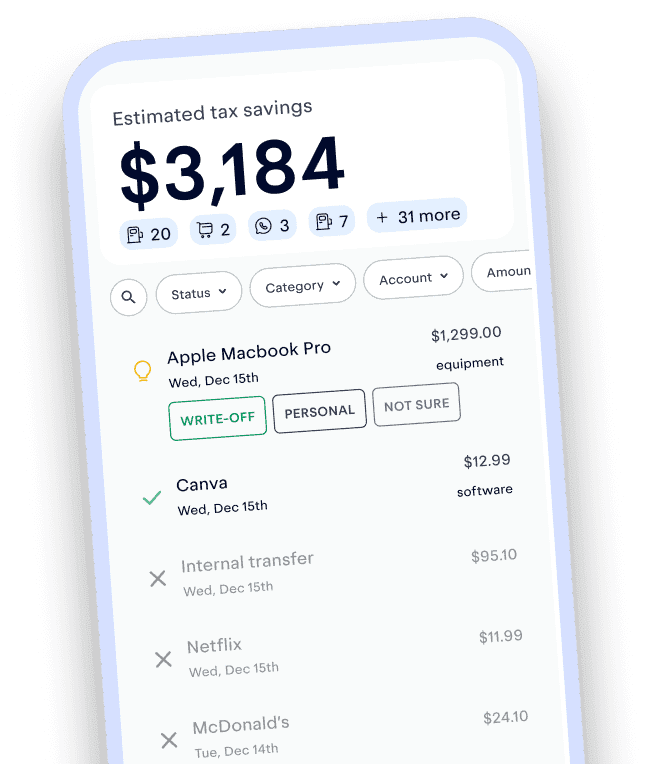
Track and claim every eligible deduction with Keeper
Keeper scans your accounts for write-offs and files your return — with tax pros reviewing every one.
Try it freeStep 6: Make quarterly estimated tax payments
Unlike employees who have taxes withheld from every paycheck, LLC owners must pay taxes themselves on a quarterly basis. If you don't, you'll face underpayment penalties on top of your tax bill. Use our estimated tax penalty calculator to see how much those penalties might be for you. Ouch! If you've missed payments, our guide on how to deal with missed quarterly tax payments can help, or book a call with a Keeper tax pro for more help.
Add these estimated tax due dates to your calendar!
Q1 (Jan–Mar): April 15
Q2 (Apr–May): June 15
Q3 (Jun–Aug): September 15
Q4 (Sep–Dec): January 15
A safe rule of thumb: set aside 25–30% of every deposit into a separate tax savings account. If you expect to owe less than $1,000 after withholding, or if you paid at least as much in taxes last year as you expect to owe this year (the "safe harbor" rule), penalties don't apply.

Over 1M Americans trust Keeper for their complex taxes
The #1 tax app for freelancers, gig workers, and self-employed filers.
Get started free

Disclaimer: This article is for informational purposes only and does not constitute legal or tax advice. Tax rules change frequently. Consult a licensed CPA or tax professional for guidance tailored to your situation.
Frequently Asked Questions
FAQ
Almost certainly yes. If you have employees, opened a business bank account, elected corporate taxation, or simply want clean separation between your personal and business finances, you need an Employer Identification Number (EIN). Apply for free at IRS.gov using Form SS-4.
Yes, but the rules depend on your state. In community property states, a married couple may be able to treat their LLC as a disregarded entity. In non-community property states, a jointly owned LLC defaults to partnership taxation and must file Form 1065.
Multi-member LLCs still need to file Form 1065 even with zero activity. Failing to file triggers per-partner, per-month penalties. Single-member LLCs with no activity may not need to file Schedule C, but check state requirements — many states have annual fees or minimum taxes regardless of income.
State rules vary widely. California imposes an $800 minimum franchise tax on all LLCs plus an additional fee on gross revenues above $250,000. Texas has a franchise tax. Other states are more LLC-friendly. Always review your state's requirements in addition to federal obligations.

Krislyn is Chief Growth Officer at Keeper. At Keeper, she strives to make expert-level tax strategies that used to require a traditional CPA accessible to all. Prior to Keeper, she was at Curology, where she helped bring custom, prescription-grade skincare out of the dermatologist's office to millions of faces.
View full bio
a tax professional
This content has been reviewed by an Enrolled Agent (EA) with the IRS — the highest credential awarded by the agency. Enrolled Agents are empowered to represent all taxpayers before the IRS, on all types of tax-related matters. Accountants who earn this certification have passed a comprehensive three-part exam on individual and business tax returns. To maintain EA status, they must stay up to date in the field by completing 72 hours of continuing education every three years.
View full bio1 source
- Form 2553 (Rev. December 2017) · irs.gov
Keeper’s tax guides are built on primary sources: the tax code, IRS forms, instructions and publications, and state tax agency guidance. We link to external sources where appropriate and check figures against the tax year they apply to. This article was peer reviewed by a licensed tax professional (CPA or EA).
This article is for informational purposes only and isn’t tax, legal, or financial advice. Tax rules change and depend on your situation, so talk to a tax professional about yours.