
Arkansas 1099 taxes: a 2026 guide for the self-employed

 Keeper StaffKeeper is a delightfully smart tax filing software that's especially useful for people with 1099 contracting and freelance income. Our blog breaks down IRS guidance with real-world examples and analysis by tax professionals — empowering taxpayers to save money and take control of their finances.
 Krislyn ChanKrislyn is Chief Growth Officer at Keeper. At Keeper, she strives to make expert-level tax strategies that used to require a traditional CPA accessible to all. Prior to Keeper, she was at Curology, where she helped bring custom, prescription-grade skincare out of the dermatologist's office to millions of faces.
Key takeaways
- 1099 income in Arkansas is subject to three taxes: 15.3% federal self-employment tax, 10% to 37% federal income tax, and 0% to 3.7% Arkansas income tax.
- Set aside 20–25% of your profit in a high-yield savings account, so the money earns interest until your tax payments are due. For a single filer with no other income, total tax runs from 21.0% of profit at $40,000 to 30.3% at $200,000.
- Arkansas’s top income tax rate is 3.7% for 2026, down from 3.9%. The cut passed in May 2026 and applies to the whole year.
- Arkansas estimated payments start above $1,000. If you expect to owe more than $1,000, make quarterly estimated tax payments, due April 15, June 15, and September 15, 2026, and January 15, 2027.
- No local income tax. Little Rock, Fayetteville, and other Arkansas cities don’t tax income.
How much tax do 1099 workers pay in Arkansas?
These tables show estimated 2026 tax on self-employment profit, the amount left after business expenses. They assume this is your only income, you take the standard deduction, and you have no kids or tax credits.
Single filer, 2026
| 1099 profit | Total tax | % of profit | Self-employment tax | Federal income tax | Arkansas income tax |
|---|---|---|---|---|---|
| $40,000 | $8,419 | 21.0% | $5,652 | $1,775 | $992 |
| $60,000 | $13,770 | 22.9% | $8,478 | $3,559 | $1,732 |
| $80,000 | $19,120 | 23.9% | $11,304 | $5,344 | $2,472 |
| $100,000 | $25,854 | 25.9% | $14,130 | $8,235 | $3,490 |
| $150,000 | $42,957 | 28.6% | $21,194 | $16,413 | $5,350 |
| $200,000 | $60,630 | 30.3% | $28,234 | $25,196 | $7,200 |
Married filing jointly, one self-employed spouse, 2026
| 1099 profit | Total tax | % of profit | Self-employment tax | Federal income tax | Arkansas income tax |
|---|---|---|---|---|---|
| $40,000 | $6,922 | 17.3% | $5,652 | $398 | $872 |
| $60,000 | $11,975 | 20.0% | $8,478 | $1,885 | $1,612 |
| $80,000 | $17,206 | 21.5% | $11,304 | $3,550 | $2,352 |
| $100,000 | $22,583 | 22.6% | $14,130 | $5,335 | $3,119 |
| $150,000 | $36,219 | 24.1% | $21,194 | $9,795 | $5,229 |
| $200,000 | $51,786 | 25.9% | $28,234 | $16,472 | $7,079 |
How Arkansas taxes 1099 income
If you’re a freelancer, independent contractor, gig worker, or solo business owner in Arkansas, your net profit (1099 income minus business expenses) is taxed three ways:
- Federal self-employment tax: 15.3% on most of your profit (92.35% of it). That’s 12.4% for Social Security, on earnings up to $184,500 in 2026, plus 2.9% for Medicare with no cap. It replaces the payroll taxes an employer would split with you. Estimate it with the self-employment tax calculator.
- Federal income tax: 10% to 37% on what’s left after three deductions: the $16,100 standard deduction ($32,200 married filing jointly), half of your self-employment tax, and the 20% QBI deduction.
- Arkansas income tax: 0% to 3.7% on your profit minus the $2,470 standard deduction, then reduced by a $29 personal credit. You report it on Form AR1000F.
What’s different about Arkansas
- No deduction for half of your self-employment tax. The IRS lets you subtract half of your self-employment tax from your income. Arkansas doesn’t, so at $80,000 of profit you pay Arkansas tax on $5,652 more than the IRS counts.
- A small standard deduction. Arkansas’s standard deduction is $2,470 per person ($4,940 married filing jointly), well below the federal $16,100.
- Two tax tables. If your net income is $94,700 or less, Arkansas phases in rates from 0% to 3.7%. Above $94,700, all but the first $4,700 is taxed at 3.7%.
- No QBI deduction. The IRS lets you deduct up to 20% of your business profit. Arkansas doesn’t.
A self-employed person in Arkansas at $80,000 pays $19,120: about $141 less than in California and $2,472 more than in Texas, which has no income tax.
Arkansas income tax rates for 2026
These rates apply if your net income is $94,700 or less, for every filing status. Above that, Arkansas taxes the first $4,700 at 2% and everything else at 3.7%.
| Rate | All filers |
|---|---|
| 0% | $0 – $5,600 |
| 2% | $5,600 – $11,200 |
| 3% | $11,200 – $16,000 |
| 3.4% | $16,000 – $26,400 |
| 3.7% | Over $26,400 |
Example: Arkansas tax on $80,000 of 1099 income
Here’s the math for a single self-employed person in Little Rock with $80,000 of profit and no other income.
| Step | Amount |
|---|---|
| Self-employment tax: $80,000 × 92.35% × 15.3% | $11,304 |
| $80,000 minus half of self-employment tax | $74,348 |
| Income the IRS taxes: $74,348 minus the $16,100 standard deduction and $11,650 QBI deduction | $46,599 |
| Federal income tax | $5,344 |
| Income Arkansas taxes: $80,000 minus the $2,470 standard deduction | $77,530 |
| Arkansas income tax, after the $29 personal credit | $2,472 |
| Total 2026 tax | $19,120 (23.9%) |
Self-employment tax is the biggest piece. Every dollar you write off as a business expense lowers all three taxes, since your self-employment tax, federal income tax, and Arkansas income tax are all based on your profit after expenses.

What tax write-offs can I claim?
How to lower your Arkansas 1099 tax bill
At $80,000 of profit, every $1,000 of business expenses you deduct cuts about $268 from your total tax. Common write-offs for self-employed people in Arkansas include:
- Your phone and internet, for the share you use for work
- Car expenses, using a set rate per mile or your actual costs (compare the two)
- A home office, if you use part of your home regularly and only for work (estimate yours)
- Software, equipment, and supplies you buy for your business
- Health insurance premiums you pay as a self-employed person
- Retirement contributions to a SEP-IRA or Solo 401(k)
Most of these are small purchases spread across a year of bank and card statements, which is where they get missed. See the full list of tax write-offs for self-employed people.
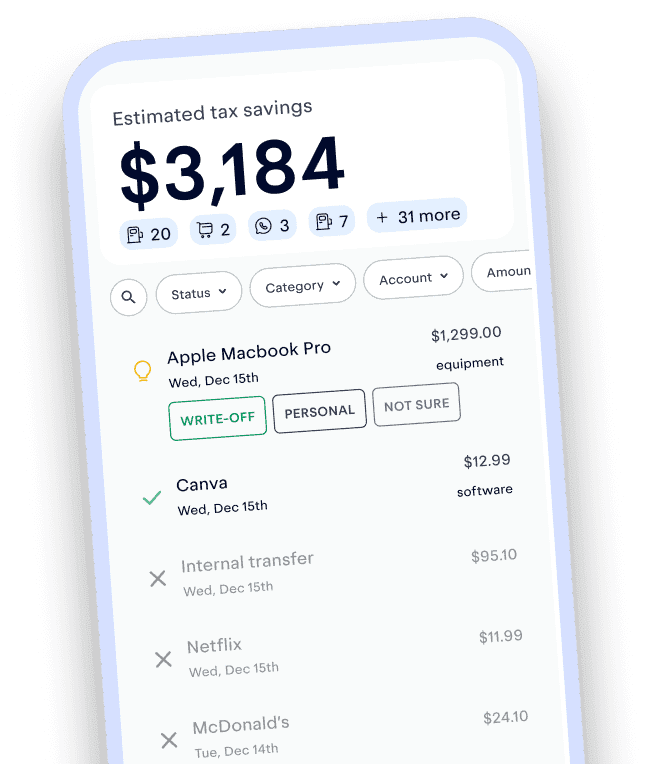
Track and claim every eligible deduction with Keeper
Keeper scans your accounts for write-offs and files your return — with tax pros reviewing every one.
Try it freeArkansas estimated tax payments
If you expect to owe more than $1,000 in Arkansas tax for 2026, make estimated payments to the Arkansas Department of Finance and Administration on ATAP or with Form AR1000ES. They’re due on the same dates as your federal payments, and each is a quarter of your Arkansas tax:
| Payment | Share of your Arkansas tax | Due date |
|---|---|---|
| 1st | 25% | April 15, 2026 |
| 2nd | 25% | June 15, 2026 |
| 3rd | 25% | September 15, 2026 |
| 4th | 25% | January 15, 2027 |
- Federal payments are separate: you pay the IRS on the same four dates with Form 1040-ES.
- To avoid a penalty for paying too little, pay at least 90% of your Arkansas tax in on-time payments. The penalty is 10% a year on the shortfall, and Arkansas figures it on the smaller of this year’s or last year’s tax.
Get your payment amounts with the Arkansas quarterly tax calculator.
Should you form an LLC or S corp in Arkansas?
You don’t need one to work as an independent contractor. If you work for yourself without forming a business, you report 1099 income on Schedule C, part of your regular tax return, and pay the taxes above.
- LLCs cost $45 to form online ($50 on paper), plus a $150 franchise tax report every year by May 1.
- S corps can make sense once your profit is around $80,000, when the self-employment tax savings get significant. You pay yourself a reasonable salary and take the rest as profit payouts (distributions) that aren’t subject to self-employment tax.
Run the numbers for your income to see what you’d save.
Do self-employed people in Arkansas charge sales tax?
Usually not for professional services like writing, design, consulting, and bookkeeping. Physical goods are taxable at a 6.5% state rate plus city and county taxes.
7 sources
- Act 2 of the 2026 First Extraordinary Session (income tax rates) · arkleg.state.ar.us
- 2026 Form AR1000ES: declaration of estimated tax · dfa.arkansas.gov
- 2025 AR1000F instructions (adjustments to income) · dfa.arkansas.gov
- LLC forms and fees (Arkansas Secretary of State) · sos.arkansas.gov
- State sales and use tax rates (Arkansas DFA) · dfa.arkansas.gov
- IRS releases tax inflation adjustments for tax year 2026 · irs.gov
- Contribution and benefit base · ssa.gov
This article is for informational purposes only and isn’t tax, legal, or financial advice. Tax rules change and depend on your situation, so talk to a tax professional about yours.