


Key takeaways
If you get paid to train AI as an independent contractor, you owe income tax plus 15.3% self-employment tax on your profit, and you pay it yourself.
You'll likely receive a 1099-NEC if a platform pays you $2,000 or more directly in 2026 (Mercor and Handshake AI pay through Stripe, for example), or a 1099-K if you're paid through PayPal and receive more than $20,000 across more than 200 transactions.
You may or may not receive a 1099 tax form for work you've completed, but that income is still taxable!
It's wise to set aside about 25% to 30% of every payout for taxes.
If you expect to owe $1,000 or more in taxes for the year, you should make quarterly estimated tax payments.
As an independent contractor, you're eligible for tax write-offs. You can deduct ordinary and necessary business expenses, like the business share of your laptop, headset, internet, software, and a dedicated home office. Keeper helps you track and claim every write-off, then file your taxes.
AI training jobs are on the rise. AI companies pay people to write and rate chatbot answers, check code and math, and label data, and the platforms that hire them are growing fast. micro1's gross revenue run rate grew from $100 million to $500 million in eight months (TechCrunch), and Handshake says it has paid more than $100 million to over 750,000 AI fellows (Handshake). US searches for "AI training jobs" roughly tripled over the past year, according to Semrush.
For most people, it's a side hustle. In a survey for an Oxford Economics study commissioned by Scale AI (the company behind Outlier), 94% of data annotators said they do the work for supplemental income (Oxford Economics).
Early numbers from Keeper's Side Hustle Index show AI training workers report median earnings of $375 a month on about 7 hours a week, and rate pay predictability just 2.3 out of 5.
That unpredictable, on-the-side income is what makes taxes tricky. Nobody likes a surprise tax bill in April. Here's what you need to know.
Do you have to pay taxes on AI training work?
Yes. Money you earn rating chatbot answers, writing prompts, labeling data, or grading code for platforms like Outlier, DataAnnotation, Mercor, Handshake AI, Alignerr, or micro1 is taxable income. The IRS says gig income must be reported whether or not you receive a 1099 or W-2, and whether you're paid in cash, through an app, or in another form (IRS Gig Economy Tax Center).
Most of these platforms treat US workers as independent contractors. That means three things in practice:
No taxes are taken out of your pay. Mercor, for example, tells US contractors it does not deduct taxes from payments.
You owe self-employment tax on top of regular income tax. This is the Social Security and Medicare tax an employer would normally split with you.
You're running a small business in the IRS's eyes, so you report the income and your expenses on Schedule C.
Over 1M Americans trust Keeper for their complex taxes
The #1 tax app for freelancers, gig workers, and self-employed filers.
Get started free

Which tax form will each AI training platform send you?
Here's what each platform says about taxes, based on its own help pages as of October 7, 2026.
Platform | How you're paid | Tax form to expect for 2026 payments |
|---|---|---|
Mercor | Stripe, weekly | Form 1099-NEC through Stripe by February. Mercor's page still says $600, but the federal threshold for 2026 payments is $2,000. You must file as an individual, not a business (Mercor). |
Handshake AI | Stripe, weekly | Form 1099-NEC by January 31 if you meet the IRS threshold. A W-9 is required (Handshake). |
Alignerr | Deel, PayPal, or Stripe, weekly | Paid through Deel: 1099-NEC by the end of January. Paid through PayPal: PayPal sends a 1099-K only above $20,000 and 200 transactions federally, though some states use lower limits. Alignerr says Stripe payouts don't come with a form (Alignerr). |
DataAnnotation | PayPal, on request | Because it pays through PayPal, you may get a 1099-K only if you pass PayPal's threshold, or no form at all. |
Outlier | PayPal, Airtm, or ACH, weekly | No public information available. |
micro1 | Deel, twice a month | Its contractor agreement says you're responsible for your own taxes. Deel's standard practice is to issue a 1099-NEC to US contractors (Deel). |
Turing | Deel | Turing's help center says US contractors receive a Form 1099 through Deel by January 31. |
Snorkel Expert Community | HireArt, weekly | No public information available. |
Prolific | PayPal, on request | Says participants handle their own taxes and suggests exporting your submission history (Prolific). |
Mindrift (Toloka) | Payoneer or PayPal, twice a month | No public information available. |
Plenty of AI trainers will get no form at all, especially in 2026 when the 1099-NEC threshold rose to $2,000. That's not a big deal if you keep your own record of payouts, and Keeper helps you keep track of your income so you're not relying on a 1099. Just remember: even if you don't get a tax form, that income is still taxable.
Comparing platforms? See our roundup of the best AI training jobs.
Will you get a 1099? The thresholds changed for 2026
Maybe not, and that's fine. A missing form doesn't mean missing tax.
There are two forms you might receive, depending on how the platform pays you:
Form | Who sends it | When it's required for 2026 payments | What changed |
|---|---|---|---|
1099-NEC | The platform that paid you directly (for example, through Stripe or direct deposit) | You were paid $2,000 or more during the year | Up from $600 for 2025 payments (IRS 1099-NEC instructions) |
1099-K | A payment network such as PayPal | You received more than $20,000 and more than 200 transactions | The lower $600 rule was repealed and the $20,000/200 rule restored (IRS fact sheet, Oct. 2025) |
A few things trip people up here.
Payments through PayPal usually don't show up on a 1099-NEC. The IRS instructions say payments made by card or through a third-party payment network belong on Form 1099-K, not 1099-NEC (IRS). So if a platform pays you through PayPal and you earned $8,000, you may get no form at all. You still report the $8,000.
A 1099-K shows your gross amount. It isn't reduced for PayPal fees or anything else. Report the full amount on Schedule C, then deduct legitimate business costs, such as the fees, as expenses (IRS: What to do with Form 1099-K).
Don't count the same money twice. If the same payment shows up on two forms, report it once. If a form is wrong, ask the issuer for a corrected one. The IRS can't fix it for you.
If you didn't get a form, add up your payouts from the platform's earnings dashboard or your PayPal or bank history. That total is your gross income. Our guide on what to do if you don't receive a 1099 walks through it.
How much tax will you owe on AI training income?
You'll owe two federal taxes on your profit (what you earned minus business expenses), plus state tax in most states.
Self-employment tax: 15.3%
Self-employment tax is 12.4% for Social Security plus 2.9% for Medicare. It applies once your net self-employment earnings reach $400 for the year (IRS).
It's not charged on 100% of your profit. You multiply your profit by 92.35% first, which brings the effective rate to about 14.1% of profit. You can then deduct half of the self-employment tax when figuring your income tax.
For a deeper explanation, see what is self-employment tax.
Income tax: your regular bracket
Your AI training profit is added to any other income (like a W-2 job) and taxed at your ordinary rates. Two things help soften your tax bill:
Half of your self-employment tax is deductible.
The qualified business income (QBI) deduction generally lets you deduct up to 20% of your business profit if your taxable income is under the 2026 threshold of $201,750 for single filers or $403,500 for married couples filing jointly (Rev. Proc. 2025-32). The deduction is now permanent, and starting in 2026 there's a $400 minimum if you have at least $1,000 of qualified business income. More in our QBI deduction guide.
Let's see an example
Candice is a single filer who made $20,000 in AI training payouts in 2026. She spent $1,500 on business expenses, and her W-2 day job already puts her in the 22% tax bracket.
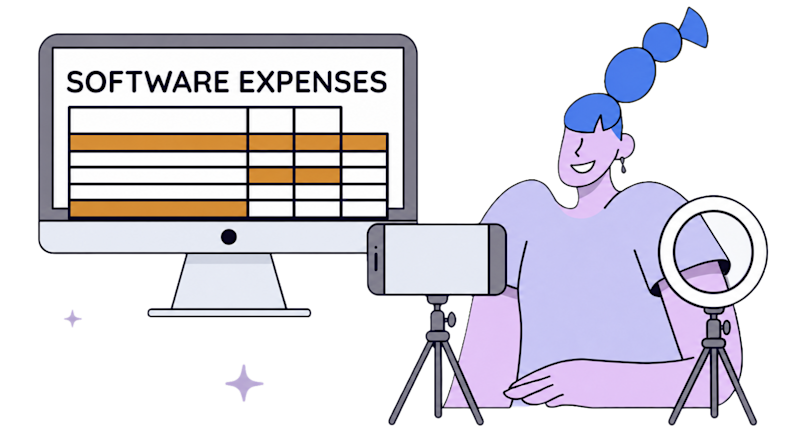
Here's roughly how her extra federal tax adds up:
That means Candice pays about 28% of her $20,000 in AI training income in federal taxes. Since she owes about $5,640, she should be making quarterly estimated tax payments throughout the year. If she doesn't, she could face an underpayment penalty on top of her tax bill.
How much to set aside from each payout
Using the same math, here's a rule of thumb for federal taxes on your profit:
Your federal bracket | Set aside from each payout (federal) |
|---|---|
10% | about 22% |
12% | about 23% |
22% | about 30% |
24% | about 32% |
How we got these: self-employment tax of about 14.1% of profit, plus income tax on profit after the half-SE-tax and 20% QBI deductions. Add your state's income tax rate on top. If your income is low enough that the standard deduction covers it, your real bill can be lower. If you have no expenses, apply the percentage to the full payout.
Not sure which bracket you're in? Keeper's tax bracket calculator and 1099 tax calculator can estimate it.
Do you need to pay quarterly estimated taxes?
If you expect to owe $1,000 or more when you file, the IRS wants you to pay as you go, in four installments during the year (2026 Form 1040-ES).
The main exception: if taxes taken out of a W-2 paycheck already cover most of your bill (at least 90% of this year's tax, or 100% of last year's), you don't need to make extra payments.
If you earned more than $150,000 last year, that second number is 110%.
The 2026 deadlines are:
Payment | Covers income earned | Due date |
|---|---|---|
1 | Jan 1 – Mar 31, 2026 | April 15, 2026 |
2 | Apr 1 – May 31, 2026 | June 15, 2026 |
3 | Jun 1 – Aug 31, 2026 | September 15, 2026 |
4 | Sep 1 – Dec 31, 2026 | January 15, 2027 |
You can skip the January payment if you file your 2026 return by February 1, 2027 and pay everything you owe.
If you missed earlier payments, pay what you can now. The IRS charges the penalty like interest on each late quarter. The rate for October through December 2026 is 7% a year, compounded daily (IRS, IR-2026-98). Paying sooner shrinks it. Our guide to missing a quarterly payment covers the details, and the quarterly tax calculator estimates what to send.
The safe harbor rule. If you pay at least 100% of last year's total tax (110% above $150,000 AGI) spread across the four deadlines, you won't owe an underpayment penalty, even if you end up owing more in April. This is the easiest approach when your AI training income jumps around month to month. See the safe harbor rule.
If you also have a W-2 job, there's an easier way
You can have more tax withheld from your paycheck instead of making quarterly payments. Use the IRS Tax Withholding Estimator and enter the extra amount in Step 4(c) of a new Form W-4. Withholding is treated as if it were paid evenly through the year, even if you increase it in November (IRS Pub. 505). That makes it a useful catch-up move if you fell behind. More in our guide to having 1099 and W-2 income in the same year.
What can AI trainers write off?
You can deduct ordinary and necessary costs of doing this work. Costs that are part personal and part business can only be deducted for the business share (IRS Pub. 334). Every write-off also lowers your self-employment tax, so it saves more than the same deduction would for an employee.
Common ones for remote AI training work:
Expense | What you can deduct | Notes |
|---|---|---|
💻 Computer, monitor, keyboard, headset, webcam | The business-use share of the cost | Items up to $2,500 each can usually be deducted in full the year you buy them under the de minimis safe harbor, if you make the election (Pub. 334). See deducting a computer. |
🌐 Internet | The business-use percentage | Base it on a reasonable estimate, like hours of task work versus total use. See deducting internet. |
📱 Phone | The business share, if you use it for the work (for example, two-factor logins or task apps) | |
🏠 Home office | $5 per square foot up to 300 square feet ($1,500 max) with the simplified method, or actual costs on Form 8829 | The space must be used regularly and only for business, like a desk area you don't use for anything else (IRS). See simplified vs. regular home office. |
🤖 Software and AI subscriptions | Tools you use for the work, like a grammar checker, a coding environment, or a paid AI model you need to compare outputs | Only the business-use share. See software deductions. |
🎓 Courses that sharpen skills you already use | Deductible if they maintain or improve skills for your current work | Not deductible if the course qualifies you for a new line of work (IRS Topic 513). |
💳 Payment fees | PayPal or transfer fees taken out of payouts | Deduct them as an expense when your 1099-K shows the gross amount. |
🩺 Health insurance | Premiums for you, your spouse, and dependents, if you're not eligible for an employer plan | Taken on Schedule 1, not Schedule C, and limited to your profit (Form 7206 instructions). See the self-employed health insurance deduction. |
🏦 Retirement contributions | SEP IRA or solo 401(k) contributions | The 2026 employee deferral limit for a solo 401(k) is $24,500, and total contributions are capped at $72,000 (IRS Notice 2025-67). See solo 401(k) vs. SEP IRA. |
Don't want to dig through a year of statements? Keeper automatically scans your linked bank accounts and credit cards for tax write-offs like your internet bill, software subscriptions, and new equipment, then files your taxes with every deduction included.
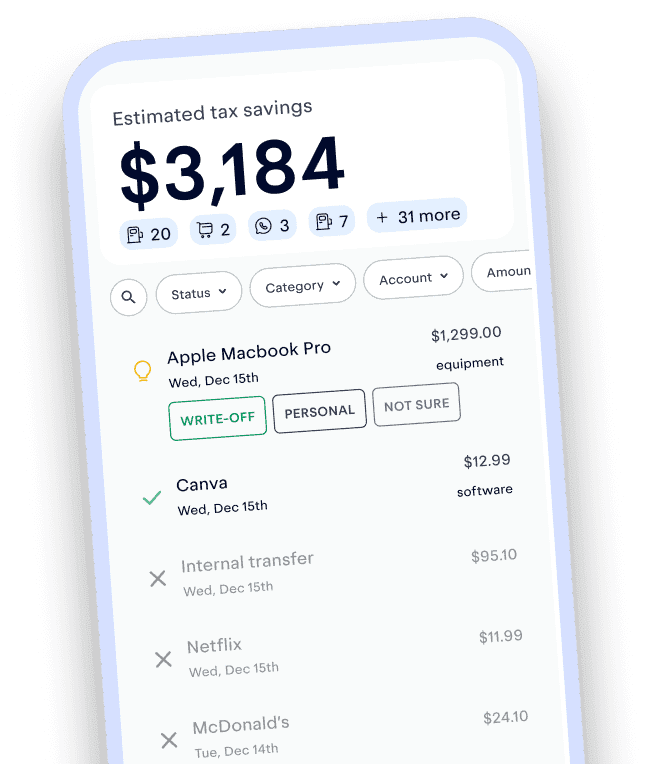
Track and claim every eligible deduction with Keeper
Keeper scans your accounts for write-offs and files your return — with tax pros reviewing every one.
Try it freeHow to file taxes for AI training work, step by step
Total your gross income from every platform. Use 1099s if you got them, and your dashboards or PayPal history if you didn't. Or let Keeper tally it for you from your linked accounts, so payouts from every platform add up in one place.
Total your business expenses and keep receipts or statements. An app like Keeper can automatically find and track your tax-deductible expenses as they happen, so there's nothing to piece together at tax time.
Fill out Schedule C. Report gross receipts on line 1 and expenses in Part II. You file a separate Schedule C for each business. If you do the same kind of work across several platforms, many people treat that as one business on one Schedule C, but that's a judgment call to confirm with a tax pro. For a line-by-line walkthrough, see Keeper's Schedule C guide.
Fill out Schedule SE to figure self-employment tax if your net earnings are $400 or more (Schedule SE instructions).
Claim the QBI deduction (Form 8995) and half of your self-employment tax.
Subtract the estimated payments you already made and pay any balance by the filing deadline. For 2026 returns, that's April 15, 2027. A filing extension gives you more time to file, not to pay.
Our step-by-step guide to self-employment taxes goes deeper on each form.
FAQ
None of them withholds taxes, so paying income tax and self-employment tax is up to you. Whether you get a 1099 depends on how you're paid. Platforms that pay you directly, like Mercor and Handshake AI, send a Form 1099-NEC once you've earned $2,000 in 2026. Platforms that pay through PayPal, like DataAnnotation, usually don't send one, and PayPal only sends a 1099-K above $20,000 and 200 transactions. See the platform-by-platform table above. Either way, all of it is taxable.
Yes. Those numbers only decide whether the platform has to send you a form. Once your net self-employment earnings reach $400 for the year, you also owe self-employment tax (IRS).
No. You file one tax return. Your income from all platforms goes on Schedule C (one per business), and self-employment tax for all of it is figured on one Schedule SE.
Usually, yes. Most states tax self-employment income, and some expect their own quarterly estimated payments too. Check your state's tax agency for its rules and deadlines.
Because nothing was withheld, and because you're paying both halves of Social Security and Medicare. An employer pays half of that 15.3% for employees. Deductions and quarterly payments are the two levers you control.
This article is for general education and isn't tax advice for your specific situation. Tax figures are for tax year 2026 and were checked against IRS sources on October 7, 2026.

Krislyn is Chief Growth Officer at Keeper. At Keeper, she strives to make expert-level tax strategies that used to require a traditional CPA accessible to all. Prior to Keeper, she was at Curology, where she helped bring custom, prescription-grade skincare out of the dermatologist's office to millions of faces.
View full bio24 sources
- AI data startup Micro1 reaches $500M gross run rate amid AI training boom · techcrunch.com
- Handshake AI Program · joinhandshake.com
- The Economic Impact of the Data Annotation Industry · oedevelopment.oxfordeconomics.com
- Gig economy tax center · irs.gov
- Taxes and Work Authorization · talent.docs.mercor.com
- Filling out tax forms (W-8 or W-9) · ai-support.joinhandshake.com
- Tax information for U.S.-based users/U.S. tax residents · intercom.help
- Deel · help.letsdeel.com
- How much have I earned from Prolific, and do I have to pay tax? · participant-help.prolific.com
- Instructions for Forms 1099-MISC and 1099-NEC (12/2026) · irs.gov
- IRS issues FAQs on Form 1099-K threshold under the One, Big, Beautiful Bill; dollar limit reverts to $20,000 · irs.gov
- What to do with Form 1099-K · irs.gov
- Self-employment tax (Social Security and Medicare taxes) · irs.gov
- 26 CFR 601.602: Tax forms and instructions. · irs.gov
- F1040ES (PDF) · irs.gov
- Interest rates remain the same for the fourth quarter of 2026 · irs.gov
- Tax Withholding Estimator · irs.gov
- Publication 505 (2026), Tax Withholding and Estimated Tax · irs.gov
- P334 (PDF) · irs.gov
- Simplified option for home office deduction · irs.gov
- Topic no. 513, Work-related education expenses · irs.gov
- Instructions for Form 7206 (2025) · irs.gov
- WASHINGTON The Internal Revenue Service today announced cost of living adjustments applicable to dollar limitations for pen · irs.gov
- 2025 Instructions for Schedule SE (Form 1040) · irs.gov
This article is for informational purposes only and isn’t tax, legal, or financial advice. Tax rules change and depend on your situation, so talk to a tax professional about yours.