



Key takeaways
Selling courses, templates, ebooks, presets, or paid community memberships can trigger two different taxes: income tax plus 15.3% self-employment tax on your profit, and sales tax (or VAT) on the sale itself.
Who handles sales tax depends on your platform. Skool, Gumroad, Lemon Squeezy, Etsy, Thinkific Payments, and Teachable Payments collect and pay it for you. Kajabi collects it but leaves the filing to you. On Stan Store and Podia, it's on you.
For 2026, most platforms only send a Form 1099-K if you take in more than $20,000 across more than 200 transactions. Plenty of creators earning five figures get no form at all, and that income is still taxable.
Your 1099-K shows gross sales. Platform fees, refunds, ad spend, and any sales tax the platform collected aren't your profit, so subtract them on Schedule C.
Set aside about 25% to 30% of your profit for federal taxes, and pay quarterly if you'll owe $1,000 or more.
Every $1,000 in business expenses you forget to claim costs a creator in the 22% bracket about $305 in federal tax. Keeper finds write-offs like ad spend, software, and platform fees in your bank and card statements automatically.
Selling what you know online has turned into a real side business for a lot of people. Skool draws about 135,000 US searches a month, Gumroad about 90,000, Stan Store about 50,000, and Kajabi about 40,000, according to Semrush (October 2026).
The tax side hasn't caught up. Most guides to "taxes on digital products" are written by sales tax software companies, and they skip the part most creators actually need first: how much income tax you'll owe and what you can deduct.
This guide covers both taxes in one place, with a platform-by-platform table built from each company's own help pages as of October 8, 2026.
Still deciding what to sell? See the best digital products to sell in 2026, ranked by search demand.
Do you have to pay taxes on digital product and course sales?
Yes. Money from selling an online course, ebook, template, Lightroom preset, Notion dashboard, or paid community is taxable income. The IRS says income from online platforms must be reported whether or not you get a 1099 (IRS Gig Economy Tax Center).
What confuses most creators is that two separate taxes are involved, and they work very differently:
Income tax + self-employment tax | Sales tax / VAT | |
|---|---|---|
Who pays this tax | You, on your profit | Your buyer, on the purchase price |
Where it's reported | Your federal return (Schedule C and Schedule SE) and state income tax return | State sales tax returns (and EU/UK VAT returns for foreign buyers) |
Does it apply in every state? | Federal, yes. State income tax in most states. | No. It depends on the buyer's state and what you sell. |
If you sell regularly and intend to make money, the IRS treats you as running a business, even if it's a side hustle. You report sales and expenses on Schedule C, and pay self-employment tax if your profit is $400 or more (IRS).
Over 1M Americans trust Keeper for their complex taxes
The #1 tax app for freelancers, gig workers, and self-employed filers.
Get started free

How each platform handles your taxes
This table is based on each platform's own help pages, terms, and pricing pages, as of October 8, 2026. Platforms change these policies often, so check your dashboard too.
A merchant of record (MoR) is the company that legally sells to your customer. When your platform is the merchant of record or a marketplace facilitator, it collects and pays the sales tax, not you.
Platform | How you get paid | Who handles US sales tax | Tax form you may get for 2026 | Platform fees (deductible) |
|---|---|---|---|---|
Skool | Weekly bank payouts through a Stripe Express account Skool sets up | Skool. It says it's the merchant of record and handles sales tax and EU VAT (Skool) | 1099-K from Skool at $20,000 and 200 transactions, or lower thresholds in some states (Skool) | $9/mo + 10% per sale (Hobby) or $99/mo + 2.9% + 30¢ (Pro) |
Stan Store | Your own Stripe or PayPal account | You. Stripe Tax can calculate tax where you're registered, but you file (Stan) | 1099-K from Stripe over $20,000 and 200 transactions (Stan) | $29 or $99/mo, 0% Stan fee, Stripe 2.9% + 30¢ |
Kajabi | Kajabi Payments to your bank, or Stripe/PayPal | Kajabi collects it, you file and pay it. Kajabi's tax tool "does not file or remit" (Kajabi) | 1099-K from Kajabi Payments over $20,000 and 200 transactions. Stripe or PayPal send their own for sales they process (Kajabi) | $179–$499/mo, plus 2.7%–2.9% + 30¢ processing, plus $0.15 per sale for the tax tool |
Gumroad | Bank deposit or PayPal | Gumroad. Merchant of record for all sales since January 1, 2025, worldwide (Gumroad) | 1099-K from Stripe (in Gumroad's Tax center) over $20,000 and 200 transactions (Gumroad) | 10% + 50¢ per direct sale, 30% on Discover sales, plus card processing |
Teachable | teachable:pay (Teachable Payments) or your own gateway | Teachable, on teachable:pay or its monthly gateway. You, if you use a custom payment gateway | Teachable's help center says US school owners get a 1099-MISC. It collects a W-9 once you pass $100 in earnings | $39/mo + 7.5% (Starter), or $89–$189/mo with no transaction fee |
Thinkific | Thinkific Payments, or Stripe/PayPal | Thinkific, for US sales through Thinkific Payments | 1099-K from Thinkific Payments at $20,000 and 200 transactions (Thinkific) | $54–$219/mo, plus about 2.9% processing and 0.5% per taxed sale |
Podia | Your own Stripe or PayPal | You. Podia "doesn't file or remit your sales taxes for you" (Podia) | Not published by Podia. Any 1099-K would come from Stripe or PayPal | $42–$150/mo, 0–5% Podia fee, plus processing |
Payhip | Your own Stripe or PayPal | Payhip, as a marketplace facilitator since July 1, 2026 (Payhip) | Not published by Payhip. Any 1099-K would come from Stripe or PayPal | 0–5% Payhip fee depending on plan, plus processing |
Lemon Squeezy | Bank or PayPal, twice a month | Lemon Squeezy. Merchant of record (Lemon Squeezy) | 1099-K over $20,000 and 200 transactions (Lemon Squeezy) | 5% + 50¢, plus extra for international and subscriptions |
Etsy (digital downloads) | Etsy Payments | Etsy, as a marketplace facilitator (Etsy) | 1099-K at $20,000 and 200 sales, or lower state thresholds. See our Etsy 1099 guide | $0.20 listing, 6.5% transaction, 3% + 25¢ processing |
Choosing between platforms? Check out our guide on selling digital products.
Will you get a 1099-K? The 2026 thresholds
Maybe not, and that doesn't change what you owe.
Form | Who sends it | When it's required for 2026 | Common example |
|---|---|---|---|
1099-K | A payment platform or processor (Stripe, PayPal, Kajabi Payments, Skool, Etsy, etc.) | More than $20,000 in payments and more than 200 transactions (IRS) | Your course and membership sales |
1099-NEC | A business that pays you directly for services | $2,000 or more, up from $600 for 2025 (IRS) | Affiliate commissions or a brand deal paid by bank transfer |
The $20,000 rule was restored by the One Big Beautiful Bill Act in 2025. It replaced the $600 threshold that had been scheduled to start, so anything you read saying "$600 for 2026" is wrong for 1099-Ks.
Some states use lower thresholds. Etsy, for example, says it sends 1099-Ks at $600 to sellers in Maryland, Massachusetts, Vermont, Virginia, and Washington, D.C., $1,000 in Illinois and New Jersey, and $2,500 in Arkansas (Etsy). Skool and Patreon list similar state rules.
A cheap course can keep you under the 200-transaction threshold. Selling a $197 course 142 times brings in about $28,000, and you still won't hit the 200-transaction threshold. Even if you don't get a 1099-K, you owe taxes on that income!
If you sell on several platforms, each one counts separately. You might earn $45,000 in total and get no 1099-K from anyone. Keep your own running total. Keeper can pull income from every connected account into one place, so you're not relying on forms that may never arrive.
Didn't get a 1099-K? Check out Keeper's guide on what to do if you don't receive a 1099.
Your 1099-K may overreport your actual earnings
A 1099-K shows your gross sales: the full amount buyers paid before fees, refunds, and chargebacks (IRS). You should report that gross figure, and then subtract fees, refunds, and chargebacks so you don't overpay taxes.
What's in the 1099-K total | Where it goes |
|---|---|
Your sales | Schedule C, line 1 (gross receipts) |
Refunds and chargebacks you gave back | Schedule C, line 2 (returns and allowances) |
Platform and payment processing fees | Schedule C, line 10 (commissions and fees) |
Affiliate commissions paid out of your sales | Schedule C, line 10 or 11 |
Sales tax or VAT the platform collected and paid for you | Not your income. Don't include it in gross receipts, and don't deduct it (Schedule C instructions) |
If a 1099-K is simply wrong, ask the issuer to correct it. If you can't get a corrected form, the IRS explains how to back out the error on your return (IRS).
Do you have to charge sales tax on digital products and online courses?
Often not personally, if your platform is the merchant of record. If it isn't, it depends on where your buyers live and what exactly you sell. Work through it in this order.
Step 1: Check whether your platform already handles it
If you sell through Skool, Gumroad, Lemon Squeezy, Etsy, Payhip, Thinkific Payments, or Teachable Payments, the platform collects and pays US sales tax on those sales. You generally don't register or file for them.
If you sell through Stan Store, Podia, Kajabi, your own Stripe checkout, or a Teachable custom gateway, sales tax is your responsibility.
Step 2: Figure out where you have "nexus"
Nexus is a connection to a state that's strong enough that the state can make you collect its sales tax. You almost always have it in the state where you live and work.
You can also have it in other states by selling a lot there. Since the Supreme Court's 2018 Wayfair decision, most states require out-of-state sellers to collect once they pass $100,000 in sales into that state in a year (Streamlined Sales Tax). California, Texas, and New York set the bar at $500,000.
Some states also count transactions (often 200 sales), but that test is disappearing. Illinois dropped it on January 1, 2026 (Illinois DOR), and Kentucky on August 1, 2026 (Kentucky DOR).
For most creators and sellers doing under six figures, it's typically your home state.
Step 3: Check whether that state taxes what you sell
States don't treat digital goods the same way. Five states (Alaska, Delaware, Montana, New Hampshire, and Oregon) have no statewide sales tax. Alaska does have local sales taxes. The rest fall roughly into three groups:
states that tax digital goods, like ebooks, audio, and video downloads
states that tax them only in some forms, such as permanent downloads but not streaming
states that exempt them
Online courses are the murkiest category. A common pattern:
Pre-recorded, on-demand course content is the most likely to be taxed, because states treat it like a digital video or software.
Live, real-time classes are often exempt.
One-on-one coaching is generally treated as a nontaxable service.
Here's how some large states handle it as of October 2026:
State | Ebooks, templates, downloads | Online courses and memberships |
|---|---|---|
California | Not taxable today if nothing physical changes hands (CDTFA Pub 109) | Not taxable today. A new law makes remotely accessed prewritten software taxable starting January 1, 2027. It excludes digital books, audio, and video, but whether a hosted course platform is "software" is unsettled |
Florida | Generally not taxable when delivered only electronically (FL DOR TAA 18A-015) | Generally not taxable |
New York | E-books, music, and photos delivered electronically aren't taxable. Prewritten software is | Depends on the course. Interactive e-learning has been ruled taxable software, while primarily educational internet courses have been ruled not taxable (NY advisory opinion) |
Texas | Treated like physical products, so generally taxable | Online access to content can be a taxable information service, taxed on 80% of the price (Texas Comptroller) |
Pennsylvania | Taxable since 2016, including streaming and subscriptions (PA DOR) | Likely taxable for pre-recorded content. Not specifically addressed |
Washington | Taxable whether downloaded, streamed, or accessed (WA DOR) | Pre-recorded courses are taxable. Since October 1, 2025, live online group classes and workshops are taxable too. One-on-one tutoring and consulting are excluded (WA DOR) |
Tennessee | Taxable | Pre-recorded course video is taxable. Live instructor-led classes aren't. A membership that bundles both was ruled fully taxable (TN DOR) |
Maryland | Taxable at 6% | Pre-recorded instruction is taxable. Live, interactive instruction is excluded (Comptroller of Maryland) |
Ohio | Digital audio, video, and books are taxable (Ohio Dept. of Taxation) | Not specifically addressed |
If your product mixes formats, like a course with live Q&A calls and a community, the rules can treat the whole bundle as taxable. That's worth a quick check with a tax pro or your state's revenue department before you build it.
Collected sales tax is not your income. When the tax is charged to the buyer, the IRS says not to include it in gross receipts, and you don't deduct it when you pay it to the state (Schedule C instructions).
What about customers in the EU, UK, and other countries?
If you're not based in the EU, you owe EU VAT on digital sales to EU consumers from the first sale. There's no minimum threshold for non-EU sellers (European Commission). The UK works the same way (GOV.UK).
This is the best practical reason to use a merchant-of-record platform. Skool, Gumroad, Lemon Squeezy, and Teachable handle foreign VAT for you. If you sell through your own Stripe account on Stan or Podia, foreign VAT is technically your job.
How much income tax will you owe on course and digital product sales?
You'll owe two federal taxes on your profit, which is sales minus refunds and business expenses. Most states add income tax too.
Self-employment tax: 15.3%. This covers Social Security and Medicare. It applies to 92.35% of your profit, so the effective rate is about 14.1%. The Social Security portion stops at $184,500 of combined wages and self-employment earnings in 2026 (SSA). See what is self-employment tax.
Income tax at your regular rates. Your creator profit is added to any other income, like a day job.
Two deductions shrink the income tax part:
Half of your self-employment tax.
The qualified business income (QBI) deduction, which is generally up to 20% of your profit. It's now permanent (Rev. Proc. 2025-32). Selling courses isn't a "specified service" business under the QBI rules, because the IRS definition of consulting expressly excludes "training and educational courses" (Treas. Reg. 1.199A-5). That only matters if your taxable income is above $201,750 (single) or $403,500 (married filing jointly) in 2026. See our QBI deduction guide.
Let's see an example
Maya sells a $197 Canva design course on Kajabi and runs a $49-a-month community on Skool, on top of her W-2 job.
Neither platform sends her a 1099-K. Her Kajabi sales were under 200 transactions, and her Skool sales were under $20,000. She still reports all $42,000.
Here's roughly how her extra federal tax adds up:
That's about 30% of her profit, or 19% of her gross sales. Because she owes more than $1,000, she should be making quarterly estimated payments or having more withheld from her paycheck.
Simplified example. It assumes all of Maya's creator profit stays in the 22% bracket and that her W-2 income already uses up her standard deduction. Subtracting her $15,700 in refunds and expenses saved her roughly $4,790 in federal tax.
Why tracking expenses reduces your taxes
Digital products have unusually high expenses for a side business. Ad spend, platform subscriptions, transaction fees, software, and freelancers add up fast. All of these expenses are tax write-offs that lower your taxable income, so each dollar reduces both your income tax and your self-employment tax.
Using the same math as Maya's example, every $1,000 of business expenses you claim saves about $305 in federal tax in the 22% bracket, or about $231 in the 12% bracket. Miss $5,000 of ad spend and subscriptions, and you overpay by roughly $1,500.

How much to set aside from each sale
Your federal bracket | Set aside from profit (federal) |
|---|---|
10% | about 22% |
12% | about 23% |
22% | about 30% |
24% | about 32% |
How we got these: self-employment tax of about 14.1% of profit, plus income tax on profit after the half-SE-tax and 20% QBI deductions. Add your state's income tax rate. If your income is low enough that the standard deduction covers it, you'll owe less.
Not sure which bracket you're in? Try Keeper's tax bracket calculator or 1099 tax calculator.
Do you need to pay quarterly estimated taxes?
If you expect to owe $1,000 or more when you file, the IRS wants you to pay during the year (2026 Form 1040-ES).
Payment | Covers income earned | Due date |
|---|---|---|
1 | Jan 1 – Mar 31, 2026 | April 15, 2026 |
2 | Apr 1 – May 31, 2026 | June 15, 2026 |
3 | Jun 1 – Aug 31, 2026 | September 15, 2026 |
4 | Sep 1 – Dec 31, 2026 | January 15, 2027 |
You won't owe an underpayment penalty if your payments and withholding cover at least 90% of this year's tax, or 100% of last year's (110% if last year's AGI was over $150,000).
If you also have a W-2 job, you can raise your paycheck withholding instead, using Step 4(c) of a new Form W-4. Withholding counts as if it were paid evenly through the year, so it can catch you up even late in the year (IRS Pub. 505).
Missed a payment? See what happens if you miss a quarterly payment, and use Keeper's estimated tax penalty calculator to see what the underpayment penalty could cost you.
What can course creators and digital product sellers write off?
You can deduct ordinary and necessary costs of running the business. For anything that's part personal and part business, deduct only the business share (IRS Pub. 334).
Expense | What to know |
|---|---|
💳 Platform subscriptions | Kajabi, Skool, Teachable, Stan, Podia, and similar monthly or annual plans |
🧾 Transaction and processing fees | Platform cuts and Stripe/PayPal fees. They're inside your gross 1099-K amount, so claiming them matters |
📣 Advertising | Meta, TikTok, YouTube, and Google ads, plus paid newsletter placements and promo codes for giveaways. See advertising expenses |
🤝 Affiliate commissions you pay | Deductible. If you pay a US affiliate $2,000 or more directly in 2026, you may need to send them a 1099-NEC. Payments made through PayPal, Stripe, or a card are reported on 1099-K by the processor instead (IRS) |
🎬 Freelancers | Video editors, designers, copywriters, and virtual assistants. Same $2,000 1099-NEC rule |
🎥 Equipment | Camera, microphone, lighting, laptop, and tablet. Items up to $2,500 each can usually be deducted in full the year you buy them if you make the de minimis election (Pub. 334). See deducting a computer |
🛠️ Software and AI tools | Canva, CapCut, Notion, Zoom, email marketing tools, and AI subscriptions you use for the business. See software deductions |
🎓 Courses you take | Deductible if they improve skills for the business you already run, like a marketing or video-editing course. Not deductible if they qualify you for a new line of work (IRS Topic 513) |
🏠 Home office | A space used regularly and only for the business, like a filming corner. $5 per square foot up to 300 square feet with the simplified method. See simplified vs. regular home office |
🌐 Internet and phone | The business-use share. See deducting internet and your phone bill |
🩺 Health insurance and retirement | Self-employed health insurance premiums and SEP IRA or solo 401(k) contributions. These go on Schedule 1, not Schedule C. See solo 401(k) vs. SEP IRA |
A note on big production budgets. If you spend heavily to film a course before launch, the tax rules for when you can deduct those costs aren't fully settled for online courses. Most small creators deduct them as they go. If you're spending thousands on production before you've made a sale, ask a tax pro about timing and start-up cost rules.
Don't want to dig through a year of card statements? Keeper scans your bank and credit card transactions for write-offs like ad spend, Kajabi and Skool subscriptions, and software, then files your taxes with every deduction included.
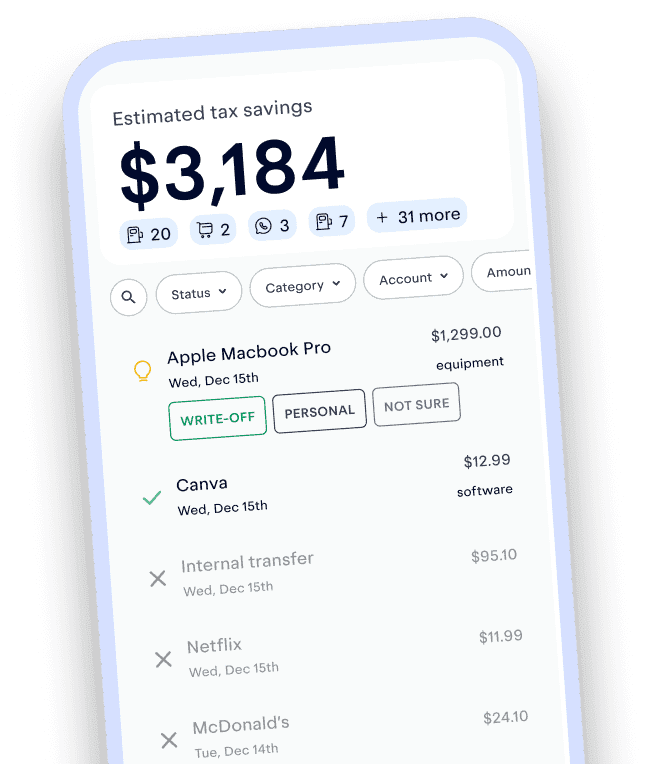
Track and claim every eligible deduction with Keeper
Keeper scans your accounts for write-offs and files your return — with tax pros reviewing every one.
Try it freeAffiliate commissions and other creator income
Not all creator income comes from selling your own product.
Affiliate commissions. Skool pays affiliates 40% of the subscription price for people they refer (Skool). Gumroad, Kajabi, and Lemon Squeezy run affiliate programs too. Commissions are self-employment income. A business that pays you $2,000 or more directly in 2026 should send a 1099-NEC, but report the income either way.
Brand deals and sponsorships from your audience go on the same Schedule C. Our influencer and creator tax guide covers gifted products and sponsorships.
Is selling digital products a business or a hobby?
If you're actively marketing and selling, it's almost certainly a business. That's good news: hobby income is still taxable, but hobby expenses aren't deductible at all, and that rule is now permanent (26 U.S.C. 67).
The IRS looks at things like whether you run it in a businesslike way, keep records, and are trying to make a profit (IRS). Our business vs. hobby guide covers the factors.
You don't need an LLC to deduct business expenses or file a Schedule C. See do you need an LLC to deduct business expenses. An LLC can help with liability. An S corp election can lower self-employment tax once profits are consistently high, but it adds payroll and costs. Run your numbers with the S corp savings calculator.
How to file taxes on digital product and course income, step by step
Add up gross sales from every platform. Use 1099-Ks if you got them, and platform dashboards or payout reports if you didn't. Keeper can total income across connected accounts for you.
Back out what isn't income. Sales tax or VAT your platform collected doesn't count as gross receipts.
List refunds and chargebacks for Schedule C line 2.
Total your business expenses, including fees, ads, subscriptions, freelancers, and equipment. Keep receipts or statements.
Fill out Schedule C with your gross receipts and expenses. Choose a business code that fits. Many course creators use 611000 (educational services), and many digital product sellers use 454110 (electronic shopping). See business codes.
Fill out Schedule SE if your profit is $400 or more (Schedule SE instructions).
Claim the QBI deduction (Form 8995) and the deduction for half your self-employment tax.
File your state sales tax returns if your platform doesn't collect and remit for you.
Subtract the estimated payments you made and pay the balance by April 15, 2027. A filing extension gives you more time to file, not to pay.
Our step-by-step guide to self-employment taxes goes deeper on each form.
FAQ
Kajabi Payments sends a Form 1099-K to the account owner if you have more than $20,000 in payments and more than 200 transactions in the year. Some states require it at lower amounts. If you process sales through a connected Stripe or PayPal account instead, those companies send their own forms (Kajabi).
Yes, if you pass the federal thresholds. Gumroad provides a Form 1099-K from Stripe in its Tax center for US sellers with more than $20,000 in gross sales and more than 200 transactions. The amount includes Gumroad's fees, sales tax and VAT it remitted, and affiliate commissions, so you'll subtract those on your return (Gumroad).
Stan doesn't process payments itself. Your Stripe account sends a 1099-K if you take in more than $20,000 across more than 200 transactions, and you can also download it inside Stan (Stan). If you're paid through PayPal, PayPal applies its own reporting.
Skool says it sends a Form 1099-K to creators who reach $20,000 and 200 transactions, or lower thresholds in certain states (Skool). Skool counts each payout as a transaction, so many community owners won't get one. All Skool income is still taxable.
Only if your platform doesn't do it for you, you have nexus in the buyer's state, and that state taxes your type of course. Skool, Gumroad, Teachable Payments, Thinkific Payments, Payhip, and Lemon Squeezy collect US sales tax for you. Pre-recorded courses are taxable in states like Washington, Tennessee, and Maryland. Live classes and one-on-one coaching are often exempt.
Not right now. California generally doesn't tax digital products when nothing physical is transferred. Starting January 1, 2027, prewritten software accessed remotely becomes taxable. That change excludes digital books, audio, and video (CDTFA).
Report gross sales, then deduct fees, refunds, and other expenses separately. Your profit comes out the same. But if your gross sales don't match a 1099-K the IRS received, you're more likely to get a notice.
Yes, if you have a profit. Income tax applies to any profit. Self-employment tax kicks in once your net earnings reach $400 for the year.
Over 1M Americans trust Keeper for their complex taxes
The #1 tax app for freelancers, gig workers, and self-employed filers.
Get started freeThis article is for general education and isn't tax advice for your specific situation. Tax figures are for tax year 2026. Platform policies were checked against each company's help pages on October 8, 2026, and federal rules against IRS sources.

Krislyn is Chief Growth Officer at Keeper. At Keeper, she strives to make expert-level tax strategies that used to require a traditional CPA accessible to all. Prior to Keeper, she was at Curology, where she helped bring custom, prescription-grade skincare out of the dermatologist's office to millions of faces.
View full bio48 sources
- Gig economy tax center · irs.gov
- Self-employment tax (Social Security and Medicare taxes) · irs.gov
- Skool VAT FAQs · help.skool.com
- How to report Skool income · help.skool.com
- How to Collect Sales Tax with Stan · help.stan.store
- Stripe 1099-K Form · help.stan.store
- Kajabi Payments sales tax overview · help.kajabi.com
- Kajabi Payments 1099-K tax forms · help.kajabi.com
- Sales tax on Gumroad · gumroad.com
- Does Gumroad issue form 1099-K and 1099-MISC? · gumroad.com
- Thinkific · support.thinkific.com
- Collecting sales taxes on Podia · help.podia.com
- US Sales Tax · help.payhip.com
- Docs: Merchant of Record · docs.lemonsqueezy.com
- Docs: Tax Forms · docs.lemonsqueezy.com
- Etsy · help.etsy.com
- IRS issues FAQs on Form 1099-K threshold under the One, Big, Beautiful Bill; dollar limit reverts to $20,000 · irs.gov
- Instructions for Forms 1099-MISC and 1099-NEC (12/2026) · irs.gov
- Etsy · help.etsy.com
- What to do with Form 1099-K · irs.gov
- Instructions for Schedule C (Form 1040) (2025) · irs.gov
- Form 1099-K FAQs: What to do if you receive a Form 1099-K · irs.gov
- Remote Seller State Guidance · streamlinedsalestax.org
- FY 2026-12, Destination-Based Retailers' Occupation Tax Changes · tax.illinois.gov
- KY SSUTA Recertification · revenue.ky.gov
- Nontaxable Sales · cdtfa.ca.gov
- 18A-015 (PDF) · floridarevenue.com
- TSB-A-06(5)S:2/06:Tower Innovative Learning Solutions, Inc.,Petition No. S020312B,tsba065s · tax.ny.gov
- Data Processing Services are Taxable · comptroller.texas.gov
- Digital Products · pa.gov
- Digital products including digital goods · dor.wa.gov
- Live presentations · dor.wa.gov
- TN DOR · revenue.support.tn.gov
- Business Tax Tip #29 Sales of Digital Products and Digital Code · marylandcomptroller.gov
- Sales and Use Taxability · tax.ohio.gov
- The One Stop Shop · vat-one-stop-shop.ec.europa.eu
- VAT rules for supplies of digital services to consumers · gov.uk
- SSA · ssa.gov
- 26 CFR 601.602: Tax forms and instructions. · irs.gov
- 26 CFR § 1.199A-5 · law.cornell.edu
- F1040ES (PDF) · irs.gov
- Publication 505 (2026), Tax Withholding and Estimated Tax · irs.gov
- Publication 334 (2025), Tax Guide for Small Business · irs.gov
- Topic no. 513, Work-related education expenses · irs.gov
- How to refer others to Skool? · help.skool.com
- 26 U.S. Code § 67 · law.cornell.edu
- Hobby or business: here’s what to know about that side hustle · irs.gov
- Instructions for Schedule SE (Form 1040) (2025) · irs.gov
This article is for informational purposes only and isn’t tax, legal, or financial advice. Tax rules change and depend on your situation, so talk to a tax professional about yours.