




Gambling losses are deductible (with strings attached)
According to IRS Topic No. 419, gambling losses are deductible, but only up to the amount of your gambling winnings. You cannot use gambling losses to offset your salary, business income, or any other type of income. That means if you won $8,000 and lost $12,000 this year, you can only deduct $8,000 in losses, not the full $12,000. That extra $4,000 in losses simply disappears. You can't carry it forward to next year or use it anywhere else on your return.
The 90% limit
On July 4, 2025, the One Big Beautiful Bill Act (OBBBA) was signed into law by President Trump. Buried within this legislation is a provision that impacts gamblers: beginning January 1, 2026, you can only deduct up to 90% of your qualified gambling losses, capped at the amount of your winnings. So the new formula works like this:
Deductible loss = 90% of your total losses, but never more than your total winnings
Under the new law, even if you break even or lose money gambling, you may still owe taxes on "phantom income" (money you never actually kept). Even House Ways and Means Committee Chairman Jason Smith called the provision a "mistake".
Could the 90% limit be repealed?
Possibly. On September 16, 2026, the House Ways and Means Committee voted 38–5 to advance H.R. 10357, which would restore the full deduction for gambling losses (still capped at your winnings) starting with the 2026 tax year. As of October 9, 2026, it still needs to pass the full House and the Senate, and a House vote isn't expected until after the November elections. Until then, the 90% limit is the law.
You can only deduct losses if you itemize
You can only claim gambling losses as an itemized deduction on Schedule A. If you take the standard deduction, which most Americans do, you can't deduct your gambling losses, even if you have documentation.
That means unless your total itemized deductions (mortgage interest, state and local taxes, charitable contributions, and gambling losses) add up to more than your standard deduction, you're better off taking the standard deduction, and your gambling losses won't reduce your tax bill at all. For 2026, the standard deduction is $16,100 if you're single, $32,200 if you're married filing jointly, and $24,150 if you're head of household.
So if you think you can just gamble and write off the loss - it's not that simple!
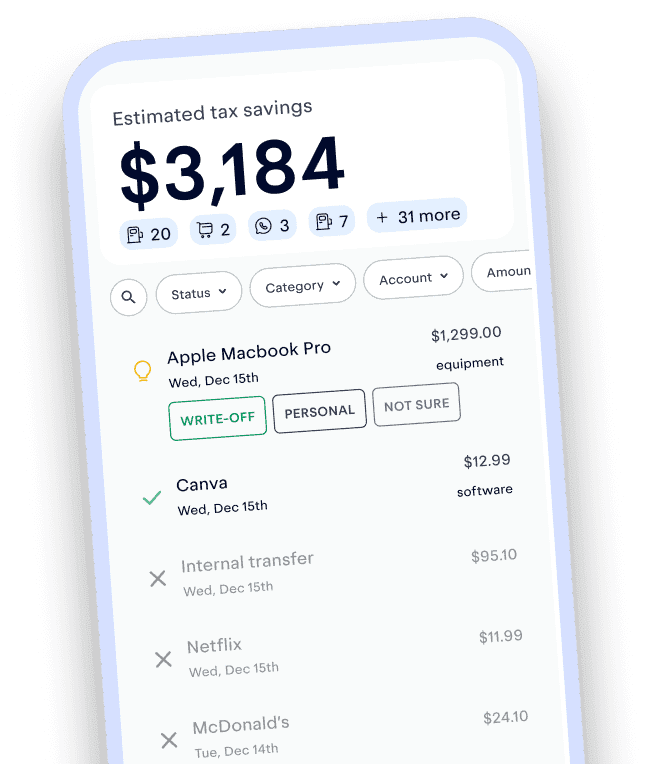
Track and claim every eligible deduction with Keeper
Keeper scans your accounts for write-offs and files your return — with tax pros reviewing every one.
Try it freeKeep a gambling log
Casino win/loss statements are helpful but are generally not sufficient on their own to survive an audit. Whether you win or lose, the IRS requires you to maintain detailed records of your gambling activity. Items you should be tracking include:
Date and type of each wagering activity
Name and address of the gambling establishment
Amount won or lost per session
Names of other people present, if applicable
Supporting documents to retain:
W-2G forms
Betting app transaction histories (FanDuel, Kalshi, DraftKings, etc.)
ATM receipts from casinos
Casino credit and check-cashing records
Poker tournament receipts and buy-in documentation
Understanding your W-2G
Casinos, sportsbooks, and other gaming operators are required to report certain winnings to the IRS using Form W-2G. Starting in 2026, the One Big Beautiful Bill Act raised the reporting thresholds for most types of gambling:
Type of winnings | Before 2026 | Starting in 2026 |
|---|---|---|
Slots and bingo | $1,200 | $2,000 |
Keno | $1,500 | $2,000 |
Sports and other bets | $600 | $2,000, only when the payout is at least 300× the bet |
Poker tournaments | $5,000 | $5,000 (no change) |
After 2026, these thresholds will be adjusted for inflation.
Keeper pro tip: Just because you don't receive a W-2G doesn't mean you can skip reporting. The IRS requires you to report all gambling winnings, whether or not you got a form. Payers generally withhold 24% for federal taxes when your winnings (minus your bet) are more than $5,000 from a lottery, sweepstakes, or wager that paid at least 300 times your bet. That 24% may not cover everything you owe, so you'll still need to file to find out whether you owe more or get a refund.
How are prediction markets like Kalshi and Polymarket taxed?
Sports betting apps like FanDuel and DraftKings follow fairly well-established gambling tax rules. But a growing category of platforms (prediction markets like Kalshi, Polymarket, and Robinhood's event contracts), are sitting in a legal and tax no-man's-land, and millions of users don't realize it.
Are prediction markets bets or financial contracts?
Prediction markets let you trade on the outcome of real-world events: elections, interest rate decisions, sports championships, even geopolitical events. Financially, the experience feels a lot like gambling, but legally and regulatorily, the platforms themselves argue they're something entirely different.
Kalshi is regulated by the Commodity Futures Trading Commission (CFTC) as a registered Designated Contract Market, the same category as futures exchanges. The platform argues this makes it a financial instrument provider, not a gambling operator.
Polymarket's original platform is decentralized and based offshore. It runs on the Polygon blockchain, and positions are denominated in USDC, a USD-pegged stablecoin. In late 2025, Polymarket also launched a CFTC-regulated U.S. version after acquiring QCEX, a licensed exchange.
This distinction matters a great deal for taxes. As of October 2026, the IRS has issued zero formal guidance on how prediction market contracts should be classified or reported, so you're basically in uncharted territory.
Four possible tax treatments to know about
1. Ordinary Income
In this case, you'd report all net gains as "Other Income" on Schedule 1, Line 8z. Losses are not separately deductible. They offset your gains before you report them. It's generally considered the most conservative approach. However, there's an unfortunate downside: you pay ordinary income tax rates (up to 37%) on your net profit.
2. Capital Gains
Some tax professionals treat event contracts like other investments, reporting each trade on Form 8949 and Schedule D. Most contracts are held for less than a year, so gains are usually taxed at your ordinary rate. The upside is on losses: they offset other capital gains, and up to $3,000 of net losses a year ($1,500 if married filing separately) can be deducted against other income, with the rest carried forward.
3. Gambling Income/Loss Treatment
With this method, you'd report gross wins as income, deduct gross losses on Schedule A (if you itemize), which is subject to the winnings cap and the new 90% limit starting in 2026. This is defensible if your activity closely resembles wagering. However, it introduces the phantom income problem: you could owe taxes on a break-even year, and you lose the ability to net wins and losses directly.
4. Section 1256 Contracts
Kalshi's CFTC registration opens the theoretical possibility that its event contracts qualify as Section 1256 contracts, which is a category of financial instruments taxed under a favorable 60/40 split, where 60% of gains are treated as long-term capital gains and 40% as short-term, regardless of how long you held the position. This could save thousands. However, this classification is legally untested for event contracts, and the IRS has historically taken a narrow view of what qualifies.
Here's how losses work under each treatment:
Tax treatment | How losses work |
|---|---|
Ordinary income | Losses only reduce your prediction market gains. A net loss for the year isn't deductible. |
Capital treatment | Capital losses generally offset capital gains, with up to $3,000 of net capital loss generally deductible against other income annually. |
Gambling treatment | Beginning in 2026, the deductible amount is generally limited to 90% of wagering losses and cannot exceed wagering gains. Losses can only be claimed if the taxpayer itemizes deductions on Schedule A. |
Section 1256 treatment | Qualifying contracts have their own gain-and-loss rules, including 60/40 treatment and mark-to-market accounting. |

Over 1M Americans trust Keeper for their complex taxes
The #1 tax app for freelancers, gig workers, and self-employed filers.
Get started free

State taxes
Kalshi has also fought legal battles with several states, including New Jersey, Nevada, Maryland, and Massachusetts, over whether its sports contracts are illegal gambling, and federal courts have issued conflicting rulings. Those cases are about whether the platforms can operate in a state, not about whether you owe tax. If your state has an income tax, your prediction market profits are generally taxable there too.
Keeper pro tip: If you've traded on Kalshi or Polymarket, report your gains honestly. For most people, treating net profits as ordinary income and documenting everything carefully is the safest path until the IRS issues clear guidance. If you had significant volume (say, over $10,000 in activity), consult a Keeper CPA before you file.
Are you a casual or regular gambler?
Most people who gamble are considered casual (or recreational) gamblers in the eyes of the IRS. But if gambling is genuinely your primary income source and you approach it with the regularity and profit intent of a business, you may qualify as a professional gambler. Tax treatments then differ.
Casual gamblers:
Report winnings on Schedule 1, Form 1040
Deduct losses on Schedule A (only if you itemize; starting in 2026, only 90% of your losses, capped at your winnings)
Cannot deduct travel, meals, or other gambling-related expenses separately
Professional gamblers:
Report winnings and deduct losses and business expenses on Schedule C (combined losses and expenses still can't exceed your winnings, and starting in 2026, only 90% of them are deductible)
Can deduct ordinary and necessary business expenses (travel to tournaments, entry fees, research tools) beyond just wagering losses
Pay self-employment tax (15.3%) on net gambling income
Must make quarterly estimated tax payments
What is phantom income and how is it taxed?
Let's start with an example. Say you go to the casino 10 times and you win $2,000 on five visits and lose $2,000 on the other five. Net result: you broke even for the year.
You must report $10,000 in total winnings as taxable income
You can deduct up to 90% of $10,000 in losses = $9,000 (as long as you itemize)
Result: $1,000 in taxable gambling income (even though you broke even)
That's phantom income. You can owe taxes on gambling income even when you break even or lose money overall.
Gambling tax checklist
Start a gambling log.
Don't assume you'll itemize. Run the numbers yourself or work with a CPA to help you determine if itemizing your deductions will exceed the standard deduction.
Download your app statements from your gambling platform of choice.
Plan for the 90% cap if you gamble regularly.
Check your state's rules separately.
Consider quarterly estimated payments if you have significant winnings.
FAQs
Possibly, but it depends on how you classify the income in the first place. If you report prediction market gains as gambling income, your losses follow gambling loss rules (capped at winnings, deductible only if you itemize, and subject to the 90% limit starting in 2026). If you report it as ordinary income, you can net wins and losses directly without itemizing, which is often simpler and more favorable for casual traders.
Yes, lottery tickets count as gambling, and the cost of losing tickets is deductible as a gambling loss, but only up to the amount of any gambling winnings you report, and only if you itemize.
The same rules apply. Sportsbooks will issue W-2G forms when applicable thresholds are met (now $2,000 starting in 2026). Your net transaction history from the app can serve as supporting documentation for your gambling log.
No. Gambling losses that exceed your winnings in a given year cannot be carried forward. They are lost permanently.
Disclaimer: This article is for informational purposes and reflects federal tax law as of October 2026. Tax laws are subject to change. Consult a qualified CPA or tax advisor for guidance specific to your situation.

Krislyn is Chief Growth Officer at Keeper. At Keeper, she strives to make expert-level tax strategies that used to require a traditional CPA accessible to all. Prior to Keeper, she was at Curology, where she helped bring custom, prescription-grade skincare out of the dermatologist's office to millions of faces.
View full bio
a tax professional
This content has been reviewed by an Enrolled Agent (EA) with the IRS — the highest credential awarded by the agency. Enrolled Agents are empowered to represent all taxpayers before the IRS, on all types of tax-related matters. Accountants who earn this certification have passed a comprehensive three-part exam on individual and business tax returns. To maintain EA status, they must stay up to date in the field by completing 72 hours of continuing education every three years.
View full bio3 sources
Keeper’s tax guides are built on primary sources: the tax code, IRS forms, instructions and publications, and state tax agency guidance. We link to external sources where appropriate and check figures against the tax year they apply to. This article was peer reviewed by a licensed tax professional (CPA or EA).
This article is for informational purposes only and isn’t tax, legal, or financial advice. Tax rules change and depend on your situation, so talk to a tax professional about yours.