




Key takeaways
The direct Roth IRA contribution phases out at $153,000-$168,000 (single) and $242,000-$252,000 (married filing jointly) for 2026.
The backdoor Roth is a two-step move: put after-tax money in a traditional IRA, then convert it to a Roth.
The 2026 IRA contribution limit is $7,500 ($8,600 if you are 50 or older).
Watch the pro-rata rule: if you have any pre-tax money in a traditional, SEP, or SIMPLE IRA, part of your conversion gets taxed. Roll those balances into a 401(k) first.
The mega backdoor Roth - through a Solo 401(k) that allows after-tax contributions - can move $50,000+ a year into Roth accounts.
The Roth IRA is one of the best retirement accounts. Your money grows tax-free, there are no required withdrawals during your lifetime, and everything you take out after age 59½ is tax-free. But the IRS only lets you contribute directly if your income is under a certain threshold.
The good news is there's a side door, and it's completely legal. It's called the backdoor Roth IRA. You just have to know the steps, and avoid the one mistake that trips up most first-timers.
What is a backdoor Roth IRA?
When you boil it down, the backdoor Roth consists of 2 steps:
Step 1: Put money into a traditional IRA. Anyone can do this, at any income level.
Step 2: Convert that traditional IRA into a Roth IRA. Anyone can do this too. The income cap on conversions went away back in 2010.
Neither step has an income limit on its own. So if you earn too much to fund a Roth directly, you fund a traditional IRA first and then move the money over. You end up in exactly the same place - money sitting in a Roth, growing tax-free. There's just that one little annoying extra step.
For 2026, you can move up to $7,500 this way each year, or $8,600 if you are 50 or older.
What are the income limits?
The income limit is based on your MAGI, which is short for modified adjusted gross income - basically your income with a few deductions added back in. For most freelancers it lands close to your total income.
For 2026, the income limits for:
Single phases out between $153,000 and $168,000. Above $168,000, you can't contribute directly at all.
Married filing jointly phases out between $242,000 and $252,000. Above $252,000, you can no longer contribute directly.
If your income is above those numbers, that's where the backdoor Roth IRA helps.
How do you set up a backdoor Roth IRA?
Step 1: Open a traditional IRA. Any major brokerage works - you can set one up with Fidelity, Schwab, or Vanguard in a few minutes.
Step 2: Contribute up to $7,500 ($8,600 if you are 50+). This is after-tax money, so do not deduct it on your tax return. You are making what is called a non-deductible contribution, which just means you already paid tax on it.
Step 3: Leave the cash as cash. Do not invest it yet (more on why in the mistakes section below). You want to convert roughly the same dollar amount you put in.
Step 4: Convert it to a Roth. Within a few days to a couple of weeks, convert the traditional IRA balance to a Roth IRA. Most brokerages have a one-click convert-to-Roth button.
Step 5: File Form 8606 at tax time. This is the form that tells the IRS you already paid tax on the money, so your conversion isn't taxed a second time. It's the step people most often forget, and the reason a clean backdoor Roth can turn into a headache.
Step 6: Invest inside the Roth. Now put the money to work - index funds, ETFs, whatever fits your plan. From here on.
That's it! You now have money in a Roth IRA, and all that growth is now tax-free.
Over 1M Americans trust Keeper for their complex taxes
The #1 tax app for freelancers, gig workers, and self-employed filers.
Get started free

How to avoid the pro-rata rule on your backdoor Roth IRA
The pro-rata rule is something that catches most people, and turns into an ugly surprise tax bill.
When you convert money to a Roth, the IRS doesn't just look at the fresh $7,500 you contributed. It adds up all of your traditional, SEP, and SIMPLE IRAs and treats them as one big pot. Your conversion is then taxed based on the mix of pre-tax and after-tax money in that pot.
Confusing? Here's an example.
Say you are a freelancer with $92,500 sitting in a SEP IRA from past years - all pre-tax money you have never been taxed on. You add $7,500 of after-tax money to a traditional IRA and convert that $7,500 to a Roth.
You might expect the conversion to be tax-free, since you already paid tax on that $7,500. But the IRS sees a $100,000 pot that is 92.5% pre-tax and only 7.5% after-tax. So when you convert $7,500, only about $560 is treated as tax-free. The other roughly $6,940 gets taxed as income. Oops. That's not really the result you wanted.
Well, now what do you do? You need to have a $0 balance across all your traditional, SEP, and SIMPLE IRAs by December 31 of the year you convert.
To do that, you should:
Roll your SEP or traditional IRA into a Solo 401(k) (or an employer 401(k) that accepts roll-ins). Money inside a 401(k) does not count in the pro-rata math, so this empties the pot without triggering a tax bill. For freelancers with an old SEP IRA, this is usually the move.
Convert the whole balance in a year you are ready to pay the tax on it. Painful, but it clears the deck for clean backdoor Roths going forward.
Common mistakes to avoid
Investing the money before you convert. If your $7,500 grows to $7,800 before you convert, that $300 of growth is taxable. So, just let the cash sit!
Forgetting Form 8606. Without it, the IRS has no record that you already paid tax on the money, which can mean getting taxed on it twice. Ouch!
Accidentally deducting the contribution. The whole point is that it is after-tax.
Ignoring an old SEP or traditional IRA. That is the pro-rata trap above. Deal with the balance before you convert the money!
Assuming you can undo it. You're out of luck, my friend. A 2017 law (the Tax Cuts and Jobs Act) ended the ability to reverse a Roth conversion. Once it is done, it is done.
What's the mega backdoor Roth?
If you are maxing out the regular backdoor and still want to save more, there is a bigger version of this - the mega backdoor Roth. It runs through a Solo 401(k), the retirement plan built for self-employed people with no employees.
The short version of how it works:
A Solo 401(k) lets you put away up to $72,000 in 2026 ($80,000 if you are 50+, or $83,250 if you are 60 to 63). That total is split across three buckets: your employee contribution (up to $24,500), your employer profit-sharing contribution, and after-tax contributions.
Those after-tax contributions are the key. You roll them into a Roth - either a Roth 401(k) inside the plan or a Roth IRA - and from there they grow tax-free, just like a regular backdoor, but at much higher limits.
However, your Solo 401(k) provider has to actually allow after-tax contributions and in-plan conversions. Fidelity and E*TRADE do, but other providers may not. So check before you count on it!
Now, when you put both strategies together, imagine moving $50,000 or more into Roth accounts in a single year. Compounded over a 25- or 30-year career, that builds a serious tax-free nest egg!
What if you are a W-2 employee?
While Keeper is built for freelancers, independent contractors, and small businesses, the backdoor Roth works exactly the same if you earn a W-2 paycheck and make too much for a direct Roth. Same two steps, same pro-rata rule, same Form 8606.
And if your employer 401(k) allows after-tax contributions, ask your HR or benefits team about the mega backdoor!
Track and claim every eligible deduction with Keeper
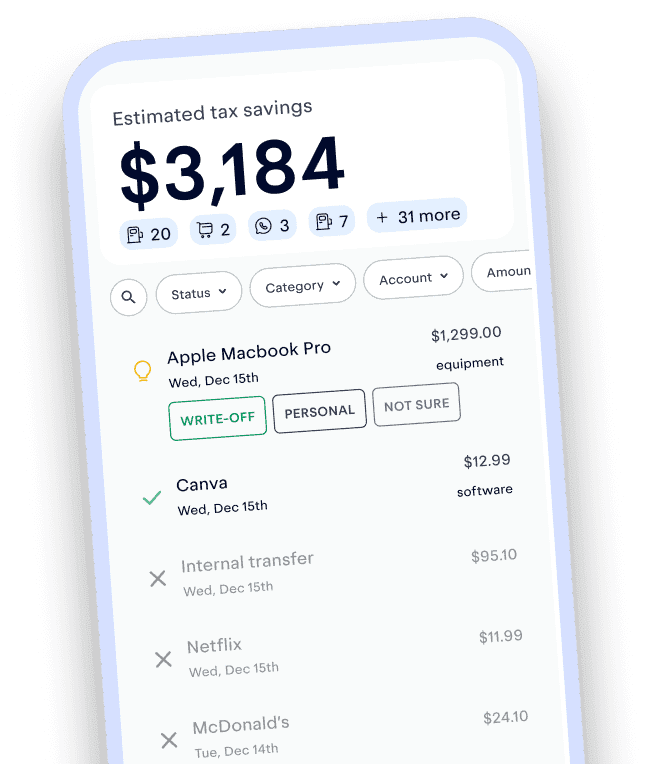
Keeper scans your accounts for write-offs and files your return — with tax pros reviewing every one.
Try it freeRules and deadlines for Roth contributions
You have until tax day to contribute. That means you can make a 2026 traditional IRA contribution right up to the April 2027 filing deadline. That said, doing the contribution and the conversion in the same calendar year keeps the paperwork simpler! Here are the numbers to know:
Roth / traditional IRA: $7,500 ($8,600 if 50+
Roth income phase-out: $153,000-$168,000 (single), $242,000-$252,000 (married filing jointly)
Solo 401(k) employee contribution: $24,500 ($32,500 if 50+; $35,750 if 60 to 63)
Solo 401(k) total: $72,000 ($80,000 if 50+; $83,250 if 60 to 63)
The five-year rule. Converted money generally needs to sit in the Roth for five years before you can withdraw it penalty-free if you are under 59½. For most people saving for retirement this usually isn't an issue. Just don't backdoor any money you think you'll need next year. Instead, consider sticking it in a high yield savings account (HYSA) for easy access.
State taxes count too. If part of your conversion is taxable because of the pro-rata rule, that taxable piece usually gets taxed by your state as well, not just the IRS.
FAQs
Is the backdoor Roth legal?
Yes. There is no income limit on traditional IRA contributions or on Roth conversions, which is exactly what makes the strategy work.
Can I undo a conversion if I change my mind?
No. The 2017 Tax Cuts and Jobs Act ended the ability to reverse, or recharacterize, a conversion. Once you convert, it is permanent - so be sure before you click.
Do I have to convert right away, or can I wait?
You can wait, but waiting adds risk: any growth while the money sits in the traditional IRA is taxable when you convert. Most people convert within a few days to a couple of weeks.
What if I am married and my spouse has a traditional IRA?
The pro-rata rule only looks at your own IRAs, not your spouse's. So if your spouse has a SEP IRA from their business, it does not affect your backdoor Roth - and you can each do your own.
For high-earning freelancers who would otherwise be shut out of a Roth entirely, it is $7,500 a year of tax-free growth you would be leaving on the table. Clear out any old SEP or traditional IRA balances first, file your Form 8606, and run it every year your income climbs past the limit. The compounding takes care of the rest.

Keeper Office Hours
Got a tax question, a confusing expense, or something you're stuck on in Keeper? Join a live, open Q&A with a Keeper expert. Submit your question ahead of time or ask it during the session. No presentation. No lecture. Just answers.

Krislyn is Chief Growth Officer at Keeper. At Keeper, she strives to make expert-level tax strategies that used to require a traditional CPA accessible to all. Prior to Keeper, she was at Curology, where she helped bring custom, prescription-grade skincare out of the dermatologist's office to millions of faces.
View full bio
a tax professional
This content has been reviewed by an Enrolled Agent (EA) with the IRS — the highest credential awarded by the agency. Enrolled Agents are empowered to represent all taxpayers before the IRS, on all types of tax-related matters. Accountants who earn this certification have passed a comprehensive three-part exam on individual and business tax returns. To maintain EA status, they must stay up to date in the field by completing 72 hours of continuing education every three years.
View full bioKeeper’s tax guides are built on primary sources: the tax code, IRS forms, instructions and publications, and state tax agency guidance. We link to external sources where appropriate and check figures against the tax year they apply to. This article was peer reviewed by a licensed tax professional (CPA or EA).
This article is for informational purposes only and isn’t tax, legal, or financial advice. Tax rules change and depend on your situation, so talk to a tax professional about yours.