




Key takeaways
A 1099 reports a payment or transaction. It is not a tax bill, but it's important for filing your self-employment taxes.
Form 1099-NEC is the form freelancers and independent contractors most commonly receive for client payments.
You should expect Form 1099-NEC threshold if you earned more than $2,000 in 2026.
For third-party network payments, you should expect Form 1099-K if payments exceed $20,000 and the number of transactions exceeds 200.
You must report taxable business income even if you do not receive a 1099.
A 1099 may show gross payments before business expenses, fees, refunds, or cost basis. The full amount is not always taxable.
Did you get a 1099 tax form in your inbox? If you're a freelancer or independent contractor, these forms will help you file your self-employment taxes, so stay tuned!
What is a 1099 form?
A 1099 form is a type of "information return," which means it informs the IRS about taxable payments or financial transactions. Contractor pay, payment app sales, interest, dividends, and retirement withdrawals are common examples.
A payer usually sends one copy to you and another to the IRS. At the end of the day, it's a record that you were paid by a person or company that isn't your employer.
For freelancers and contractors, the most common forms are:
Form 1099-NEC: Payments for work you performed as a nonemployee
Form 1099-K: Payments processed through cards, payment apps, or online marketplaces
Form 1099-MISC: Certain payments such as rent, royalties, prizes, and awards
These forms show income earned from work like driving for DoorDash, freelancing on Upwork, renting a room out on Airbnb, or sales on TikTok Shop.
Other 1099 forms report investment income, government payments, retirement distributions, real estate transactions, and other activity.
What is the difference between a 1099 and a W-2?
Form 1099 is different from form W-2, which is used to report wages, salaries, or tips from an employer.
If you get a 1099 from a company, it's a sign that you aren't considered their employee. Taxes usually are not withheld from contractor payments, although backup withholding can apply in some situations.
Of course, it’s possible to get both a 1099 and a W-2 in the same year. They just generally won’t be from the same source.
Who gets a 1099 form?
Whether you receive a 1099 depends on the form, the type of payment, how you were paid, and the reporting threshold.
You'll get a form if you're a self-employed person, freelancer, or independent contractor who:
Earned at least $2,000 from a client or platform who wrote you a check or paid through direct deposit
Made at least $20,000 and logged at least 200 transactions through third-party network transactions.
The deadline to mail it out is January 31, but it may show up a few days later, in early February.
What 1099 forms mean for your taxes
There's no hiding what's on your 1099. When you get your form, you'll notice it shows your Taxpayer Identification Number (or your Social Security number). That means the IRS knows you got that money — and you'll be expected to report it.
There is one piece of good news: you won't necessarily owe taxes on all the money reported on your 1099s. That income doesn't include your write-offs, which will reduce your taxable income and lower your tax bill. That's why it's so important to track everything you're spending on your work, from your car expenses to your computer.

What tax write-offs can I claim?
Afraid of missing write-offs? Give Keeper a try. Our app scans your purchases for business expenses and writes them off for you, so you can spend less time updating spreadsheets and scanning receipts.
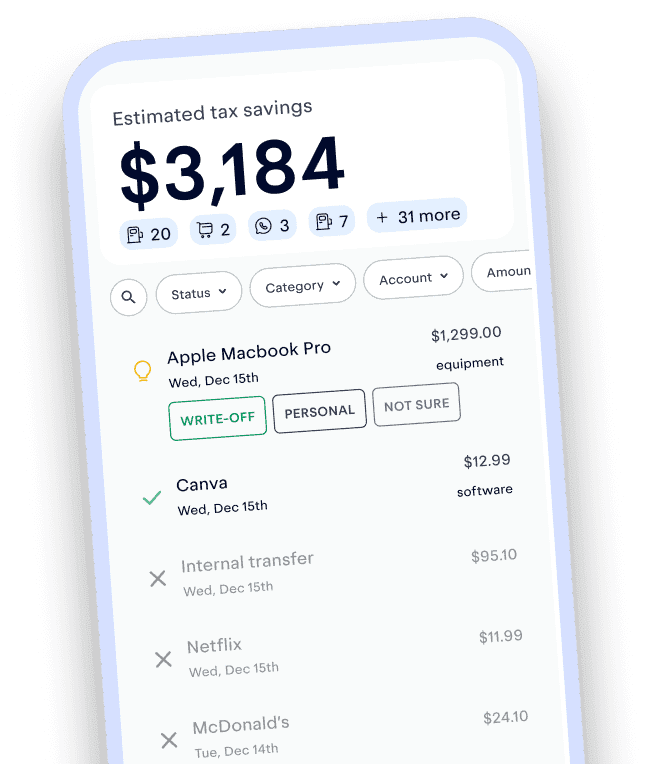
Track and claim every eligible deduction with Keeper
Keeper scans your accounts for write-offs and files your return — with tax pros reviewing every one.
Try it freeTypes of 1099 forms
There are several different types of 1099 forms, reflecting the different types of income you can get from a non-employer.
Form 1099-NEC
1099-NEC forms report money paid to a non-employee for their services. (The "NEC" stands for "Nonemployee Compensation”.) If you did any independent contract work, or ran a small business, you'll get one of these from your clients and customers.
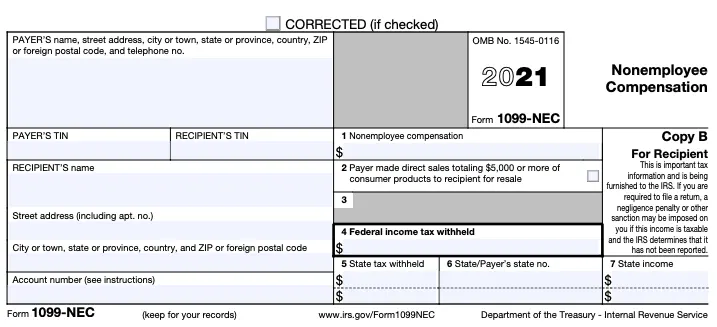
You'll get one of these if someone pays you more than $2,000 for your contract work. If you have multiple clients, expect several 1099-NECs.
Keeper pro tip: This $2,000 threshold controls when the payer has to issue the form. If a client pays you $500 for freelance work and does not send you a 1099 form, you still generally have to report and pay taxes on that income.
Form 1099-K
Next to the 1099-NEC, this is the most important type of 1099 for independent contractors. The IRS uses it for "Payment Card and Third Party Network Transactions", which include:
Bottom line: If you accepted credit card payments on your online store, from your small business clients, or even from your Uber and Lyft rides, you might get one of these — but only if you:
Earn at least $20,000 in work-related payments
Log at least 200 separate business transactions
For more information on this form, check out our guide to the 1099-K.
If you'd like to learn more about how to use your form on your taxes, skip ahead to the section on reporting your 1099 income. Otherwise, keep reading to learn more about the other types of 1099s.
Form 1099-MISC
Since the IRS added the 1099-NEC to its repertoire of forms, this is no longer the most important one for people working on a contract basis.
These days, the 1099-MISC does exactly what it sounds like: it covers miscellaneous income. It's a catch-all for payments that don't fit easily into other categories, including:
Rental income
Royalties
Prize winnings
Promotional payments, like from a sports betting app
Form 1099-A
The 1099-A form is used for mortgage-related payments. For instance, it might be sent to you if your mortgage lender cancels or forgives part of your debt. (It might also come into play if you have a short sale on your home.)
Canceled debt might not be "earned" the way a payment from Upwork is, but the IRS still thinks of it as income. That's why you'll still need to report it — and be ready to pay taxes on it.
Form 1099-B
If you get a 1099-B, it will probably come from a brokerage or barter exchange. They use this type of form to record their customers' capital gains and losses.
If you sold securities like stocks and options, you might get one of these. If so, expect it to show the gain — or loss — you made on each investment, as well as the dates you bought and sold them.
Form 1099-C
The C here stands for "Cancellation of Debt." If you settled your debt with a credit card issuer (or another lender) for less than you owe, you might end up getting a 1099-C.
Form 1099-CAP
This form is sent out to shareholders when a corporation either undergoes a big change in capital structure, or gets acquired.
The income that's being reported is any cash, stock, or other property received as a result of these changes.
Form 1099-DIV
You'll get a 1099-DIV if you're paid more than $10 in dividends from investments. Dividends on your account at a credit union, though, don't count. (They’re technically reported as interest instead.)
Form 1099-G
Form 1099-G reports payments from the government, whether it comes from the local, state, or federal level. If you received unemployment benefits in the previous year, you'll likely get one.
Other types of payments also count, including tax credits, grants, and PhD stipends from public universities.
Form 1099-INT
This type of 1099 reports interest income. Expect one if you earned more than $10 in interest from a financial institution, like a brokerage, mutual fund, or bank.
Form 1099-LTC
"LTC" stands for “Long-Term Care," but this type of 1099 also covers accelerated death benefits. Insurance companies, government agencies, and viatical settlement providers send these out to their payees.
Form 1099-OID
The "OID" here means "Original Issue Discount." This type of 1099 form is given to investors whose bonds have matured, assuming they were originally issued at a discount from their value at maturity.
Here's an example. Say you paid $850 for a bond with a $900 face value. Once it matures, you'll get the full $900 — meaning you essentially got it at a $50 discount.
If this situation applies to you, you'll get a 1099-OID from the original issuer of your discounted bond.
Form 1099-PATR
If you're a member of a co-op who received at least $10 in patronage dividends, expect a 1099-PATR
Form 1099-Q
The 1099-Q form reports money that you, your child, or your child's school received from a qualified tuition plan, like 529 plan or Coverdell ESA. Anytime you make withdrawals to pay for school, you'll likely get one of these forms.
If you do get a 1099-Q, don't panic. When you use those funds for qualified education expenses, they aren't actually subject to tax. All you'll need to do is keep your 1099-Q form for your records.
Form 1099-R
You'll get one of these forms when you get distributions from a retirement plan or profit-sharing plan, including an IRA, pension, or annuity. It's possible to get one of these even if you're not yet retired — for instance, if you took out a loan from your 401(k) and didn't repay it.
Keep in mind: The amount reported on this form isn't always taxable. (A direct rollover from a 401(k) plan to an IRA, for example, won't be taxed.)
Form 1099-S
This type of 1099 records "Proceeds from Real Estate Transactions." If you sold your home, a commercial property, or even a plot of land, you'll have to file one of these.
This form exists to make sure sellers report all their capital gains. But of course, the taxes you pay on real estate transactions can get pretty complicated. If it was your primary residence that you sold, for example, you won't have to pay capital gains taxes on the first $250,000 you made on the sale.
Form 1099-SA
You'll get a 1099-SA if you've taken any distributions from your HSA, or health savings account. Luckily, these won't be taxable if you've used them to pay for qualified health expenses.
How do you report 1099 income?
No matter what type of 1099 income you have coming in, you'll almost always need to report it when you file your taxes.
Keeper can help freelancers, contractors, and small businesses organize business expenses throughout the year and file returns that include self-employment income. Keeping clean records matters even when every payment is already listed on a form because the form usually does not show your deductible business expenses.
Over 1M Americans trust Keeper for their complex taxes
The #1 tax app for freelancers, gig workers, and self-employed filers.
Get started free

There is no single “1099 income” line that works for every form. Where the amount goes depends on what it represents.
If your form reports... | A common reporting location is... |
|---|---|
Freelance or independent contractor income | Schedule C |
Rental income | Schedule E, or sometimes Schedule C |
Investment sales | Form 8949 and Schedule D |
Interest or dividends | Form 1040, Schedule B, or Schedule D, depending on the amount and type |
Retirement distributions | Form 1040, using the taxable amount determined under the retirement rules |
Real estate sale proceeds | Form 8949 and Schedule D, or Form 4797 for certain business property |
What not to do with your 1099 form
When you file your taxes, don't report gross income that's less than the total on all your 1099s.
Why? Because the same form you received was also sent directly to the IRS. So they know you earned at least that amount. Report any less, and you might be at risk of an audit.
If there are issues with your 1099 that make your income look higher than it actually was, you still shouldn't ignore the numbers on your form. Luckily, there are ways to deal with these problems when you file.
What to do if your 1099 income is too high
If your 1099 includes money that you didn't actually earn, don't worry. You can adjust for that when you file your taxes. You'll essentially:
Include all the income on your 1099s when reporting your gross earnings (even the money you didn't actually earn)
Cancel out the extra income elsewhere on your tax return
How you handle step #2 will depend on how the extra income ended up on your 1099 in the first place.
If your client accidentally included reimbursements on your 1099
Sometimes, clients will offer to reimburse you for on-the-job expenses. For example, pretend you're a freelance travel writer reviewing a new resort. You might pay for your stay out of pocket, then have the magazine pay you back.
That money shouldn't be taxable for you — but the magazine might include it on her 1099-NEC by mistake.
In this situation, you should:
Report all the money on your 1099-NEC as income, including the hotel reimbursements
Claim the hotel fees as a business write-off
This cancels out the extra money on your 1099-NEC. And it won't raise any eyebrows at the IRS, because your reported income will still match what's on your 1099.
If a payment processor accidentally includes personal transactions on your 1099-K
PayPal, Venmo, and other apps are only supposed to include business transactions on your 1099-K. But mistakes happen. Say your roommate venmos you his share of the rent before you pass it on the landlord, and that payment gets reported on your 1099-K.
In this situation, you should:
Report the mistakenly included personal transaction on line 8z of your Schedule 1 ("Other Income")
Add the same amount on line 24z ("Other Adjustments"), which will subtract this from your taxable income
Again, this cancels the extra money you shouldn't be taxed on without reporting a gross income that's less than what your 1099s indicate.
What to do if you don't get a 1099
Say you earned more than $2,000, but you still weren’t sent a 1099 form. Unfortunately, that doesn't mean you can just ignore that income. Skip reporting it to the IRS, and you're technically committing tax fraud. That can get you in serious trouble.
If you haven't gotten your forms by early February, go through the following checklist:
✓ Make sure you earned at least $2,000
If it turns out that you made less than $2,000 from the platform or client you were waiting on, you should still report that income to the IRS. It’s just like reporting cash income.
✓ Check your email spam folder
Sometimes, 1099 forms get sent digitally. This is an easy place for them to wind up.
✓ Verify that your address is correct
Moved in the last year? Your contact information might be out of date, and they might have just sent it to the wrong place.
✓ Go ahead and file without your 1099
If you know you should have a 1099, but find yourself empty-handed, know that you won't get in trouble. In fact, a missing 1099 doesn't even have to delay your filing.
Go ahead and report your income using other records, including your:
Invoices
Bank statements
Payment reports
Sales receipts
You don't have to let someone else's slip-up ruin your tax season.
FAQs
Do I have to report income under $600 or $2,000?
Yes, if it is taxable income. The $600 and $2,000 amounts are payer reporting thresholds for certain forms. They are not general income-tax exemptions.
Do I need a 1099 form to file my taxes?
No. You can use your own records to file if a form is missing. Report the correct income and keep documentation supporting the amount.
Does receiving a 1099 mean I am self-employed?
No. Some 1099 forms report freelance income, but others report interest, dividends, retirement distributions, government payments, and property transactions.
Why is my 1099 amount higher than the money I kept?
Some forms report gross payments before processing fees, refunds, shipping, reimbursed expenses, or other costs. Reconcile the form with your records and report income and expenses in the appropriate places.
Can I receive a 1099 below the federal threshold?
Yes. A payer may issue a form voluntarily, a lower state threshold may apply, or backup withholding may require reporting. Receiving a form does not change whether the underlying payment is taxable.

Erin is a financial planner and tax preparer. She loves to optimize everything, plan travel and win at board games.
View full bio8 sources
- Information return reporting · irs.gov
- About Form 1099-NEC, Nonemployee Compensation · irs.gov
- About Form 1099-K, Payment Card and Third Party Network Transactions · irs.gov
- About Form 1099-C, Cancellation of Debt · irs.gov
- 1099-DIV dividend income 1 · irs.gov
- About Form 1099-LTC, Long Term Care and Accelerated Death Benefits · irs.gov
- About Form 1099-OID, Original Issue Discount · irs.gov
- About Form 1099-S, Proceeds from Real Estate Transactions · irs.gov
This article is for informational purposes only and isn’t tax, legal, or financial advice. Tax rules change and depend on your situation, so talk to a tax professional about yours.