






Key takeaways
Rover pays you as an independent contractor, meaning you're on the hook for 15.3% self-employment taxes, plus income tax!
Since 2025 Rover pays through Stripe, so you should expect to receive form 1099-K. Generally, you'll get one if you pass $20,000 in payments and 200 transactions (some states have a lower threshold!). Many pet sitters don't receive a form, but still owe taxes!
Your 1099-K reports gross income, before Rover's 20% fee, so it might end up looking higher than your actual payouts. Make sure to deduct that fee!
We recommend setting aside 25-30% for taxes proactively, so you're well covered for your tax bill. You can set that money aside in an HYSA, gaining interest over time.
You can write off client supplies and mileage (72.5 cents for the first half of 2026, 76 cents for the second half), but not your own pet's costs.
Caring for pets through Rover can be an amazing experience, not to mention a great source of income. Dealing with your Rover taxes, on the other hand, might have you feeling a little ruff — especially if you’re not sure where to start.
This guide makes it easy to complete your Rover tax forms and write off related expenses! Read on to learn all about calculating your taxes as a pet sitter, dealing with your Rover 1099, and more.
Do you owe taxes on Rover income?
Yes. Rover treats you as an independent contractor, so your earnings are taxable and nothing is withheld like with a traditional W-2 job. You report the income yourself and pay the tax when you file. That includes cash tips and any off-platform payments, which are taxable even though they don't show up on your 1099 tax form.
What tax form does Rover send?
As of 2026, Rover pays sitters through Stripe, so the form is a Form 1099-K, not the 1099-NEC that older guides describe.
Detail | What to know |
|---|---|
Tax form | 1099-K, issued through Stripe |
Federal threshold (2025 on) | More than $20,000 in payments AND more than 200 transactions Several states require a form at a much lower amount, some as low as $600 |
Where to find it | Your Stripe or Rover payout settings |
Beware: most casual Rover sitters earn under the $20K threshold per year and get no 1099 tax form at all, but that income is still taxable! Read our guide on what to do if you didn't get a 1099 tax form.
One more thing to watch: the 1099-K reports gross earnings, including Rover's service fee and any sales tax collected, so the number may look higher than what actually hit your bank account. Make sure to deduct those fees!
Deduct Rover's service fee
Rover keeps a 20% service fee and pays you the other 80%. That fee is a deductible business expense, and it matters because the 1099-K report includes Rover's service fee! If you report the gross earnings and forget to deduct the fee, you're essentially paying taxes on money that went to Rover.
But hey, if you're feeling altruistic and want to pay more in taxes, we're not stopping you. 😅
You are a contractor: self-employment tax and quarterly payments
Being self-employed means two things:
You owe self-employment tax of 15.3% on your net earnings, once they reach $400, on top of income tax.
Since nothing is withheld, the IRS expects quarterly estimated payments in April, June, September, and January if you expect to owe at least $1,000 in federal tax (after subtracting withholding and refundable credits), and you don't meet an IRS safe harbor. To be safe, set aside 25% to 30% of your earnings, and see our quarterly taxes guide for how they work.
Rover tax write-offs
Tax write-offs can significantly reduce how much you owe in taxes, which is why it's important to keep track of your expenses. You can use an app like Keeper to do handle expense tracking and taxes automatically for you, or use an expense tracking template to track them yourself.

Tax deductible expenses | Description |
|---|---|
Rover's fee | The 20% Rover service fee |
Supplies for clients | Leashes, treats, waste bags, toys, cleaning supplies |
Mileage | Drives to clients, walks, and supply runs at 72.5 cents for the first half of 2026, 76 cents for the second half (70 cents for 2025) |
Car expenses | Gas, car maintenance, parking, tolls |
Home boarding | A portion of home expenses, only for space used regularly and only for boarding |
Phone and internet | The business-use share of your phone or WiFi bill |
Certifications and insurance | Pet first-aid or CPR courses, liability or bonding coverage |
Keeper pro tip: The home boarding deduction is strict: the space has to be used regularly and exclusively for the business, so a shared living room usually does not qualify. And your own dog's food, toys, and vet bills are personal expenses, not tax deductible!
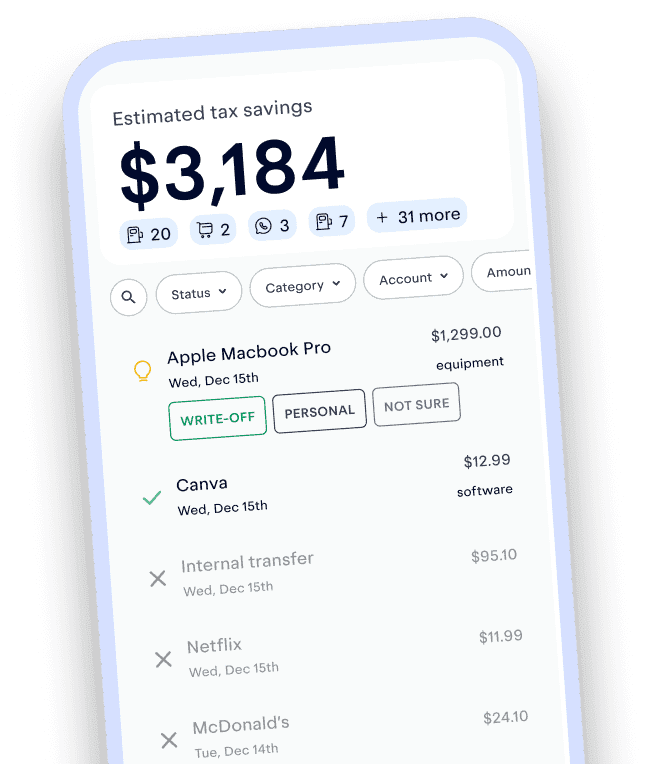
Track and claim every eligible deduction with Keeper
Keeper scans your accounts for write-offs and files your return — with tax pros reviewing every one.
Try it freeHow to file your Rover taxes
Gather your records. Your 1099-K if you got one, your Rover and Stripe payout reports, and receipts for supplies.
Total your income, including cash tips and off-platform payments.
Start from the gross, then deduct Rover's fee and your other expenses.
Report your net profit on Schedule C, then calculate self-employment tax on Schedule SE.
Make quarterly estimated tax payments if you expect to owe $1,000 or more.
CPA tips for Rover pet sitters
Report income even if you didn't get a 1099. Most sitters are under the threshold and get nothing, but the income is still taxable.
Deduct the 20% Rover fee. If you notice your payouts are lower than what's reported on your 1099-K, this is why. Make sure you deduct the 20% Rover fee to avoid overpaying your taxes.
Be careful with the home boarding deduction. The space has to be used regularly and exclusively for your business!
Do not deduct your own pet's costs. Only client-animal and business expenses qualify.

Over 1M Americans trust Keeper for their complex taxes
The #1 tax app for freelancers, gig workers, and self-employed filers.
Get started free

FAQs
Will I get a 1099 from Rover, and which one?
Since Rover pays through Stripe, it is a 1099-K, and you only get one if you pass $20,000 and 200 transactions (note that some states have a lower threshold!).
Why is my 1099-K higher than what Rover paid into my bank?
Your 1099-K reports gross earnings, including Rover's 20% fee and any sales tax. Deduct the fee to get to your real profit.
Can I write off part of my home if I board dogs there?
Only if the space is used regularly and exclusively for boarding.
Are cash tips from clients taxable?
Yes. Tips are taxable income even though they never appear on a 1099.

Sign up for Tax University
Get the tax info they should have taught us in school.

Keeper Office Hours
Got a tax question, a confusing expense, or something you're stuck on in Keeper? Join a live, open Q&A with a Keeper expert. Submit your question ahead of time or ask it during the session. No presentation. No lecture. Just answers.

Jesus Morales is an Enrolled Agent and has 7 years of bookkeeping and tax experience. He enjoys hiking, traveling, and studying tax law.
View full bio
a tax professional
This content has been reviewed by an Enrolled Agent (EA) with the IRS — the highest credential awarded by the agency. Enrolled Agents are empowered to represent all taxpayers before the IRS, on all types of tax-related matters. Accountants who earn this certification have passed a comprehensive three-part exam on individual and business tax returns. To maintain EA status, they must stay up to date in the field by completing 72 hours of continuing education every three years.
View full bioKeeper’s tax guides are built on primary sources: the tax code, IRS forms, instructions and publications, and state tax agency guidance. We link to external sources where appropriate and check figures against the tax year they apply to. This article was peer reviewed by a licensed tax professional (CPA or EA).
This article is for informational purposes only and isn’t tax, legal, or financial advice. Tax rules change and depend on your situation, so talk to a tax professional about yours.